SPECIAL Informat.ro / Who Is Elif Eralp, the “Mamdani of Berlin”: The Left’s Victory on Rents and Germany’s New Polarization


Always see our news on Google
Victory for the radical left in Berlin and the success of the far-right AfD party in Mecklenburg-Western Pomerania send the same signal: the traditional parties of the center are losing ground, but the German electorate is polarizing in opposite directions. For Chancellor Friedrich Merz, Sunday’s result is more than a regional warning: the CDU suffered a historic defeat at a time when its political authority is already being challenged.
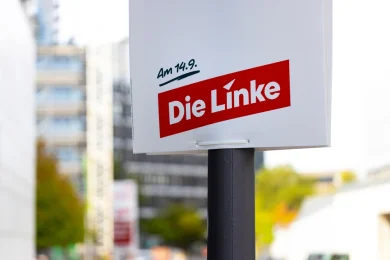
Elif Eralp, the Die Linke candidate, led the party to first place in the elections for Berlin’s House of Representatives, with 25.3% of the vote, ahead of the CDU, with 19%, AfD, with 16%, and SPD, with 12.1%. The result nearly doubled the left’s previous score and makes Eralp a leading contender for the position of Governing Mayor of the capital, provided a coalition can be formed.
The SPD and Greens indicated their willingness to hold talks with Die Linke, and a Die Linke–SPD–Greens coalition could have a majority. But negotiations are not over, and the Greens have set political conditions, including a firm commitment by Die Linke to combat antisemitism.
Who is Elif Eralp, nicknamed “Berlin’s Mamdani”
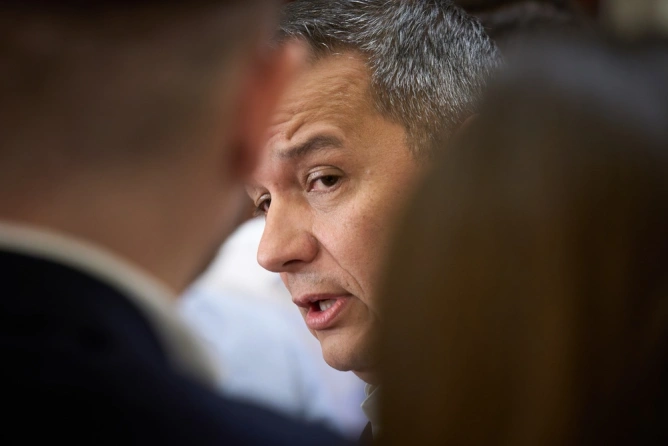
Eralp, 45, is a lawyer and politician within Die Linke, born in Munich to a family of left-wing Turkish refugees who left Turkey after the 1980 coup. She could become the first woman of Turkish origin and from a refugee family to lead Berlin, as well as the first mayor of the capital from Die Linke since German reunification.
Since German reunification in 1990, Berlin has had governing mayors from the SPD or CDU; Die Linke has participated in governing coalitions, including the SPD–Die Linke and SPD–Die Linke–Greens alliances, but has never held the office of governing mayor.
Her profile combines the classic discourse of the social left — against inequality, large property owners, and real-estate speculation — with a biography representative of multicultural Berlin. On election night, Eralp presented the victory as one of “love and justice” against hatred, explicitly framing the confrontation with AfD in a city where immigration and identity remain highly politicized issues.
The Die Linke candidate did not win solely through an identity-based message or by mobilizing the progressive electorate. Data cited by Deutsche Welle indicate very strong support among young people: 43% of voters aged 16–24 and 48% of those aged 25–34 voted for Die Linke.
The campaign: rents and expropriation
The core of Eralp’s campaign was the housing crisis. The message was direct: Berlin must become affordable again, and the rental market cannot be left solely in the hands of major property owners and investors.
The most controversial, but also most recognizable, promise is the transfer into public ownership of approximately 220,000 homes belonging to major real-estate companies. Eralp invoked the 2021 Berlin referendum, in which 58% of voters supported drafting legislation to socialize large real-estate portfolios.
The proposal nevertheless faces major legal, political, and budgetary obstacles. The SPD estimates the cost of nationalization at approximately 20 billion euros, while an Infratest dimap poll mentioned by Reuters showed that only 37% of respondents supported the measure. In other words, Die Linke’s electoral victory does not automatically amount to a consensual mandate for expropriations, but rather to the validation of a firm agenda for public intervention in the housing market.
The Mamdani model applied to Berlin
Eralp acknowledged the inspiration provided by Zohran Mamdani, the mayor of New York and one of the most visible figures of the new urban left. A strategist from Mamdani’s campaign came to Berlin in the spring to speak with Eralp and the Die Linke team, and the candidate said they exchanged ideas.
The similarity is primarily one of political method. Instead of technocratic language about economic indicators, both placed an everyday, easy-to-understand issue — the cost of housing — at the center of their campaigns, then linked it to a broader critique of the concentration of property and economic power. This formula turns frustration over rents into a simple political explanation: cities have become too expensive for the people who work in them.
There are, however, limits to the comparison. Berlin is a city-state, and Eralp will depend on coalition negotiations, most likely with the SPD and Greens. Both parties have signaled openness, but the Greens have made cooperation conditional on a clear commitment by Die Linke against antisemitism, allegations that the party rejects as systemic.
AfD wins in the east
In Mecklenburg-Western Pomerania, the result was Berlin’s political mirror image. AfD won 38.2% of the vote and came first, ahead of the SPD, with 35.5%; Die Linke won 6.5%, the Greens 5.7%, while the CDU stopped at 4.9%, below the 5% electoral threshold.
For the CDU, this is an unprecedented collapse: the party will have no seats in the new regional parliament, and its 4.9% score is the weakest result ever achieved by Christian Democrats in a German regional election. In 2021, the CDU still had 13.3% in the northeastern state.
AfD does not currently have a straightforward path to government: the other parties have ruled out cooperation with it. The SPD, Die Linke, and Greens could form a majority of 39 seats together in a 71-seat parliament. But parliamentary isolation does not erase AfD’s symbolic victory: the party is consolidating its status as the main beneficiary of discontent in eastern Germany.
Problems for Chancellor Friedrich Merz
Friedrich Merz called the results “a disaster”, but insisted that he would continue the government’s reforms and remained the right person to lead the CDU and Germany. This position does not resolve the fundamental problem: the chancellor’s party was overtaken in Berlin by the radical left and disappeared from the regional parliament in Mecklenburg-Western Pomerania.
Pressure on Merz is coming from three directions. The first is electoral: the CDU has failed to stop AfD’s expansion in the east. The second is political: losing Berlin reduces conservative influence in a key state and at the country’s symbolic center. The third is internal: such a severe failure gives critics within the CDU arguments to challenge the leader’s course, at a time when his public approval is at a very low level.
Germany’s regional elections, a signal for Europe
The two results show that Europe’s response to the cost-of-living crisis will matter increasingly in the competition with radicals. In Berlin, voters endorsed a left-wing platform promising public control, lower rents, and limits on the power of major property owners. In Mecklenburg-Western Pomerania, a massive share of the electorate chose AfD, a party that capitalizes on anxieties about migration, economic stagnation, and distrust of elites.
For the European Union, the risk is not only the electoral rise of the radical right, but also the fragmentation of the democratic center. A Germany in which the CDU and SPD weaken simultaneously becomes more difficult to govern domestically and, consequently, more unpredictable in European negotiations on defense, competitiveness, energy, migration, or support for Ukraine.
At the same time, Berlin offers the European left a political lesson: messages about housing, wages, and public services can win back young urban voters when formulated concretely, without being limited to abstract rhetoric about inequality. Mecklenburg-Western Pomerania, however, offers the opposite lesson: if centrist parties fail to deliver credible responses to economic and social insecurity, the space is occupied by forces offering simpler explanations and more radical solutions.
Summary prepared with the help of Perplexity
Latest News
16:59
16:58
16:46
16:45
16:40
See more news
NEWS ON THE SAME TOPICS