SUMMARY “Trump failed to live up to expectations”: Russian media on the Democrats’ victory in the U.S. Congress



Always see our news on Google
The clear victory of the Democratic Party in the November 3, 2026 midterm elections dominated the Russian media space. Between October 29 and November 4, monitoring by the NewsVibe platform identified 256 materials about the “2026 midterms” in Russian, 109 of them published on November 4 alone, immediately after polling stations closed in the United States. Beyond the raw figures, in which RIA Novosti was the most active voice with 44 materials, the overall tone was one of a harsh defeat for Donald Trump, presented as a turning point for America’s domestic and foreign policy.
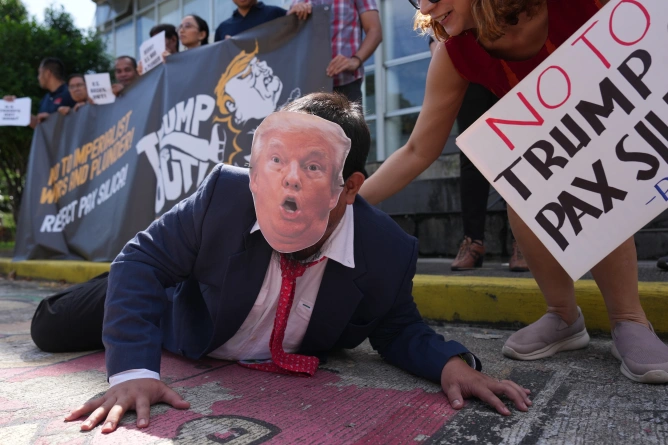
Kommersant’s visual choice is, in itself, an editorial message. The article “Donald Trump failed to live up to expectations” is illustrated with a photograph of an activist wearing a mask bearing President Donald Trump’s face, taken by Aaron Favila for the Associated Press. Through this symbolic contrast—a façade Trump, with no real substance behind the mask—the Russian daily subtly suggests that the Democrats’ victory is the consequence of the gap between the public image promised by the president and the reality perceived by voters. It is no coincidence that the article’s title—“Donald Trump failed to live up to expectations”—places the defeat in a personal, not merely partisan, register.
How the Democrats’ victory was portrayed in the Russian press
Russian media outlets such as Kommersant, Vedomosti, Argumenty i Fakty, and the state-run agencies RIA Novosti and TASS wrote that the Democrats had taken control of both chambers of Congress. Kommersant estimated, citing NBC News, that the Democrats would win 255 of the 435 seats in the House of Representatives and at least 51 in the Senate, with the possibility of reaching 56—an unprecedented advantage since Barack Obama’s first term in 2008. Echo of Moscow went even further, calling the result a victory comparable only to the one following Watergate in 1974.
The cause of the defeat was attributed in the Russian press primarily to dissatisfaction with prices and the war with Iran. Analyst Malek Dudakov, quoted by Vzgliad, spoke of a “blue tsunami”: Democrats winning not only the contested states but also Republican strongholds such as Texas, Kansas, and Ohio. Political scientist Iulia Boguslavskaia, interviewed by Vesti.ru, explained the result through Trump’s unfulfilled promises: prices continued to rise, while the military conflict with Iran contradicted his promise not to start new wars. Even Echo of Moscow emphasized that inflation of 3–3.5% was perceived as Trump’s personal problem because he had made reducing prices the central promise of his term.
The events that generated visibility
A key moment was Texas, where Democrats won for the first time since 1988. Candidate James Talarico defeated Attorney General Ken Paxton, who was directly backed by Trump. URA.RU described the result as “a serious success for the Democrats.” Another widely reported episode was the election of Abdul El-Sayed in Michigan—the first Muslim senator in U.S. history, whom Vedomosti described using his ironic remark directed at Trump: “Donald, I know you’ve had trouble with my name. So, after JD swears me into office in January, you can simply call me ‘senator’.”
Elon Musk generated one of the highest impact scores in the monitoring. Fontanka.ru, Vesti.ru, and Lenta reported his joke on X—“looks like my space lasers for election interference didn’t work this time”—after CNN revealed that he had donated more than 445 million dollars to support Republicans, the largest known contribution of this electoral cycle.
Trump’s reaction was closely followed. Vedomosti and Lenta reported that the president accepted the result and declared himself ready to work with Democrats, although he suggested that Republicans would not have lost if his name had been on the ballot. RIA Novosti also reported the White House’s official response: voters who voted for Democrats “will regret their choice” when fuel prices fall after the conflict with Iran is resolved.
The themes shaping the agenda
Investigations promised by the Democrats. The broadest theme was the Democrats’ promise to open congressional investigations into the Trump administration. TASS and Novosti Mail quoted Congressman Robert Garcia’s statement—“Hire lawyers!”—and the official list of potential targets: Kristi Noem, Stephen Miller, Tom Homan, and other close associates of the president. Vzgliad reported that Democrat Ed Markey joked that “new forests” would be needed to print the subpoenas. Dudakov even suggested the possibility of a new impeachment trial.
The effect on the war with Iran. The Russian press devoted considerable space to the connection between the Republicans’ defeat and the military conflict with Tehran. Rambler quoted Iranian Parliament Speaker Mohammad Bagher Ghalibaf as saying that Americans had voted “no” to war with Iran. Vedomosti noted that Trump himself had acknowledged the connection between the war and the election result.
Russia’s position and Ukraine. The Kremlin maintained an official distance. Spokesperson Dmitry Peskov called the elections “America’s internal affair,” adding that Trump would remain president until the end of his term and would continue to conduct his foreign policy. Deputy Foreign Minister Sergei Ryabkov told RIA Novosti and Izvestia that Russia’s policy, including its approach to the issue of Ukraine, did not depend on the results of the American elections.
“Our principled and consistent position regarding Ukraine—as well as our foreign policy in general—is not based on short-term considerations and, naturally, does not depend on fluctuations in the political barometer of other countries. We will continue our work in accordance with the directives of the President of the Russian Federation,” Ryabkov said, according to HotNews, citing Reuters.
Malek Dudakov was more direct in his analysis for Vzgliad: “Europe and Ukraine are celebrating too early,” because the United States is not expected to quickly resume funding for the Ukrainian army.
The Russian press extensively picked up Politico’s analysis of possible repercussions for the European Union and NATO, including in the Top News edition, which quoted the warning that a frustrated American administration could react harshly toward its transatlantic allies.
The overall tone and the “lesson” conveyed to the Russian public
The tone distribution in NewsVibe’s monitoring shows an interesting balance: 194 neutral materials, 50 negative, and only 12 positive, with an overall score of -0.34, but with a visible change on November 4, when the score rose to +0.09, suggesting that the Democrats’ victory was treated as relatively good news, or at least neutral news, for Russia’s perceived interests. The entity Donald Trump appears with negative sentiment in 44 of the 103 mentions, while Democrats are mentioned positively in 33 materials.
The Russian press conveyed to its audience an image of a divided America led by a weakened president, using the Democrats’ victory to suggest that a change in the majority in Washington would not automatically bring a change in policy toward Moscow or Kyiv. The implicit conclusion was that, regardless of who controls Congress, the Russia-U.S. relationship remains one of interest and pragmatism, not ideology.
*****Summary prepared with the help of a data-monitoring workflow provided by the NewsVibe Romania media monitoring platform. The analysis, data, and images presented were enhanced with the help of Machine Learning and Artificial Intelligence tools.
Latest News
20:34
20:26
20:14
20:12
19:55
See more news
NEWS ON THE SAME TOPICS





.webp)