ANALYSIS Midterms: Trump, the unpredictable variable. Why Democrats cannot rely on the optimism of the polls




Always see our news on Google
Eight days before the November 3, 2026 midterm elections, polls and electoral models show Democrats as favorites to take control of the House of Representatives and, to a lesser extent, the Senate. However, analysts remain cautious: polling errors in 2016 and 2020, plus the difficulty of measuring voters mobilized by Donald Trump, recommend prudence before speaking of a guaranteed “blue wave.”
Why the numbers should be taken with a grain of salt
Pew Research Center showed that, in 2020, national polls had their largest error in 40 years in the popular vote, while at the state level the error was among the largest of the past two decades. The error was not random: it repeatedly underestimated support for Trump.
For 2026, this experience remains relevant because Trump continues to be central to the campaign, even though he is not personally running. Pew estimates that 63% of voters consider him a factor in their vote for Congress, while 44% say their vote is actually a vote “against” him, compared with just 19% who see it as a vote “for” him.
Main reasons for caution
Selective nonresponse: Trump supporters tend to be harder to include in samples, especially if they are skeptical of the media and institutions.
Turnout estimation: polls do not merely capture preferences; they attempt to predict who will actually vote. A late Republican mobilization could change the outcome.
Trump’s effect on congressional voting: a voter may be dissatisfied with the administration but still vote Republican in some local races.
The difference between national polling and local races: an 8-point Democratic advantage nationally does not automatically translate into uniform gains in districts and states.
Who is still voting for Trump and Republicans?
The traditional Republican electorate remains important: conservative and religious voters, small-business owners, and residents of rural areas. But Trump has also brought less predictable segments into the coalition, especially working-class people without college degrees, anti-establishment voters, and people from postindustrial or exurban areas.
In 2026, however, the coalition appears less consolidated. Pew shows that 77% of voters who voted for Trump in 2024 now support Republican candidates for the House, compared with 87% of Kamala Harris voters who support Democrats. Moreover, among Trump voters who hold an unfavorable view of the Republican Party, only 49% support a Republican for the House; more than a third say they are unsure or prefer another candidate.
White evangelicals nevertheless remain Trump’s most stable base. Reuters/Ipsos estimates that his support among this group fell to 63% in October 2026, from 77% in January 2025, but it remains the only major demographic group tracked in which support exceeds 60%. White evangelicals account for approximately 13% of American adults, but nearly one-third of Trump’s winning electoral coalition in 2024.
House of Representatives: Democrats are clear favorites
All 435 House seats are up for election. Pew measures an 8-percentage-point Democratic national lead: 44% versus 36% for Republicans among registered voters.
Electoral models translate this lead into a strong advantage for Democrats. Nate Silver’s model gives them approximately a 95% chance of winning a majority in the House, while The Conversation summarizes the same forecast: Democrats are overwhelming favorites if they secure a 2–3-point lead in the “generic ballot.”
Still, a national advantage does not guarantee a broad majority. Cook Political Report classifies the race in numerous districts as open to any outcome, and the geographic distribution of the vote could leave Democrats with only a narrow majority even in a favorable year.
Senate: Democrats favored, but the race remains open
The Senate is far more uncertain than the House. Republicans start with a 53–47 majority, and Democrats need a net gain of four seats to control the upper chamber in 2027.
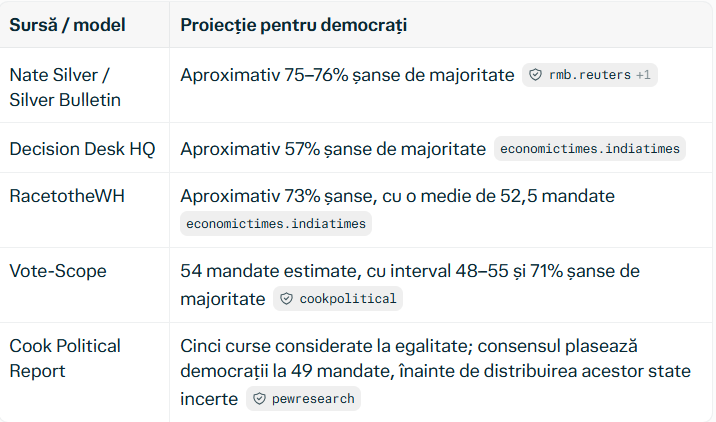
The difference between these models shows exactly why analysts avoid certainty: the Senate depends on a handful of key states, and a polling error of just one or two points could reverse control of the chamber.
Why Trump remains an unpredictable factor
Even though Trump’s approval rating fell to 30% in Pew’s October poll, this does not automatically mean a Republican collapse. Some of his voters may be disappointed with the party or the government’s performance but return to Republicans on Election Day, especially in states with limited competition or in races in which the Republican candidate is perceived as independent of Trump.
In addition, Democrats have a clear mobilization advantage: Pew finds that their supporters are 17 percentage points more likely to say they are “extremely motivated” to vote. But mobilization may be partially offset by Republican spending: in the seven Senate races considered toss-ups by Cook, Republicans are spending $947 million on advertising, compared with $625 million for Democrats.
Conclusion
For November 3, 2026, the numbers indicate that Democrats have very good chances of taking the House and real, but less certain, chances of winning the Senate. Analysts’ caution, however, stems from recent history: Trump has repeatedly mobilized voters whom polls underestimated, and in 2026 some of them appear disappointed, but not necessarily absent from the electoral rolls.
Analysis prepared with support from Perplexity
Latest News
10:12
10:03
09:47
09:36
09:36
See more news
NEWS ON THE SAME TOPICS








.webp)