ANALYSIS Three empires, one target: how the US, Russia, and China are testing the cohesion of the European Union




Always see our news on Google
There is no “common plan” by Washington, Moscow, and Beijing to break up the EU. But there is a dangerous convergence: each great power has strategic reasons to prefer a more divided, fragmented Europe that is less capable of acting as one — and their methods, from disinformation and economic pressure to bilateral diplomacy, reinforce one another.
The European Union is difficult to negotiate with when it speaks with one voice: a market of approximately 450 million consumers, a major trading bloc, and a regulatory actor capable of imposing technological, climate, or competition standards. That is precisely why European foreign policy chief Kaja Kallas warned recently that the US, China, and Russia prefer a fragmented Europe, because it is simpler to negotiate with individual states than with the entire bloc, following a logic of “divide and rule.”
Why the EU bothers the great powers
For Russia, a united EU means maintained sanctions, support for Ukraine, and a security alternative to Moscow’s influence in Central and Eastern Europe. For China, a coherent European bloc can more effectively withstand industrial subsidies, disputed trade practices, and strategic dependencies. For the Trump administration, the EU represents a regulatory and sanctioning power that can constrain American companies and counter a worldview based strictly on the balance of power.
A recent analysis published by International Affairs describes China’s and Russia’s strategies not as an identical project, but as different adaptations: Beijing initially sought to “distance” Europe from the United States, then shifted toward limiting closer transatlantic coordination; Moscow evolved from cautious engagement to open destabilization after perceiving Europe as irreversibly lost.
Russia: division, fear, and paralysis
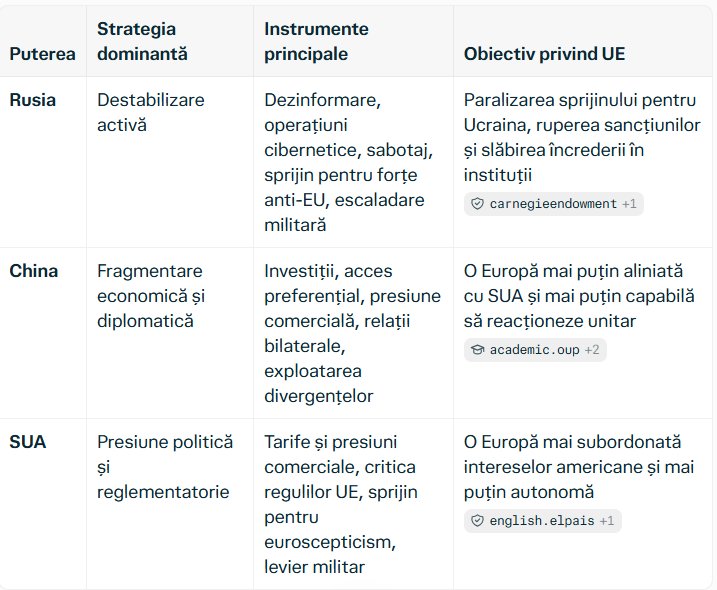
Russia’s strategy is the most direct: to erode Europeans’ trust in their own institutions, amplify internal polarization, and prevent consensus on Ukraine, sanctions, and common defense. Carnegie describes the Kremlin’s campaigns as systematic, well-funded, and broader than those of China, Iran, or North Korea.
The tools are hybrid: disinformation on social media, manipulation of sensitive issues such as migration and national sovereignty, support for anti-EU movements, cyber operations, and, according to recent analyses, sabotage and provocations at European borders.
The ultimate objective is not necessarily for a state to leave the EU, but for the EU to become slower, more fearful, and more divided: for some governments to block sanctions, reduce support for Ukraine, or prefer bilateral agreements with Moscow. Security analyses indicate that Russian propaganda explicitly targets the EU and NATO, with the aim of weakening the European security architecture.
China: not destroying, but fragmenting
Beijing has a clear economic interest in the EU not entering a recession: Europe is an essential market for Chinese exports. Therefore, China’s strategy is subtler than Russia’s — it does not seek the bloc’s collapse, but a less united Europe, more commercially dependent on China and more distant from the US.
The methods include privileged bilateral relations with certain capitals, strategic investments and economic pressure, plus the exploitation of differences among member states regarding technology, security, and relations with Beijing. A European Parliament study finds that the EU’s approach toward China remains hampered by a lack of unity, even though most member states hold similar positions.
China essentially prefers to deal with Berlin, Paris, Rome, Budapest, or Brussels separately, depending on its interests. An academic analysis shows that EU states have perceived the Chinese threat differently: France and Germany have adopted a firmer line, while Hungary and Greece have been more reluctant to criticize Beijing — a fissure that China can sustain without necessarily having created it.
US: pressure on the European model
The American case is more nuanced, because the US remains, formally, a central ally of Europe. But the Trump administration has promoted a vision in which the EU is perceived more as a regulatory and geopolitical obstacle than as an automatic partner. An analysis by the Centre for European Reform notes that the current American administration does not share the European perception of the Russian threat and has sought to exclude Europeans from negotiations with the Kremlin.
Washington’s strategy, as interpreted in recent analyses, combines commercial and technological pressure, criticism of “censorship” and European regulations, support for Eurosceptic political forces, and the threat or repositioning of the American military presence in Europe.
The objective is not necessarily the legal disappearance of the EU, but its transformation into a weaker, more divided bloc that is less capable of regulating American companies, supporting European strategic autonomy, or negotiating as a power in its own right. El País summarizes this theory as follows: the US would seek to “cultivate resistance” toward the EU and provide political and technological support to nationalist Eurosceptic groups.
Three methods, the same effect
The limits of the conjuncture
It is important to distinguish between convergence and conspiracy. There is no solid evidence that Moscow, Beijing, and Washington are coordinating a common plan to destroy the EU; their interests are rivals in many respects. Analysts who have studied the conjunctural siege of the EU warn that speaking of a single coordinated framework would be a “conspiratorial excess.”
But the effect can be convergent. Each power benefits from the EU’s real vulnerabilities: slow decision-making, divergences among states, populism, economic dependencies, and disagreements over the war in Ukraine. When Russia amplifies fear, China cultivates dependence, and the US pressures rules and alliances, the result may be the same — a Europe that no longer manages to decide quickly and act as a power.
The antidote
The European response involves more than defense or countering disinformation. It requires coherence in policy toward China, solidarity with states exposed to Russian pressure, protection of critical infrastructure and elections, plus a genuine capacity to negotiate with Washington without automatically accepting the bloc’s division.
For the Kremlin, Beijing, and, to a different extent, the White House, a strong EU is inconvenient. For the member states, however, weakening cohesion would mean less global influence, higher security costs, and a more vulnerable position in a world dominated by great powers.
Analysis produced with the support of Perplexity
Latest News
22:58
22:44
22:41
22:21
22:08
See more news
NEWS ON THE SAME TOPICS