ANALYSIS China, the US and Russia: three strategies, three forms of power



Always see our news on Google
In the competition among the great powers, China, the United States, and Russia are not pursuing the same type of hegemony. China is building its influence through economics, industry, and state discipline; the US relies on innovation, alliances, and the power of the financial system; Russia is trying to compensate for its economic weakness through military force, energy, and the ability to destabilize.
China: power through patience and scale
China’s strategy is one of long-term construction. Beijing seeks to turn the size of its economy into a strategic advantage, reduce its dependence on the West, and move up global value chains, from high-volume production to advanced technology. At the same time, the state maintains strict political control, precisely to avoid internal shocks that could slow its rise.
China’s stake is simple: to become indispensable to the global economy and harder to isolate politically. To this end, it invests in infrastructure, exports, industrial capacity, artificial intelligence, semiconductors, energy, and external projects that expand its geopolitical footprint.
US: power through networks and innovation
The United States is playing a different game. Washington is not merely trying to produce a great deal, but to control the standards, financing, technology, and alliances that make the global order function in its favor. America’s strength comes from its innovation ecosystem, universities, capital markets, the dollar, and its network of security partners in Europe and Asia.
The American stake is maintaining centrality. The US wants to remain the country that sets the rules, finances technological ecosystems, and can project military power on a global scale. That is why the competition with China is viewed in Washington not only as an economic contest, but also as a struggle over the architecture of the future.
Russia: influence through pressure
Russia has a different, more defensive and coercive model. It cannot compete with the US or China on an economic scale, so it seeks relevance through its military, nuclear arsenal, energy, and the use of conflict as a political instrument. Instead of building an attractive economic order, Moscow tries to preserve its status through fear, obstruction, and regional influence.
Russia’s stake is maintaining great-power status even without a solid economic foundation. In practice, this means defending its sphere of influence, exploiting energy dependencies, and having the ability to impose costs on adversaries. It is a hard-power strategy, but with limited long-term returns.
Strengths
China has the advantage of a huge economy, an integrated industry, and a centralized planning capacity that allows it to act coherently over the long term. The US has the advantage of innovation, economic flexibility, and a global alliance network that amplifies American power beyond its borders. Russia, by contrast, has a powerful military apparatus and a greater willingness than its rivals to use pressure instruments carrying high political costs.
Weaknesses
China remains vulnerable to slowing growth, demographic pressures, dependence on exports, and technological blockages imposed by the West. The US is weakened by internal polarization, the high cost of external commitments, and the tendency to shift politically from one administration to another. Russia suffers from an economy that is too narrow, too dependent on resources, and too incapable of generating innovation or prosperity on a broad scale.
What comes next
In the long term, the essential difference among the three powers is this: China invests in continuity, the US in networks and adaptation, while Russia invests in deterrence and disruption. China wants to rise; the US wants to remain on top; Russia wants to remain impossible to ignore. It is not merely about three large economies, but about three different ways of turning power into influence.
After the competition: a world of flexible blocs
The most likely consequence of the confrontation among the three strategies is the fragmentation of globalization, not its disappearance. Trade will continue, but it will be reorganized according to security criteria: companies will prefer suppliers from allied states, sensitive technologies will circulate with greater difficulty, and investments in infrastructure and energy will increasingly be assessed through the lens of geopolitical risk.
Competition will grow for three decisive resources: advanced technology, energy, and critical raw materials. China will try to maintain its dominant position in manufacturing and industrial supply chains; the US will limit rivals’ access to certain cutting-edge technologies; Russia will try to preserve its influence through energy, the military, and relations with states willing to challenge Western rules.
Europe will be compelled to spend more on defense, secure its industry, and accept that prosperity can no longer be separated from security. In this context, investments in defense, dual-use research, critical infrastructure, and investment screening are becoming permanent elements of European economic policy.
For Romania, the effect may be twofold. On the one hand, the proximity of war and hybrid pressure increase risks; on the other hand, its geographical position gives it the opportunity to become a regional hub for logistics, energy, defense, and the reconstruction of Ukraine. The difference will not be made by geography alone, but by the state’s ability to build infrastructure, absorb European funds, and protect institutions from corruption and foreign influence.
Europe: between alliance and autonomy
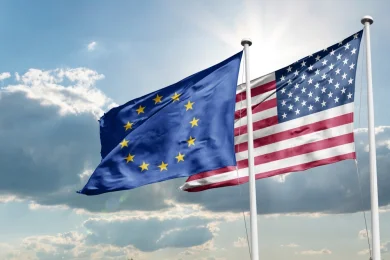
The European Union does not have the luxury of a simple choice between Washington, Beijing, and Moscow. It is strategically tied to the US through NATO and the transatlantic relationship, economically connected to China through trade and supply chains, but considers Russia the main direct threat to continental security. The European response is a balancing formula: cooperation with partners, reducing vulnerabilities, and protecting its own economic capabilities.
This is the meaning of the European economic security strategy: the single market must be strengthened, critical dependencies must be limited, and trade relations must remain open as long as they do not become instruments of political coercion. Brussels identifies four priority risks: supply-chain fragility, technology leakage, critical infrastructure security, and economic coercion.
Regarding China, the EU is not seeking total decoupling, but “de-risking”: diversifying suppliers, more careful investment screening, and protecting advanced technologies. In 2026, the EU Council adopted a revised framework for screening foreign investments, which also covers sensitive technologies, critical raw materials, energy, transport, digital infrastructure, and dual-use equipment.
Regarding the US, Europe has an interest in remaining the most solid political and military ally, without accepting its transformation into a mere market for American capital, energy, or technology. The stake is developing genuine European autonomy in defense, energy, semiconductors, artificial intelligence, digital infrastructure, and military equipment production.
Regarding Russia, the European strategy is clearer: military deterrence, reducing energy dependencies, and defending democratic institutions against cyberattacks, disinformation, and economic pressure. For the EU, Russia’s war against Ukraine has shown that energy, logistics, ports, undersea cables, and information have become components of security just as important as armies.
Romania: flank, energy, corridor
For Romania, the relationship with these three strategies is not abstract. Bucharest is located on NATO’s eastern flank, on the Black Sea, has the EU’s longest border with Ukraine, and is already a significant logistics, energy, and military hub in the region. The strategic partnership with the US, membership in NATO and the EU, represent the pillars of national security policy.
Regarding the US, Romania must turn its status as a frontier ally into an economic and industrial advantage. The modernization of the base at Mihail Kogălniceanu, defense procurement, the development of port infrastructure, and energy cooperation can bring investment, know-how transfer, and industrial capacity if Bucharest also negotiates local production, maintenance, professional training, and the integration of Romanian companies into Western supply chains.
Regarding the EU, Romania has the chance to become a gateway to Ukraine, the Republic of Moldova, the Black Sea, and the Caucasus. The Port of Constanța, the Danube, rail and road networks, energy interconnections, and storage capacity can turn the country into a strategic corridor for trade, reconstruction, and energy security.
Regarding China, Romania needs a pragmatic policy, not a naïve one. Investment and trade can be useful in non-critical sectors, but digital infrastructure, energy, ports, communications, and dual-use technologies must be protected through rigorous investment screening and European coordination. This is not economic isolation, but risk management in a world where investment can become a political lever.
Regarding Russia, Romania’s priority is strengthening deterrence in the Black Sea and internal resilience. Reports cited by the Congressional Research Service indicate concerns regarding hybrid threats, including cyberattacks, influence operations, and attempts to erode trust in NATO, the EU, and democratic institutions. Romania also has energy potential that could become strategic for the entire region. The Neptun Deep project is estimated at approximately 100 billion cubic meters of gas and is expected to begin production in 2027, while Romanian energy infrastructure has already contributed to supporting the Republic of Moldova and Ukraine.
Analysis prepared with the support of Perplexity and the NewsVibe information flow
Latest News
23:03
22:44
22:40
22:37
22:34
See more news
NEWS ON THE SAME TOPICS