The European Commission promises to reduce bureaucracy by 25% and intensifies pressure for the application of EU rules.



Always see our news on Google
The European executive says that simplifying legislation, reducing administrative burdens, and stricter enforcement of rules are essential for the competitiveness of the European Union and for the functioning of the single market.
The European Commission promises to reduce bureaucracy by 25% and intensifies pressure for the application of the rules. The EEA provides information about the image.
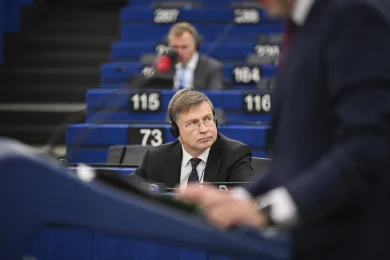
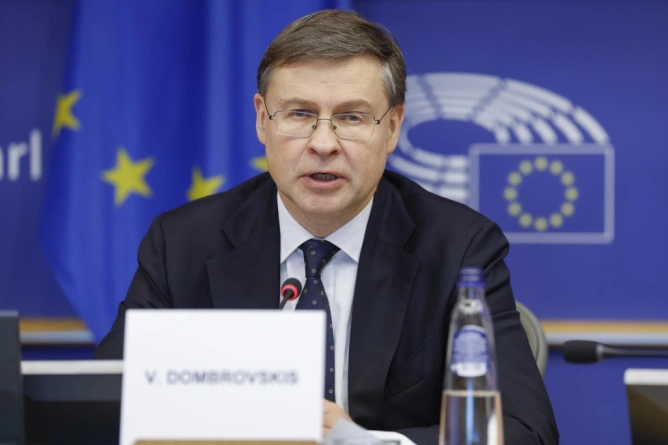
The European Commission states that it wants to reduce administrative burdens for businesses by 25% and for SMEs by 35% by the end of the current term, in an effort that it directly links to the competitiveness of the European economy, productivity, and the more efficient functioning of the single market. In an intervention in the Committee on Legal Affairs of the European Parliament, Commissioner Valdis Dombrovskis said that simplification, implementation, and enforcement of legislation must be treated together, at a time when Brussels believes that Europe needs clearer, simpler, and better-enforced rules.
In short
The European Commission maintains the goal of reducing administrative burdens by 25% for businesses and by 35% for SMEs.
Brussels estimates annual administrative savings of 37.5 billion euros by the end of the term.
The Commission says it has already proposed measures with the potential for 15 billion euros in recurring savings and 6 billion euros in one-time savings.
In the last year, ten Omnibus packages for simplification have been presented, and the work program for 2026 includes three more such packages.
The Commission launched 552 infringement procedures in the last year, sent 71 cases to the Court of Justice of the European Union, and closed 554 procedures after compliance by member states.
Valdis Dombrovskis presented the Commission's agenda in the broader context of the growth and productivity challenges facing the European Union. He said that simpler, clearer, and better-enforced rules are an essential part of the European response to these issues and directly linked this goal to long-term prosperity and the Union's ability to achieve its strategic objectives.
The Commissioner argued that the stakes are not just administrative efficiency but the relaunch of European competitiveness. In his intervention, Dombrovskis stated that "a simpler, easier, and more coherent regulatory framework does not just mean more efficient rules. It is about reigniting the engine of Europe's competitiveness and securing our long-term prosperity."
To illustrate the current cost of bureaucracy, he cited a recent OECD report, according to which 3.9% of employees in the EU work in compliance functions, compared to only 1.7% in research activities. Dombrovskis articulated one of the central messages of his intervention by saying that "Europe needs more people in laboratories and fewer people filling out forms."
The Commission states that this goal translates into an estimated 37.5 billion euros in annual administrative savings by the end of the term. According to data presented by Dombrovskis, the measures proposed so far have an estimated potential of 15 billion euros in recurring administrative savings and 6 billion euros in one-time reductions of the administrative burden. He said that these savings are "real savings" that can help strengthen the competitiveness of the EU economy.
In the last year, the Commission presented ten Omnibus packages for simplification, which targeted reporting on sustainability and corporate diligence, investments, agriculture and farmers, defense preparedness, chemicals, small mid-caps, digital rules, environmental acquis, the automotive industry, and food and feed safety. However, Dombrovskis insisted that simplification is not a one-off exercise but a continuous process of improving the quality of EU legislation.
In this logic, more than half of the legislative initiatives in the Commission's work program for 2026 have, according to the Commissioner, a strong focus on simplification and must produce net administrative savings. The program also includes three new Omnibus packages for simplification, dedicated to energy products, taxation, and reducing burdens for citizens. In parallel, the Commission's services are analyzing legislation in their own areas to identify outdated, redundant, or inefficient rules, with a view to new proposals for simplification, codification, withdrawal, repeal, or consolidation of rules.
This screening also extends to delegated and implementing acts. Dombrovskis said that, following this analysis, the Commission proposed deprioritizing 30% of the planned delegated and implementing acts for this year, a measure presented as a significant additional contribution to reducing administrative burdens.
The Commission is also preparing a dedicated communication to strengthen better regulation practices, simplification, and enforcement of legislation. The document is expected to include new ways to strengthen the analytical foundation of legislative proposals, including through more systematic and relevant impact assessments, options for strengthening better regulation principles throughout the public policy cycle and during legislative negotiations, an action plan for in-depth review and cleaning of regulations, an initiative aimed at combating gold-plating, and a set of measures to strengthen the enforcement of rules.
An important part of the speech focused on the implementation and enforcement of existing legislation. Dombrovskis said that citizens' rights and benefits for businesses depend on the full and correct application of EU law in all member states. He also presented the new tools introduced last year, including implementation dialogues. So far, members of the College of Commissioners have organized 57 such dialogues, with the participation of over 1,100 diverse actors, from industry and SMEs to public authorities and civil society.
The Commission states that it has begun to strengthen technical support for implementation. Dombrovskis mentioned the introduction, in April 2025, of an IT tool called a transposition roadmap to improve the flow of information between the Commission's services and member states. In less than a year, this functionality has been used for the implementation of 35 directives, together with a selected group of voluntary member states. Also, after an implementation dialogue regarding ViDA, the Commission launched a technical assistance project for 12 member states on topics such as electronic invoicing and digital reporting requirements.
At the same time, Dombrovskis emphasized that when cooperation fails, strict enforcement of legislation becomes necessary. In the last year, the Commission launched 552 infringement procedures, referred 71 cases to the Court of Justice in 21 member states, and in 20 of these, also requested financial penalties. In parallel, the European executive closed 554 procedures after compliance by member states. The Commissioner described these closed cases as "554 positive outcomes for our citizens and businesses."
He added that pre-infringement dialogues had a resolution rate of 76% in 2025, but acknowledged that there remains a large number of open cases, around 1,500. In his presentation, Dombrovskis warned that non-application of EU law has direct consequences and cited as an example unjustified barriers and fragmented implementation of single market rules, which, in the Commission's view, undermine Europe's competitiveness.
A politically sensitive dimension of the intervention was the explicit criticism of national overregulation, referred to as gold-plating. Dombrovskis said that member states sometimes add stricter or additional rules compared to European ones, which creates barriers, distorts competition, and reduces common prosperity. The Commission announced that it wants to work with member states to discourage this practice, including by using new technologies to identify areas of friction and by strengthening cooperation in forums such as the Single Market Enforcement Tool.
In conclusion, Dombrovskis called for cooperation from the European Parliament, the Council, and member states to integrate better regulation principles throughout the legislative cycle and to assess the impact of substantial amendments during the legislative process. He said that people and companies will not judge European institutions by the number of rules adopted, but by the ability of those rules to produce concrete benefits in practice.
Dombrovskis's intervention is part of a broader repositioning of the European Commission, which increasingly links the legislative simplification agenda to competitiveness, productivity, and the functioning of the single market. In his speech, the Commissioner presented this line as part of the current mandate of the Commission and stated that simplification, implementation, and enforcement of legislation are key priorities, alongside deepening the single market.
The message also has a clear institutional dimension. The Commission is calling not only for new proposals for simplification at the European level but also for the involvement of co-legislators in assessing the impact of amendments, as well as a change of approach in member states, where national overregulation is presented as a source of further fragmentation. In parallel, Brussels is trying to combine the promise of reducing bureaucracy with a discourse of stricter enforcement of existing rules, including through infringement, penalties, and stronger monitoring tools for implementation.

Latest News
19:11
18:57
18:39
18:27
17:54
See more news
NEWS ON THE SAME TOPICS