The European Parliament calls for tougher competition rules for American tech giants and more space for European champions




Always see our news on Google
The European Parliament calls for a faster implementation of the Digital Markets Act against major digital platforms, including through market investigations, interim measures, non-compliance cases, and fines. The annual report on competition policy, drafted by Stéphanie Yon-Courtin and adopted with 501 votes in favor, also calls for a change in merger policy to allow the emergence of European groups capable of competing globally, without reducing consumer protection.
The European Parliament calls for a competition policy adapted to the power of major digital platforms, to Europe's dependence on financial and technological infrastructures outside the EU, and to the need to allow the emergence of European companies large enough for global competition. The annual report on competition policy was adopted on Tuesday with 501 votes in favor, 61 against, and 95 abstentions.
In short
1. The European Parliament calls for a faster and tougher implementation of the Digital Markets Act.
2. MEPs propose a DMA tax for stable funding of the enforcement of the rules.
3. The report calls for an analysis of including AI models, chatbots, virtual assistants, and operating systems for connected TVs in the list of services targeted by the DMA.
4. MEPs call for a merger policy that allows for pan-European consolidation and the emergence of European champions.
5. The report calls for swift action in investigations regarding Visa and Mastercard and sees the digital euro as a tool to reduce dependence on card schemes outside the EU.
The report, drafted by Stéphanie Yon-Courtin, a Renew MEP from France, starts from the idea that competition rules can no longer be treated merely as a tool for controlling prices or market concentration. In the current digital and geopolitical economy, competition overlaps with strategic autonomy, critical infrastructure, data, artificial intelligence, payments, and Europe's ability to have its own large companies.
The first emphasis is on the Digital Markets Act. MEPs urge the European Commission to use existing tools more firmly: more market investigations, interim measures, non-compliance cases, and fines. To fund this enforcement, the report proposes a "DMA tax," which would ensure stable resources for overseeing major platforms.
The report also calls for using market investigations regarding cloud services to adjust DMA obligations. The stake is for users and companies to be able to switch cloud providers more easily, without technical, commercial, or contractual barriers that lock them into a single ecosystem.
Artificial intelligence emerges as the next frontier of competition policy. The Parliament calls on the Commission to analyze whether the list of essential platform services should be expanded to include AI models, chatbots, virtual assistants, and operating systems for connected TVs. Such an expansion would increase the scope of the DMA.
On mergers, MEPs call for a change in approach. The report supports pan-European consolidation and long-term resilience while maintaining consumer protection. The goal is for larger European firms to be able to compete with global rivals, instead of remaining fragmented in national markets.
However, the Parliament also calls for firmer action against acquisitions below the usual notification thresholds, especially in digital, AI, and pharmaceuticals. These "killer acquisitions" can eliminate innovative companies before they become real competitors to major players.
Payment systems are treated as a matter of competition and strategic autonomy. MEPs call on the Commission to finalize without unjustified delays the investigations regarding Visa and Mastercard fees and the payments sector. The report also suggests reviewing the Regulation on interchange fees.
The digital euro is presented as an opportunity to reduce excessive dependence on card schemes outside the EU. For the Parliament, payments are not just a financial service, but essential infrastructure for the economy, consumers, and European technological sovereignty.
The report also calls for stronger enforcement of the Regulation on foreign subsidies against online platforms and marketplaces from outside the EU, but with a reduction of burdens for SMEs. The idea is that European firms should not compete with actors supported by non-transparent external subsidies, without small firms being burdened with disproportionate obligations.
MEPs call for the development of key infrastructures for Europe's autonomy and innovation: cloud, AI infrastructure, financial market infrastructure, and resilient, interoperable, and competitive European payment systems. They also call for competitive energy markets that ensure stable and affordable prices.
Another proposal is the creation of a European market investigation tool. This would allow addressing structural competition issues that cannot be effectively resolved through current rules. Some member states already have similar tools, and the Parliament calls on the Commission to introduce one at the EU level.
The report also calls for mandatory procedural deadlines for antitrust investigations, so that cases do not take too long. MEPs also want a study to check whether fines exceed illegally obtained gains, so that sanctions do not become a mere cost of doing business.
In the field of defense, the Parliament calls for better access for SMEs to defense markets. In sports, the report highlights the growing phenomenon of ownership of multiple clubs by the same investors and proposes analyzing a ban on dynamic ticket pricing in the future Digital Fairness Act.
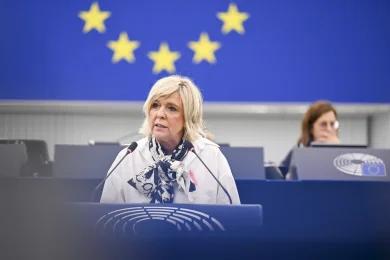
Stéphanie Yon-Courtin stated that competition decisions should not be subject to politics and that the report calls for evaluating the transfer of competition competencies from the Commission to a truly independent European Competition Authority. She linked this proposal to the DMA investigations that take too long and to Europe's dependence on Visa and Mastercard, stating that the digital euro is the EU's chance to regain control in payments.
Latest News
22:52
22:34
22:28
21:56
21:29
See more news
NEWS ON THE SAME TOPICS
.webp)


.webp)