



The European Parliament calls for a "youth mode" on social media, without targeted ads and with fewer addictive features.




Always see our news on Google
The European Parliament's Committee on Culture and Education calls for stricter application of EU rules for online platforms and better protection for children and young people. MEPs support a "youth mode" that disables targeted ads and limits addictive design, more transparency of algorithms, a European code for influencers, and ethical standards for "AI companions."
The European Parliament calls for stricter rules for social media and online platforms, so that children and young people are protected from targeted ads, addictive features, harmful content, commercial influencers, and artificial intelligence systems that can exploit minors' emotional vulnerability. The report was adopted on Tuesday in the Committee on Culture and Education with 17 votes in favor, three against, and four abstentions.
In short
MEPs call for a "youth mode" for minors, which disables targeted ads and limits features designed to keep children on platforms for as long as possible.
The report calls for a ban on the most harmful addictive design practices and protective measures for recommendation systems, so that algorithms do not push minors towards harmful or manipulative content.
The Parliament wants more transparency regarding social media algorithms, so that young people can understand why certain posts are recommended to them, hidden, or removed.
Influencers would be subject to a European code of conduct, and children must be protected from commercial exploitation through "kidfluencing" and "sharenting," meaning the exposure of children's lives online by parents.
The report calls for mandatory ethical standards for "AI companions," applications that simulate virtual friendships, and an explicit ban on AI systems that produce realistic sexual images without consent or synthetic materials of sexual abuse against children.
The report starts from the idea that children's safety cannot be left solely to parents or schools. MEPs say that the primary responsibility must lie with the companies that design and manage digital platforms, especially when their products are used daily by minors.
The text calls for the online environment to be built on principles such as privacy by design, safety as a default setting, age-appropriate design, and algorithmic transparency. In practice, this means that platforms should not treat the protection of minors as an add-on option, but as a basic condition of the service.
MEPs focus particularly on addictive and persuasive design. The report calls for a ban on the most harmful practices that affect the well-being of children and young people and urges platforms to introduce risk-based protective measures for recommendation systems.
Recommendation systems are important because they decide what content the user sees, how quickly they move from one post to another, and what type of materials are pushed in front of them. For minors, these mechanisms can increase exposure to harmful content, social pressure, commercial materials, or communities that encourage dangerous behaviors.
The report also calls for increased transparency of algorithms. MEPs say that opaque algorithms and unclear moderation limit young people's ability to understand why certain content is recommended, suppressed, or removed. This lack of clarity can reduce their ability to navigate safely in the online environment.
A central proposal is the introduction of a "youth mode." This mode should disable targeted ads and limit addictive features for minors. Such a setting would change children's experience on platforms, reducing commercial pressure and mechanisms that encourage them to spend more time online.
MEPs want clearer consequences for platforms that do not comply with the rules. The report encourages the Commission to introduce personal liability in cases of serious and persistent non-compliance with provisions regarding the protection of minors.
Influencers are another targeted area. The report notes the increasingly important role of influencers in shaping children's and young people's perceptions, aspirations, and social attitudes. MEPs call on the Commission and member states to develop a European code of conduct for this activity and a harmonized definition of "influencer marketing."
The text calls for the protection of minors from commercial exploitation through "kidfluencing," situations where children are turned into influencers, and through "sharenting," situations where parents document their children's lives online. These practices can expose minors to public pressure, commercial use of their image, and loss of control over their own digital identity.
The report also calls for coherence between the main European rules that affect the digital environment: the Audiovisual Media Services Directive, the General Data Protection Regulation, the Digital Services Act, the AI Act, and the future Digital Fairness Act. For platforms, this means that obligations regarding the protection of minors, personal data, artificial intelligence, advertising, and online content must be applied together, not separately.
Artificial intelligence is treated as a distinct risk. MEPs call for mandatory ethical standards for "AI companions," systems that simulate virtual friendships. The goal is to prevent the manipulation of minors' emotional vulnerability, especially in the case of children and adolescents who may develop attachments to conversational applications.
The report also calls for more transparency regarding the training of AI models, including clear information about the data and materials used. Measures are requested to protect children in the way these systems are developed and brought to market.
MEPs call on platforms to limit the spread of AI-generated content that imitates journalists, media professionals, or brands, including so-called "celebrity scams." The Commission is urged to treat these practices as systemic risks and to intensify ongoing investigations under the Digital Services Act.
The report calls for recommendation and moderation systems to provide more visibility for trustworthy, age-appropriate content provided by professional media organizations. This proposal aims to reduce minors' exposure to harmful, manipulative, or disguised commercial content.
Another point concerns sexual images generated or manipulated with AI. MEPs call for an explicit ban on AI systems that generate, modify, or alter realistic images or videos with sexual content of an identifiable person without consent. The report also calls for a ban on synthetic materials of sexual abuse against children.
The text calls for systematic monitoring in all member states, with comparable indicators regarding children's digital habits, access to education, and the effectiveness of protective measures. This includes age restrictions, age verification, and safety settings.
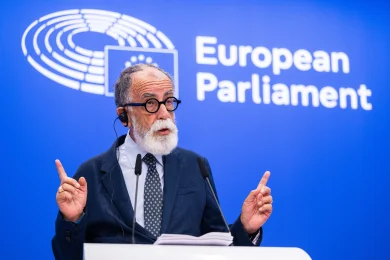
Rapporteur Sandro Ruotolo, from the S&D group, said that the responsibility for the safety of children and adolescents must primarily belong to those who design and manage digital platforms. He compared platforms to products that must be safe from the factory.
"We do not ask children to design seat belts and we do not ask parents to install airbags. Manufacturers have a duty to ensure the safety of their products. The same principle must apply to digital platforms," said Sandro Ruotolo.
The data cited in the report shows the scale of the problem. According to Eurostat, in 2024, 97% of young people in the EU used the internet daily. Over 80% of young people in Europe use social media every day, and children and young people aged 9 to 16 spend an average of three hours a day online. According to the EU Joint Research Centre, the time spent on social media by children and young people has more than tripled since 2010.
The report is set to be voted on by the entire Parliament in the plenary session from September 14-17. If supported by the plenary, the text will increase political pressure on the Commission and member states for stricter enforcement of existing rules and for new measures regarding online safety for minors.
The report was adopted on Tuesday by the Committee on Culture and Education of the European Parliament. The text will be voted on by the plenary of the European Parliament in the session from September 14-17.
Latest News
12:01
11:56
11:56
11:55
11:51
See more news
NEWS ON THE SAME TOPICS
.webp)







.webp)









.webp)


