ANALYSIS / When the school system is boiling over: why French high school students block the streets, while Romanian students choose silent protest


Always see our news on Google
Violent blockades in France began with a shortage of teachers and precarious conditions in schools. In Romania, where results and funding are even more worrying, students generally choose symbolic protest rather than confrontation.
Protests in French high schools began with concrete grievances related to study conditions, but quickly acquired a national and political dimension, and in some cities degenerated into violence. The French case shows both students’ ability to formulate systemic demands and the risk that legitimate mobilization may be hijacked by confrontations, political labeling, and law-and-order responses.
From the teachers’ strike to national mobilization
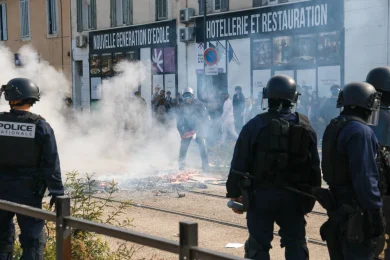
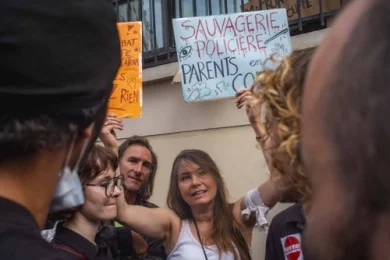
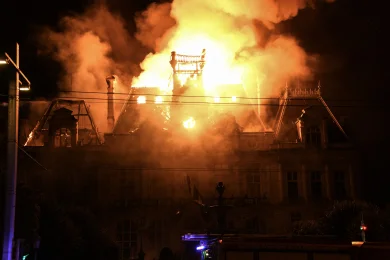
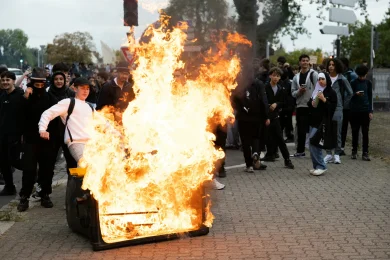
The movement did not emerge simultaneously throughout France and initially had no political leader. The first blockades were reported after the start of the school year at high schools where students cited local problems: staff shortages, inadequate material conditions, and very heavy schedules. In Brittany, students at the Théodore-Monod high school in Le Rheu complained of staff and infrastructure deficiencies; in Villeneuve-d’Ascq and Caen, the main grievance concerned the overloaded school schedule. One of the focal points of the mobilization took shape at the Saint-Exupéry high school in Créteil, in the Paris metropolitan area. There, after September 17, students joined a strike launched by teachers, demanding better study conditions and additional staff. For students, teachers’ problems — missing colleagues, overcrowded classes, and insufficient resources — became their own problems as well. Social media accelerated the spread. Videos posted on TikTok, Snapchat, and Instagram transformed local grievances into recognizable issues for high school students in other cities. A video from Créteil garnered approximately 1.4 million views on TikTok, according to Franceinfo. Going viral gave the protest visibility, but also made it harder to distinguish between the initial organizers, supportive students, and groups that joined later. Real grievances, political disputeThe demands mainly concerned the quality and fairness of public education: more resources, the rapid replacement of absent teachers, smaller class sizes, renovation of deteriorating buildings, and less overloaded schedules. High school students also challenged Parcoursup, the national platform for admission to the first year of higher education.Officially, Parcoursup centralizes applications and admission offers. For many high school students, however, the mechanism is insufficiently transparent and shifts the pressure of selection to before the baccalaureate. They cite uncertainty surrounding waiting lists, the different criteria used by institutions, and the risk that students from schools or families with fewer resources will start from a disadvantaged position. Thus, challenging the platform expresses a broader fear: that access to university is becoming more selective and unequal.The High School Students’ Trade Union called for the mobilization to continue, and students later joined. Organizations such as Fage, Union Étudiante, and Unef called demonstrations and blockades, so the protest went beyond the issue of how high schools function and became a criticism of education funding and access to higher education. Political support visibly came from some La France insoumise (LFI) parliamentarians, a radical-left opposition party associated with Jean-Luc Mélenchon. Deputies Louis Boyard and Clémence Guetté traveled to Créteil, and their interventions increased the movement’s visibility.franceinfo+1The government led by Sébastien Lecornu argued that LFI had encouraged or instrumentalized the mobilization. The executive also cited the alleged involvement of “groups close to the far left,” based on intelligence assessments. LFI rejected the accusation: Manuel Bompard described the government’s position as “conspiracy theory,” while Jean-Luc Mélenchon insisted on nonviolent protest methods.franceinfo+1The presence of LFI politicians does not, however, demonstrate that the party initiated the protest. The first blockades emerged around local demands from students and teachers. But political support made the movement more vulnerable to accusations of instrumentalization.When blockades become violenceOn October 1, the mobilization entered a serious phase. Authorities counted around 900 actions in front of high schools, while police made nearly 2,000 arrests in a single day, mainly for violence, participation in violent gatherings, or attacks on law-enforcement forces. In Nantes, a fire destroyed the entrance hall of the Nelson Mandela high school; in other cities, arson attacks, projectiles, vandalized bus stops, and clashes with police and gendarmes were reported.Violence against school leadership was particularly serious. The Normandy education authority reported that the principals of the Blaise-Pascal high school in Rouen and the Elisa-Lemonnier high school in Petit-Quevilly had been assaulted and lightly injured. In Ingré, the principal of the Maurice-Genevoix high school was also assaulted and injured. Education Minister Édouard Geffray said that, since the beginning of the blockades, 119 people had been injured: 85 students and 34 staff members. The Interior Ministry reported that some groups included masked individuals armed with projectiles and fireworks mortars; authorities also mentioned containers of hydrochloric acid. This information does not permit generalizing the violence to all the high school students involved, but indicates the overlap of participants and intentions of different kinds. Gérald Darmanin, the Justice Minister, made a necessary distinction between students’ demands and assaults on school staff. He spoke of an “active and violent minority,” but stated that high school students must be heard and that the concern of part of the youth is legitimate.
Romania: a deeper education crisis
The problems cited by French high school students have clear equivalents in Romania: teacher shortages, overcrowded classes, poor infrastructure, pressure from assessments, and the feeling that students are insufficiently consulted. In some respects, recent data indicate a more severe situation in Romania.
The 2025 PISA results place Romania below the OECD average in all assessed areas: 419 points in mathematics, 413 in reading, and 425 in science. Only 48% of 15-year-old Romanian students reach the minimum level of proficiency in mathematics, compared with 65% in the OECD average. In other words, more than half do not master basic skills in this subject.
Learning problems overlap with underfunding, staff shortages, bureaucracy, and a curriculum considered by students and teachers to be too overloaded and theoretical. According to the OECD, 2.8% of teaching positions in Romania are unfilled, one of the highest proportions among the countries analyzed, and the difficulties are greater in mathematics and science.
Criticism of the curriculum concerns not only the amount of material, but also insufficient time for applied exercises, remediation, and individual feedback. The European Commission recommends continuing the curricular review at high-school level, with an emphasis on basic skills and avoiding overload.
Romania has nevertheless experienced a major mobilization in education: the teachers’ general strike in May–June 2023. Approximately 150,000 teaching staff and tens of thousands of other auxiliary and non-teaching employees suspended their work for three weeks, demanding salary increases, a new pay scale, and investment in the system. Marches and protests took place in Bucharest and other cities, while the conflict affected the end of the school year and the examination schedule. The movement was, however, union-led and peaceful: unlike some episodes in France, it did not generate student-organized blockades, attacks on school leadership, or the destruction of institutions.
Romanian students: protest without blockades
Romanian high school students rarely choose blockades, preferring forms of protest with lower personal risk. On September 28, the National Student Council called on students to come to school dressed in black, opposing the proposal for mandatory uniforms, under the message “Education is not fixed at the tailor’s.” The action was voluntary, symbolic, and compatible with normal attendance at classes.
The CNE challenged not only uniforms, but also the lack of student consultation and the idea that a clothing regulation could solve bullying or discrimination. The organization called for public priorities to be school counseling, prevention, support for vulnerable children, meals, transportation, and infrastructure. The Ministry of Education does not support mandatory uniforms, citing both the lack of evidence that they reduce bullying and the costs for families.
The absence of high-school protests on the scale of those in France does not mean an absence of discontent. The 2024 Friedrich-Ebert-Stiftung Romania study shows that 41% of Romanian young people aged 14–29 are dissatisfied with the quality of education, while 55% believe that their interests are not well represented politically.
This combination of dissatisfaction and a sense of underrepresentation may reduce willingness to take collective action. A study published in the journal Quality of Life showed that 42% of young people believed that local authorities did not take their opinions into account, while 68% saw no real chance of changing a local decision that would negatively affect them.
Romanian students have neither unions nor the right to strike, and the pressure of grades, the National Assessment, and the baccalaureate can make interrupting classes individually riskier. In addition, the Code for Romania report shows that student representatives are insufficiently consulted in practice in school decisions, although formal participation mechanisms exist.
The difference from France therefore has less to do with the seriousness of the problems and more with organizational capacity, protest tradition, and the perceived cost of confrontation. France shows how educational grievances can quickly become a political and public-order crisis; Romania, for now, shows a more cautious response: profound discontent expressed through limited public pressure and symbolic actions.
Latest News
22:52
22:34
22:28
21:56
21:29
See more news
NEWS ON THE SAME TOPICS