EXCLUSIVE Record profits from the Iran crisis: Major oil companies have tripled their refining margins




Always see our news on Google
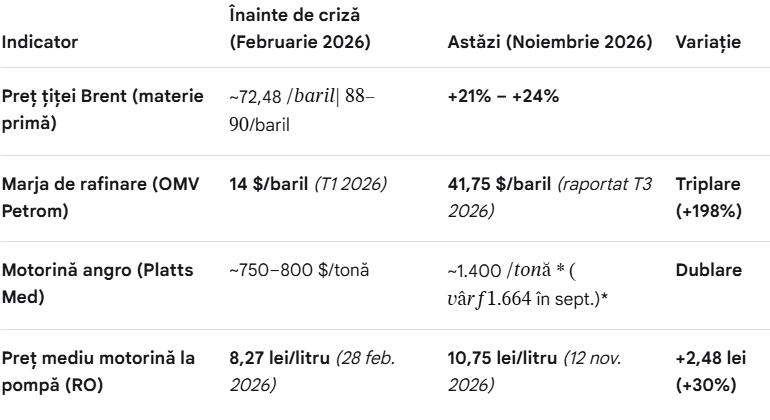
The aggressive increase in diesel prices at the pump is not merely a natural consequence of the conflict in the Middle East, but the direct result of the way oil giants have monetized the global fuel shortage. While crude oil has become approximately 21% more expensive compared with February, the price of diesel in Romania has risen by 30%, exceeding 10.70 lei per liter even with the reduced state excise duty. Financial data show that, beyond higher transportation costs, major refineries took advantage of market disruptions to triple their earnings on each barrel processed.
The increase in diesel prices at the pump is not due solely to the evolution of crude oil prices and related taxes, but also to an explosion in refining margins—the difference between the cost of the raw material and the price of the finished product sold at the refinery gate. In Romania, the average price of diesel rose from 8.27 lei/liter in February to 10.75 lei/liter in November 2026, a 30% increase that largely canceled out the government’s effort to curb prices by temporarily reducing the excise duty by 25%.
Price Increase X-Ray: Oil vs. Diesel at the Pump (Feb – Nov 2026)
In the oil industry, the gross profit obtained by transforming a barrel of oil into fuel is measured through the refining margin, while the benchmark price of the finished product is dictated by international wholesale quotations (Platts). Comparing the data from before the outbreak of the Iran crisis with the current figures shows a clear rupture between the cost of the raw material and the price charged for the refined product:
How Companies Turned the Geopolitical Crisis into Historic Profits
The much faster increase in the price of diesel compared with crude oil is based on three mechanisms through which profit became concentrated among major producers and refiners:
• Refining margins exploded amid the global diesel shortage. According to analyses by the Romania Energy Center (ROEC) and financial reports published by OMV Petrom on the Bucharest Stock Exchange, the refining margin rose from 14 dollars per barrel in the first quarter to 41.75 dollars per barrel in the third quarter. The disruption of traffic through the Strait of Hormuz and Russia’s total ban on diesel exports, introduced in July 2026, removed more than 1.3 million barrels per day from the market. Refineries used this shortage to sell the finished product at a historic markup over the cost of crude oil.
• Logistics costs placed additional pressure on prices. According to data analyzed by Goldring, maritime transport for a barrel of crude oil imported by Romanian refineries from the Mediterranean region increased nearly tenfold, from an average of 2.5–4.5 dollars before the conflict to 25 dollars per barrel. Although this additional cost erodes part of the theoretical gain of local refineries, the level of international quotations more than covered these expenses.
• Capping gas-station prices did not stop increases at the refinery gate. To protect drivers, the Romanian state reintroduced a cap on the commercial markup at the distribution level and temporarily reduced the diesel excise duty by 25%, to 2.10 lei/liter excluding VAT, according to Fuel-Prices.eu data. However, this measure blocked only gas-station margins, not the starting price at the refineries, which is dictated by international Platts quotations and where companies collected record profits.
Conclusion
Integrated oil giants—those that control both extraction and refining—are the major financial winners of the crisis in Iran. Although capping markups at the pump held back the earnings of gas stations in Romania, the real accumulation of profit shifted upstream, to the refinery gate. Taking advantage of the global diesel shortage, major companies dictated quotations that enabled them to triple their profit margins, transferring the cost of geopolitical tensions directly into consumers’ pockets and largely nullifying the state’s effort to curb prices through the reduction of the excise duty.
Analysis prepared with the support of ChatGPT
Latest News
21:40
21:34
21:28
21:19
21:16
See more news
NEWS ON THE SAME TOPICS