SPECIAL Informat.ro / An additional exam at 14 years old: admission to high school, between performance and equal opportunities




Always see our news on Google
The project put under public consultation by the Ministry of Education for high school admission in 2027 introduces the possibility for high schools to organize their own competitions for up to 50% of the places in the 9th grade, after the National Assessment. The stakes of the debate are not just technical: it concerns the risk that additional selection at ages 14-15 may exacerbate the differences between children who have access to private tutoring and those who depend solely on public school.
In the form presented by the ministry, it is not about mandatory admission for all students nor about the elimination of computerized allocation. Students who do not participate in the high school tests or do not obtain a place through competition remain eligible for computerized allocation, which is done in the order of averages and expressed preferences.
What the project provides
The Law on Pre-University Education no. 198/2023 allows high schools to organize admission competitions for a maximum of half of the places approved in the schooling plan, and the ministry argues that the methodology under public debate applies a legal provision already adopted. The application is scheduled for the generation that entered the 5th grade in the 2023-2024 school year, thus for the admission in 2027.
The National Assessment remains mandatory, and access to the exam organized by the high school would be conditioned by obtaining at least a grade of 5 in each of the National Assessment tests, after appeals. The ministry proposes two admission tests, established by the high school based on the profile, but with unique subjects developed at the national level by the National Center for Curriculum and Evaluation.
For the theoretical pathway, the proposed list includes, for example, mathematics, computer science, or physics for the mathematics-computer science profile; biology, chemistry, and physics for natural sciences; Romanian, modern language, or Latin for philology; and geography, social education, or history for social sciences. The effective weight of the results obtained in the exam in the admission average would still be decided by each high school, which maintains an important area of institutional autonomy. The proposed calendar compresses the sequence of stages: the final results of the National Assessment are to be posted on July 7, 2027, registrations for admission competitions on July 8, tests on July 9 and 12, and final results on July 15. The computerized allocation is to take place on July 26.
The project in its current form increases the risk of exam fraud
At the same time, the director of the "I.L. Caragiale" National College in Bucharest, Andreia Bodea, stated that the project put under public consultation provides for exams without audio-video supervision and without anonymization of the works, which could lead to suspicions of fraud.
"The organization method is inadequate, inappropriate, raises great suspicions. (...) We are not talking about its opportunity, we are talking about the organization method. At a time when for years national exams, of any nature, have been organized with audio-video supervision, with anonymization of the works and with evaluation from outside the school, suddenly this exam appears in which the rooms have no audio-video supervision, the works are not anonymized, the subjects, although unique and developed by the ministry, potential students will be supervised by the teachers of the respective schools, and the correction, evaluation will also be done by the teachers of the respective colleges," Bodea said at Digi24.
Why the introduction of the admission exam is contested by Save the Children Organization
Save the Children Romania warns that additional exams can amplify "hidden costs" of education, especially by increasing the demand for tutoring and by providing advantages for families who can afford paid preparation. The organization points out that almost half of the consulted students, 43%, already declare that they take tutoring, which shows that the private tutoring market is already a relevant component of the school path.
The fundamental objection is one of equity. In a system where the quality of teaching, access to teachers, digital infrastructure, and family possibilities differ significantly between localities, an additional test does not exclusively measure the knowledge accumulated at school. It can indirectly measure the time, money, and educational support that the family was able to mobilize before the exam.
The risk is higher in the case of subjects that are not examined in the National Assessment and for which there is no same preparation routine in all schools. In practice, announcing a competition in computer science, physics, chemistry, foreign language, or history can quickly create the pressure of parallel preparation, even if the subjects are national and the curriculum is public.
What the OECD says
In its assessment of Romania, the Organization for Economic Cooperation and Development (OECD) has recommended re-evaluating the pathways and certification in secondary education, including considering, in the long term, the elimination of the 8th-grade exam. In the short term, the organization has called for improving the quality and equity of the National Assessment, precisely because the exam has major consequences on the educational future of students.
The OECD's finding is relevant to the current controversy: Romania uses national exams for selection when transitioning from middle school to high school, and this succession of filters can become a barrier to students' progress and can contribute to early school leaving.
However, the formulation according to which the OECD would explicitly recommend that admission be based on the averages from the 7th and 8th grades, "not through additional exams," must be treated with precision. The recommendation identified in the OECD document does not formulate a direct admission network through annual averages, but advocates for reducing the "unique stake" character of the examination at the end of the 8th grade and for a fairer assessment.
The OECD does not automatically validate either the return to the middle school average or the multiplication of exams. Its signal is broader: access to the next level of education should not be decided by such a rigid mechanism that it transforms an evaluative moment into a social obstacle.
"In the future, Romania should review the pathways and certification in secondary education, including considering the elimination of the 8th-grade exam," says the Organization for Economic Cooperation and Development (OECD).
The report OECD "Education and Skills in Romania: Driving Inclusive Growth", published in May 2025, shows that the National Assessment at the end of the 8th grade already has a high stake for Romanian students, in the conditions of strong competition for prestigious theoretical high schools. In this context, the introduction of additional admission competitions raises the question of whether selection becomes more relevant for the school profile or, on the contrary, more burdensome and more dependent on family resources.
European models
EU states do not use a single form of high school admission. There are systems with standardized exams, systems based mainly on school results, and mixed formulas, in which testing appears mainly for pathways or schools with special profiles.
Comparison shows that the exam is not, in itself, a European exception: the Czech Republic has a standardized test for high school programs that ends with the maturity exam, equivalent to the baccalaureate. But there is a fundamental difference between a common evaluation, with unitary and predictable rules, and an additional competition in which each high school decides its subjects, the weight of the test, and its own admission criteria.
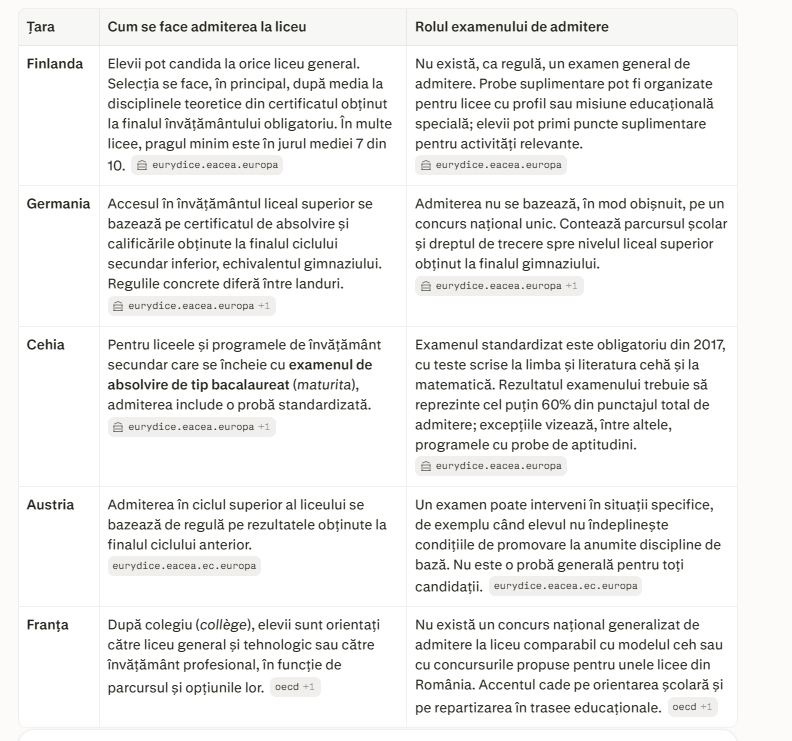
Finland offers an important counterexample for the argument based on evaluating the school path. There, students can apply to any general high school, and selection is made based on the average obtained in theoretical subjects; tests are reserved mainly for units with special educational tasks.
Effects on children
From the perspective of educational psychology, the issue is not only the number of exams but the accumulation of pressure during a period already defined by change: the end of middle school, the choice of a pathway, and the exit from the known collective. When admission to the most sought-after high schools involves additional tests, the child may perceive the National Assessment not as the end of a stage but as the first obstacle in a succession of selections.
For students with limited family resources, this pressure can also mean defensive choices: giving up from the start on high schools considered inaccessible, even before actually competing. For those from rural areas or from schools without stable teachers in the subjects of competition, formal access to the exam does not guarantee comparable chances of preparation.
There is also a possible argument in favor of the competition: high schools can argue that the specialized tests better identify interest and preparation for a certain field than two subjects examined in the National Assessment. But this argument becomes convincing only if the test is strictly related to the profile, the curriculum is announced in advance, the correction is transparent, and free support for preparation is genuinely available, not just declared.
The real test of the reform
The ministry has introduced some guarantees: national subjects, minimum threshold at the National Assessment, limiting the competition to a maximum of 50% of places, and maintaining computerized allocation for the other students. These elements reduce the risk of a completely arbitrary exam, but do not eliminate the differences in access to preparation and the competition for high schools with high prestige.
The vulnerable point remains the autonomy of high schools in establishing subjects and the weight of the exam in the final average. If the objective is selection by profile, the ministry should impose comparable rules between high schools, publish model subjects well in advance of the admission year, monitor the effects on vulnerable students, and finance free remedial preparation in schools.
In the absence of such measures, the competition may become more of a mechanism for social sorting than for educational orientation. The comparative European lesson is not that exams should be banned or generalized, but that selection should be proportional, transparent, and compensated by public policies that do not leave the child's chances at the discretion of family income.
*****Summary made with the help of a data monitoring flow provided by the media monitoring platform NewsVibe Romania. The analysis, data, and images presented have been enhanced with the help of Machine Learning and Artificial Intelligence tools.
Read also:
Latest News
08:22
08:05
07:50
07:35
07:21
See more news
NEWS ON THE SAME TOPICS