COMPARISON How it works in Europe and what Romania intends to do regarding social scholarships for students



Always see our news on Google
The social scholarship for students is legally defined as a tool to support school participation, but in practice, for many families, it functions as a subsistence income. The difference between the two functions becomes central now, when the Ministry of Education proposes that scholarships be paid "only during the school courses", not during vacations, as is currently the case, according to an article from Edupedu.
Romania builds support for students on three levels — Minimum Income for Inclusion, social scholarship, and educational voucher — but these tools are not interchangeable. Each has its own law, its own criteria, and its own purpose, which means that reducing one is not automatically covered by the other two.
A scheme with 840,000 beneficiaries
Data from the Ministry of Education and Research shows the real scale of the system: in January 2025, in the 2024–2025 school year, over 1.4 million school scholarships were awarded nationwide. The social scholarship had the most beneficiaries — 840,820 students, representing 60% of the total — and was, in the same month, the category with the highest funding. For comparison, the merit scholarship was awarded to 325,265 students, and the resilience scholarship to 170,318 students, which is 12% of the total scholarship recipients. The figures show a shift in emphasis compared to previous years, when the merit scholarship was the component with the highest funding; in 2025, the priority has shifted towards social support.
The share of the social scholarship is relevant to the debate regarding payment during vacations, as any potential modification would target the category with the highest number of beneficiaries in the scholarship system. This is not about adjusting a niche scheme, but about the main financial protection tool for students from vulnerable families, which is why any change in payment rules should be treated with technical rigor, not just administrative.
The social scholarship, under current rules
For the 2025–2026 school year, the minimum amount of the social scholarship is 300 lei per month. It is awarded to students from families with income below 50% of the net minimum wage, to orphans, those under special protection, and those with certain medical conditions specified by methodology.
Under current rules, the scholarship is paid even during vacations, with exceptions mainly applied in the summer — for students who do not pass, repeat the year for non-medical reasons, or accumulate unexcused absences. The scholarship is, therefore, already conditioned by attendance and conduct; it is not an unconditional aid.
However, the money enters the family budget like any other available income — it can cover food, transport, clothing, or utilities, not just direct school expenses. For households with minimal resources, the boundary between "support for the student" and "family income" is, in practice, almost non-existent.
What the explanatory note does not say
The explanatory note from the Ministry of Education for changing the way scholarships are allocated does not include a quantitative assessment of the effects produced by limiting the payment of scholarships to the period of courses. The document does not estimate how many students would lose the scholarship during vacations, what annual amount would disappear from family income, what the budget savings would be, or how many of the affected students receive Minimum Income for Inclusion or social vouchers for educational support concurrently.
Although the ministry invokes the need to support vulnerable students and prevent school dropout, the financial impact chapter does not contain data, and the section regarding monitoring and evaluating the measure shows that the project "does not refer to this subject."
In practice, a measure that can affect part of the 840,820 beneficiaries of the social scholarship is sent for public consultation without key figures that would allow for the evaluation of the real impact. The lack of this data makes any rigorous comparison with the situation in other EU member states difficult, where decisions of this type are usually documented with explicit budgetary and social estimates.
VMI: social placement, not scholarship
The Minimum Income for Inclusion, regulated by Law no. 196/2016, includes the component called "aid for families with children." This is granted to low-income families that have one or more children aged up to 18 years in care and aims to prevent the risk of child poverty, as well as to stimulate participation in education. Starting from April 1, 2026, the eligibility ceiling for this component is a maximum of 998 lei net monthly income adjusted. The amount is differentiated based on family income, number of children, and single-parent family situation: for families with a net monthly income adjusted of up to 393 lei, the aid is higher than for those with incomes between 394 and 998 lei.
Unlike the social scholarship, the aid for families with children is granted to the household, not to the individual student, and is not calculated based on the duration of courses or during vacation months. It is a social assistance tool intended for low-income families, while the social scholarship is an educational support measure granted to the student and conditioned by the criteria specified in the scholarship methodology, including conduct and attendance. It is, therefore, a general protection mechanism against poverty — useful, but not functionally equivalent to the scholarship.
The educational voucher: 500 lei, one-time
The third instrument is the social voucher for educational support — 500 lei per child, granted once a year, on an electronic card, exclusively for school supplies and clothing necessary for school. The use is restrictive: the money cannot be used for food, rent, or transport, and the program is aimed at preschoolers, as well as students in primary, secondary, and high school cycles. The difference in frequency is equally important: the scholarship is monthly, the voucher is annual — the two measures are complementary and do not exclude each other.
What European examples show
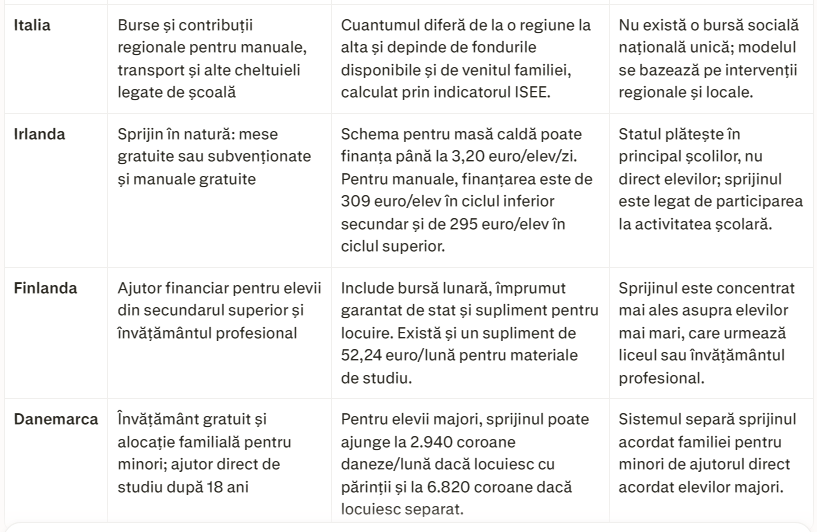
European comparisons show that there is no single model of "social scholarship" for students. Some states use periodic payments strictly correlated with the school year, others use annual aids for the start of school, and others combine school support with family benefits or targeted material assistance.
France provides an example of a mixed system. For the 2026–2027 school year, the college scholarship is awarded based on family income, with values of 120 euros, 336 euros, or 525 euros annually, paid in three installments. In parallel, the state provides the back-to-school allowance (allocation de rentrée scolaire — ARS) which is granted annually, before the start of courses, and for 2026 is 426.87 euros for children aged 6–10 years, 450.41 euros for those aged 11–14 years, and 466.02 euros for those aged 15–18 years. For certain vocational tracks, there is also an equipment bonus of 341.71 euros, granted together with the first installment of the high school scholarship.
The French model resembles, in general lines, the architecture in Romania, as it combines a scholarship granted to students from low-income families with a separate aid for the material costs of returning to school.
The difference does not lie so much in the existence of the two types of support, but in the amount, the eligible categories, and the method of payment. The French ARS allowance is an annual cash benefit, established based on the child's age — between 426.87 and 466.02 euros in 2026 — while the Romanian voucher has limited use.
Ireland uses a Back to School Clothing and Footwear Allowance, which is an annual benefit intended for low-income families, for clothing and footwear, in the amount of 160 euros for children aged 2–11 years and 285 euros for children aged 12–22 years returning to secondary education in 2026. The aid is only partially similar to the Romanian social voucher of 500 lei, as in Ireland it is a cash benefit and is not limited to the same institutional architecture as in Romania.
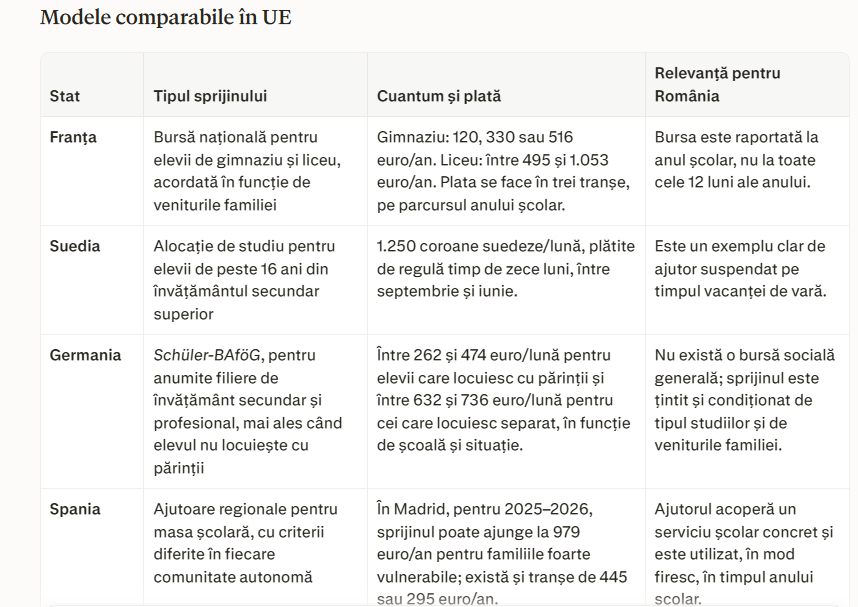
In England, the scholarship fund for young people aged 16–19 is directly correlated with participation in a study program. For vulnerable groups, support can reach up to 1,200 pounds per year, and institutions can also grant discretionary scholarships for transport, meals, textbooks, or equipment. This is a model more oriented towards the concrete costs of school participation than towards the uniform payment of a sum throughout the year.
And Spain indicates the same diversity. According to Eurydice, financial support for families of students can be granted exclusively on socio-economic criteria, can combine income with school performance, or can cover specific educational needs.
The conclusion of the comparison
Limiting the payment of social scholarships to the period of courses would not, in itself, represent a deviation from European practices — several states already link support to the school year or study program. The difference is that the cited states complement this type of restriction with parallel mechanisms, clearly dimensioned financially, for costs outside the school period. Romania theoretically has the tools — VMI and the educational voucher — but, in the absence of an official evaluation of the impact, it cannot be demonstrated whether these effectively cover the loss of income for the 840,820 beneficiaries of the social scholarship.
*****Synthesis made with the help of a data monitoring flow provided by the media monitoring platform NewsVibe Romania. The analysis, data, and images presented have been enhanced with the help of Machine Learning and Artificial Intelligence tools.
Latest News
12:12
11:59
11:52
11:51
11:41
See more news
NEWS ON THE SAME TOPICS