Europol uses the theft of the Helmet from Coșofenești as an example of the new violent robberies in European museums.



Always see our news on Google
The theft of Dacian artifacts from the Drents Museum in the Netherlands appears in a new Europol report about the shift from discreet thefts to violent and planned attacks on heritage. The perpetrators used explosives to enter the museum, and the Helmet from Coțofenești and two of the three stolen Dacian bracelets have since been recovered and returned to Romania.
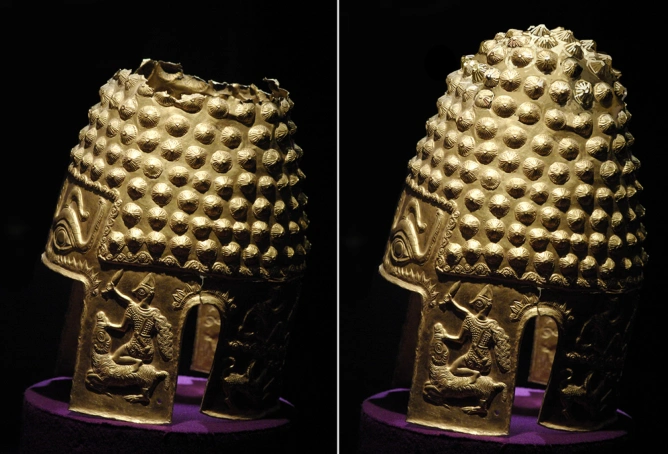
The theft of the gold helmet from Coțofenești and the three Dacian bracelets from the Drents Museum in Assen is used by Europol as one of the cases illustrating the change in heritage thefts in Europe towards more violent and better-prepared attacks. The perpetrators detonated explosives at the museum entrance on the night of January 24 to 25, 2025, and Europol states that Romanian objects are also part of the trend of criminals targeting high-value gold items.
In short
Europol includes the theft of Dacian artifacts in January 2025 among the main examples of increasing violence in attacks on museums.
The perpetrators used explosives to gain entry into the Drents Museum in Assen, in the Netherlands.
The gold helmet from Coțofenești and three Dacian gold bracelets were stolen.
Europol states that in the meantime, the helmet and two of the three bracelets have been recovered and returned to Romania.
The report links the case to the growing interest of criminal networks in gold items, which can have both exceptional cultural value and significant material value.
Europol begins analyzing the changing methods used by heritage thieves with a case that had Romania at its center: the theft of Dacian artifacts temporarily displayed at the Drents Museum in Assen.
On the night of January 24 to 25, 2025, the perpetrators entered the museum after detonating explosives at the entrance. The gold helmet from Coțofenești and three Dacian gold bracelets, objects belonging to the Romanian heritage, were stolen.
Europol places the attack within a broader change observed in Europe. The thefts of cultural goods were traditionally associated with discretion, careful recognition, and avoidance of confrontation, but recent cases include the direct use of force to open buildings and display cases.
In the same category, there are attacks with crowbars, axes, and hammers, and in some situations, criminals have used firearms or assaulted museum staff. The explosion in Assen represents one of the most evident forms of this change.
The report also provides an important update on Romanian objects. The helmet from Coțofenești and two of the three stolen bracelets have been recovered and returned to Romania. One of the three bracelets thus remains outside the group of objects that Europol describes as recovered.
The case is relevant for the report also due to the nature of the targeted objects. Europol observes that gold, silver, and precious stones have become increasingly frequent in the last two years, and most incidents in this category have involved a certain degree of violence.
The helmet and bracelets appear even in the section of the report dedicated to the changing trends, alongside other gold items and highly sought cultural artifacts. For criminals, such goods can combine their cultural value with the value of the material from which they are made.
The report warns that precious metals can be melted down, which can destroy the characteristics that allow for the identification of the object and can facilitate illegal resale. In the case of a unique archaeological artifact, this means that rapid recovery becomes essential for the preservation of heritage, not just for the recovery of financial value.
Europol does not state in the report that the authors of the theft in Assen intended to melt down the Romanian artifacts and does not establish the final reason why they were chosen. The case is used as a factual example of a violent and planned attack on high-value gold items.
The agency observes, in general, that new attacks are targeted. The perpetrators conduct reconnaissance and planning before the theft and pursue specific objects, instead of entering a museum to indiscriminately take the available goods.
Europol links this evolution to the possible emergence of new criminal profiles. Some individuals involved in recent thefts come from other areas of crime, and some groups may be formed ad-hoc for individual operations.
The report does not specifically attribute this model to the authors of the attack at the Drents Museum. The assessment of ad-hoc recruitment and new profiles concerns the general European trend, not the judicial conclusions from the Romanian artifacts case.
The Coțofenești case thus remains relevant for two of the main changes identified by Europol: the use of much more aggressive methods and the targeting of objects with high financial value, including cultural goods made from precious metals.
The helmet from Coțofenești is dated around 450 BC, and the Dacian bracelets included in the report are associated with Romanian archaeological heritage. Europol reproduces in the report images of the helmet and a bracelet from Sarmizegetusa Regia to illustrate the category of gold objects targeted in recent thefts.
The Europol report is not a new investigation into the theft from 2025 and does not establish individual responsibilities in that case. It uses the case within a broader European assessment of the evolution of crime against heritage.
For Romania, the new information is the inclusion of the case in a European trend that Europol considers significant enough for a strategic assessment: more violent attacks, targeted in advance, and an increasing focus on gold, jewelry, and other high-value goods.
Latest News
22:57
22:53
22:42
22:30
22:28
See more news
NEWS ON THE SAME TOPICS



.webp)