47 suspects arrested in an investigation into a drug-trafficking network linked to murders and grenade attacks


.webp)

Always see our news on Google
A coordinated operation supported by Europol led to the arrest of 36 people in Slovenia, Spain and Croatia, after another 11 had previously been arrested. Investigators suspect that the network hid drugs in legitimate commercial shipments and resorted to shootings, assassinations, attempted murders, kidnappings and grenade attacks when shipments were lost or internal conflicts broke out.
Thirty-six people were arrested in an international operation carried out on October 6 against a drug-trafficking network with members originating, among others, from the Western Balkans, while another 11 people had previously been arrested in the same investigation, bringing the total to 47. Europol says investigators have linked the network to shootings, assassinations, attempted murders, kidnappings and attacks with explosive devices in several European countries, and that it transported drugs hidden among legitimate commercial goods.
In brief
Thirty-four suspects were arrested in Slovenia, one in Spain and one in Croatia during the October 6 operation. Another 11 had previously been arrested.
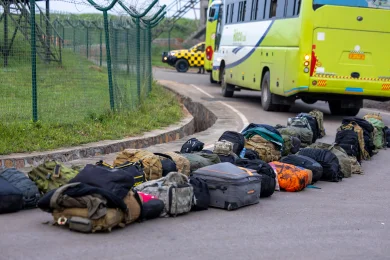
Police searched 42 properties in Slovenia and Spain and seized 51 kg of cannabis and 15 kg of amphetamine on the day of the operation, as well as firearms, jewelry and cash.
Investigators link the network to shootings, assassinations, attempted murders, the kidnapping of one member and grenade attacks against group members or their families.
The drugs were allegedly transported together with legitimate goods, using trucks, vans and passenger cars and commercial routes between several European states.
The quantities reconstructed from encrypted communications are much larger than the drugs actually seized. The suspects have not been convicted, and the charges must be proven in court.
The operation culminated on October 6 with searches at 42 properties in Slovenia and Spain. That day, 34 suspects were arrested in Slovenia, one in Spain and one in Croatia. Europol states that another 11 people had been arrested during earlier stages of the investigation, meaning that the phrase “nearly 50 arrests” refers to the total for the operation and not to the number of people detained on the same day.
During the October 6 action, authorities seized 66 kg of drugs, including 51 kg of cannabis and 15 kg of amphetamine, along with firearms, jewelry and cash. These seizures represent only what was found in the final operation and must be distinguished from the drugs seized during earlier stages of the investigation and from shipments that investigators say they later reconstructed based on the evidence.
The main characteristic of the case is the connection between drug trafficking and internal violence. According to Europol, investigators have linked the network to several shootings, assassinations and attempted murders, as well as to the kidnapping of one member. Explosive devices, including hand grenades, were allegedly used in some attacks, and the targets were primarily group members or their relatives. Investigators believe that violence was used when drugs were lost or seized, to punish people considered responsible and to maintain control over the group’s activities. The investigation also identified an attempted murder in Spain.
Europol describes a network made up of citizens of Bosnia and Herzegovina and Serbia, alongside suspects from Slovenia, Bulgaria, Türkiye and the Netherlands. This composition does not mean that all people from these countries were part of the same structure or had the same criminal liability. Authorities are investigating the individual roles and the different activities attributed to the members of the groups involved.
The transportation method was intended to conceal the drugs within ordinary commercial flows. The network allegedly recruited drivers mainly from Slovenia, Bosnia and Herzegovina and Bulgaria and used trucks, vans and passenger cars to transport the substances together with legitimate goods. Shipments documented by investigators originated in Belgium, the Netherlands and Spain and were destined for other European states, while the use of existing commercial routes provided cover for the illegal activity. The legitimate deliveries generated revenue at the same time and reduced transportation costs.
Network members allegedly used encrypted communication platforms, including SKY ECC and CryptCom, to organize shipments, communicate among participants and reduce the risk of detection. Messages recovered by investigators later became an important source for reconstructing shipments that had not been physically intercepted by police.
Between February 2022 and September 2026, authorities seized 253 kg of cocaine, 404 kg of cannabis, 18.8 kg of methamphetamine and 825 grams of MDMA as part of the investigations. They also seized 550 liters of acetic anhydride, a precursor substance used in drug production, as well as an automatic weapon fitted with a suppressor, ammunition and several pistols.
Investigators nevertheless consider that the actual trafficking activity was considerably greater than these seizures. From SKY ECC communications and other evidence, authorities reconstructed additional shipments and transactions that they attribute to the suspects. Europol says that they are also to be prosecuted in connection with approximately 2.5 tonnes of cannabis, 474 kg of cocaine, 104 kg of heroin, 30 kg of amphetamine and 11.6 kg of MDMA, as well as quantities of ketamine, hashish, ecstasy tablets and other substances.
These quantities must not be presented as seized drugs. They represent volumes that investigators claim may be linked to the network’s activity through communications and other evidence, while criminal responsibility for those shipments must be established in judicial proceedings.
The investigation was much broader than the three states in which Europol reports arrests during the final stage. Representatives of 22 countries were involved in police cooperation, while Europol provided analysis, information exchange and operational coordination. On the day of the action, a Europol expert and a Croatian investigator worked in a coordination center set up in Ljubljana, from where the arrests and field operations could be monitored in real time.
The action involved the Slovenian National Police, the judicial police unit of the Civil Guard in Barcelona and the Croatian police. The operation is part of EMPACT, the European mechanism through which national authorities, EU institutions and agencies, and international partners coordinate actions against the main forms of serious and organized crime.
Combating drug trafficking and dismantling the most dangerous criminal networks are among EMPACT’s priorities for the 2026–2029 cycle. In this case, the cross-border nature results not only from the movement of substances between states, but also from the use of legitimate commercial routes, drivers from several countries, encrypted communications and violence allegedly carried out in different jurisdictions.
Europol does not mention Romania among the countries where arrests or searches took place in the October 6 operation and does not indicate any involvement of Romanian authorities in the final action. The presence of citizens from several states in the network does not allow the accusations to be extended to the national communities from which they originate.
All the people concerned are suspects at this stage. The information published by Europol and the participating authorities describes the allegations and the results of the police investigation, while individual guilt must be established by the competent courts.
Latest News
09:15
09:14
08:57
08:38
08:34
See more news
NEWS ON THE SAME TOPICS