The Commission says batches of beef from Brazil came from animals treated with estradiol and had been certified for export to the EU



Always see our news on Google
Commission auditors identified batches of meat from female cattle treated with estradiol that had been incorrectly certified for export to the European Union. Éric Thévenard, director for health and food audits at DG SANTE, says that the products concerned were withdrawn and that Brussels will conduct a new audit before the Brazilian guarantees can be considered sufficient.
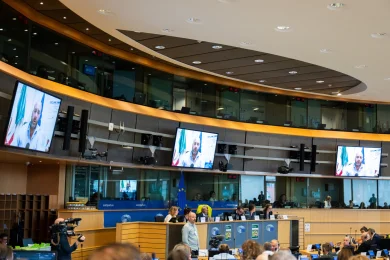
European Commission auditors identified in Brazil batches of meat from female cattle treated with estradiol that had been incorrectly certified for export to the European Union, Éric Thévenard, director for health and food audits at DG SANTE, said in the European Parliament’s Committee on Agriculture. The Commission notified the authorities of the Member States through the European Rapid Alert System for Food and Feed, and the products concerned were subject to withdrawal measures. Brussels says that the guarantees subsequently introduced by Brazil must be verified through a new audit before they can be considered sufficient.
In brief
1. A Commission follow-up audit identified batches of meat from female cattle treated with estradiol that had been certified for export to the EU.
2. The Commission says that the products concerned were reported to the Member States and withdrawn from the market.
3. Brazil suspended the farm of origin from the export protocol, as well as the certification body involved, and submitted a new corrective action plan.
4. The Commission will conduct a new audit to verify whether the Brazilian measures work in practice, but it is not scheduling it in the short term while Brazilian beef cannot enter the EU.
5. Separately, a recent audit concerning poultry and honey had a positive outcome with regard to guarantees on antimicrobials. This result does not automatically reopen the market and does not apply to beef.
The estradiol issue emerged in an audit initially carried out in 2024 concerning Brazilian controls on residues of pharmacologically active substances, pesticides, and contaminants in animals and products of animal origin. For beef, Brazil uses a separate production system for the domestic market and for exports to the EU. Operators supplying meat for the European market must guarantee that female cattle have not been treated with estradiol.
However, the 2024 audit found that the official control system could not fully verify the reliability of operators’ declarations. Brazil responded with an action plan and a private certification protocol, supervised by the competent authorities, under which only animals raised on farms included in the system could become eligible for export to the EU.
The Commission returned to Brazil for a follow-up audit conducted between 14 and 31 October 2025. According to Thévenard, the problems previously identified concerning laboratory performance had been corrected, but the guarantees regarding estradiol had not worked completely. Auditors found batches of meat from female cattle treated with estradiol that had been certified for export to the European Union.
After establishing the non-compliance, the Commission transmitted the information through the European Rapid Alert System for Food and Feed, so that the authorities of the Member States could withdraw the products concerned. Brazil suspended from the protocol the farm from which the incorrectly certified batch originated and the certification body involved, and submitted a new corrective action plan to the Commission.
Brussels does not consider the case closed, however. Thévenard said that the Commission services continue discussions with the Brazilian authorities and have sent additional questions concerning the action plan. A new audit will be conducted to verify the measures, but the official explained that he does not intend to allocate resources immediately for a control mission as long as the beef trade cannot resume.
The current situation concerning beef is also influenced by a second case, separate from estradiol. From 3 September 2026, exports of animals and products of animal origin to the EU must comply with the new European requirements concerning the use of antimicrobials throughout the animal’s lifetime. Third countries must provide guarantees that antimicrobials are not used to promote growth or increase yield and that certain substances reserved in the EU for treating human infections are not used.
Brazil had not provided the necessary guarantees for cattle when the new rules became applicable. The Commission had already explained at the beginning of September that the beef case was more complex than the poultry case because the guarantees must cover the animal’s entire lifetime. Commission officials said at the time that the situation could not be resolved within a few months.
In AGRI, Thévenard went further and said that, in practice, the outlook for beef is linked to the animals’ growth cycle. He indicated approximately two years between birth and slaughter and explained that, until Brazil can demonstrate compliance for the entire life cycle, beef cannot return to the relevant list for export to the EU. This restriction related to antimicrobials is legally distinct from the estradiol issue and must not be treated as a single violation.
For poultry and honey, the situation is different. Thévenard said that the audit conducted in 2026 to verify guarantees concerning antimicrobials had a positive outcome and that the report had been published on the same day as the AGRI meeting. The Commission had previously explained that a positive outcome may allow a proposal to amend the list of authorized countries and products, but any change must go through the European procedure and approval by the Member States.
The distinction between the two issues is essential. The estradiol case concerns the reliability of the segregation and certification of animals intended for the EU market, whereas the new antimicrobial regime imposes guarantees covering the animals’ entire lifetime. A country or product may meet one of the conditions and remain blocked by the other.
Thévenard also explained how controls work when entering the European market. All products of animal origin pass through border control posts, but the frequency of physical checks varies depending on the product and risk. For Brazil, he indicated physical checks on 100% of poultry meat, 30% of beef, and 50% of minced beef. Some of the physical checks also involve taking samples for laboratory analysis.
However, the import system does not rely exclusively on testing the final product. In the case of substances administered to animals long before slaughter, the residue may no longer be detectable in the meat. The Commission must therefore also assess the traceability, segregation, and certification systems in the exporting country. Thévenard explained that precisely this segregation mechanism was the vulnerable point identified in the Brazilian case.
The Commission says that trade agreements do not reduce these sanitary requirements. Thévenard stated that veterinary and sanitary rules and food-safety rules apply independently of the existence of a free trade agreement and that the EU may restrict imports when a country does not provide the necessary guarantees.
Therefore, any return of Brazilian beef to the European market depends on two separate demonstrations. Brazil must show that its certification system prevents the export of meat from animals treated non-compliantly with estradiol and that it can guarantee compliance with European antimicrobial requirements throughout the cattle’s lifetime. Neither of these conditions should be confused with the mere existence of a trade agreement or with the positive outcome of the audit concerning poultry and honey.
Latest News
07:30
07:25
07:19
23:04
22:36
See more news
NEWS ON THE SAME TOPICS