ANALYSIS The Ormuz-Bolojan Effect: Romania between economic instability and political chaos



Always see our news on Google
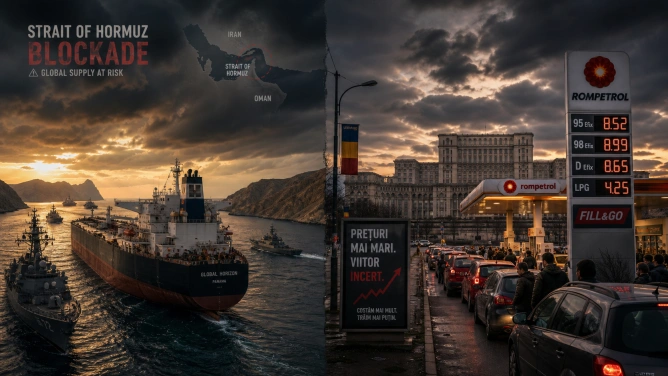
The blockage of the Strait of Hormuz following the US-Iran conflict in 2026 has already created waves of global economic shock, and Romania faces a double risk: heightened energy vulnerability and a political crisis that amplifies the negative effects.
The inevitability of a global economic crisis
A global economic crisis is no longer just a theoretical possibility – it is already underway, although the final magnitude depends on the duration of the blockade. The International Monetary Fund has revised its global growth forecasts to 3.1% for 2026, below pre-pandemic levels, warning that the situation could evolve towards stagflation if the conflict persists. Allianz estimates that in the scenario of a prolonged crisis, the global economy would enter a stagflationary regime, with the Eurozone entering technical recession (annual growth of only 0.2%) and inflation reaching peaks of 4.6% in Europe and 4.9% in the US.
OPEC oil production fell by about 7.87 million barrels per day in March 2026 compared to February, due to the partial closure of the Strait of Hormuz, which normally transports 20% of global oil trade. Iraq recorded the most drastic decline, with production dropping to just 1.63 million barrels per day. Brent oil prices surged by nearly 19% in a single day in March, reaching $111/barrel, after already recording a 28% increase in the previous week.
Can it still be avoided?
Avoiding a major economic crisis is becoming increasingly unlikely as the conflict drags on. Experts believe that the economic impact depends on three factors: duration, intensity, and geographical scope of the tensions. Even if a ceasefire were reached quickly, the lasting effects on supply chains and investor confidence would persist for months. The IMF notes that its projections are based on the assumption of a "limited conflict in duration and scope," but this assumption is becoming increasingly fragile.
Consequences beyond the fuel crisis
Global food crisis
The most alarming collateral consequence is the emerging food crisis. The Food and Agriculture Organization (FAO) has warned that the blockade of the Strait of Hormuz could trigger a global food crisis, as approximately one-third of internationally traded grains pass through this strait. Global food prices reached their highest levels in three years in May 2026, signaling the speed with which energy shocks transmit into food supply chains.
High energy costs simultaneously affect prices for grains, transportation and logistics, global agricultural production, and demand for biofuels related to vegetable oils. The US Department of Agriculture projected a 3.1% average increase in food prices in March, but this estimate was made with data prior to the war and significant upward revisions are expected.
Imported inflation and stagflation
The blockade of the Strait of Hormuz represents the detonator of a cross-border inflation caused by supply constraints, which traditional monetary policy tools cannot easily mitigate. Maritime insurance premiums have skyrocketed, and forced diversification of transport routes away from the Red Sea and Gulf has led to increased logistics costs and shipping rates globally. The global economy has entered a phase of "imported inflation," which poses a dilemma for major central banks: the sudden increase in the cost of goods will diminish the purchasing power of the population, causing consumers to cut back on spending, which exerts downward pressure on other goods and services, leading to the risk of stagflation.
Widespread geopolitical destabilization
The blockade threatens to draw China, the world's second-largest economy, into confrontation. China remains the largest buyer of Iranian oil and has continued to receive shipments through the strait since the beginning of the war, according to analysts. A general ban on tankers carrying Iranian oil threatens to disrupt this supply, risking a resumption of US tensions with Beijing ahead of President Trump's planned trip to China.
Romania: energy vulnerability amplified by political crisis
Direct economic impact
Romania immediately felt the shock of the global energy crisis. The government adopted an emergency ordinance in March 2026 declaring a state of crisis in the crude oil and petroleum products market, with measures applicable between April 1 and June 30, 2026, with the possibility of extension in three-month intervals if the situation persists. The annual inflation rate in Romania accelerated to 9.9% in March 2026 from 9.3% in the previous month, marking the highest level since September 2025, mainly due to stronger price pressures on non-food goods (10.89% compared to 9.41% in February), largely due to the sudden increase in fuel costs (12.93% compared to 4.19%).
Economics professor Cristian Păun warned that rising oil prices in international markets will fuel inflation in Romania in the coming months and will put pressure on family budgets, in the context of high dependence on fossil fuels and insufficient investment in energy alternatives. Fuel prices in Romania have risen significantly, reaching approximately $1.98/liter for gasoline and €1.81-1.86/liter for diesel in April 2026.
Hard-to-access strategic reserves
Although Romania theoretically has strategic reserves of about 2 million tons of fuel and technical reserves of about 1.2 million tons – enough to cover domestic demand for five months in the extreme hypothesis that no liter of product would be refined or imported – the serious problem is that a large part of these stocks is located outside the country. Their real effectiveness in a severe crisis depends on accessibility, transport, authorizations, and institutional coordination.
Moreover, Romania consumes more diesel than it can produce, making it vulnerable to disruptions in international supply. Energy Minister Bogdan Ivan acknowledged that Romania needs to buy every molecule of fuel necessary now at much higher prices – for example, on March 5, the quotes were $750 per thousand liters of diesel, reaching $1,100 a few days later.
The political crisis in Bucharest, a mere trifle
The fall of the Bolojan government
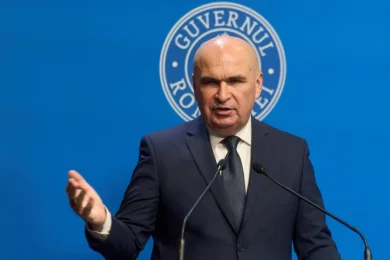
At the most inopportune moment possible, Romania entered a major political crisis. The government led by liberal Prime Minister Ilie Bolojan fell on May 5, 2026, after losing a vote of no confidence in Parliament, the motion gathering 281 votes in favor, well above the 233 needed. The motion was initiated by the Social Democratic Party (PSD), the largest party in parliament, which allied with the nationalist opposition (AUR and PACE – Romania United) to oust the executive.
The crisis was triggered, at least declaratively, by disagreements over the state budget for 2026 and other aspects of domestic economic policy. The PSD issued an ultimatum to the Prime Minister: resign or withdraw all ministers from the government. After Bolojan refused to resign, the PSD exited the coalition on April 23, and the social-democratic ministers and the party's deputy prime minister resigned. In the text of the motion, the signatories accused the Prime Minister of "destroying the economy," "impoverishing the population," and planning a "fraudulent sale of state assets."
Interim government in the era of crisis
The government is now continuing in an interim capacity, with limited powers, until a new executive is formed. President Nicușor Dan announced that he will hold consultations with political parties to form a new government, ensuring that it will also be pro-Western and will be appointed within a reasonable timeframe, but excluded the possibility of early elections. Consultations began on May 6, 2026, with separate meetings with the leaders of the main political forces that had been part of the former governing coalition.
The toxic synergistic effect
The combination of external economic vulnerability and internal political instability creates a toxic synergistic effect for Romania. The President warned of possible "political disturbances" and expressed hope that a formula can be found to continue Romania's pro-Western government and that it will be a stable one. The period of governmental provisionality – even a short one – drastically reduces the state's ability to respond effectively to external economic shocks.
At a time when quick decisions are needed regarding the allocation of strategic reserves, negotiating import contracts at volatile prices, calibrating social protection measures for families affected by inflation, and coordinating with European partners for energy supply diversification, Romania finds itself without a fully mandated government. The emergency measures adopted in March – capping fuel markups and monitoring the market – risk remaining insufficient or not being optimally implemented in the absence of stable political leadership.
Outlook and risks
Experts warn that developing countries are already facing high debt service burdens, limited fiscal space, and restricted access to financing. In this context, rising energy, transportation, and food costs could put pressure on public finances and increase pressure on household budgets, intensifying potential economic and social pressures and complicating progress towards sustainable development, especially in economies heavily dependent on imported energy, grains, and staple foods.
For Romania, the most concerning scenario is not just the prolongation of the blockade of the Strait of Hormuz, but the inability to quickly form a stable government that can manage the multidimensional crisis. Without effective political coordination, technical measures – however well-designed – risk remaining underutilized just when they are most needed.
Analysis conducted with the support of Perplexity
Latest News
21:00
20:54
20:44
20:40
See more news
NEWS ON THE SAME TOPICS






















.webp)