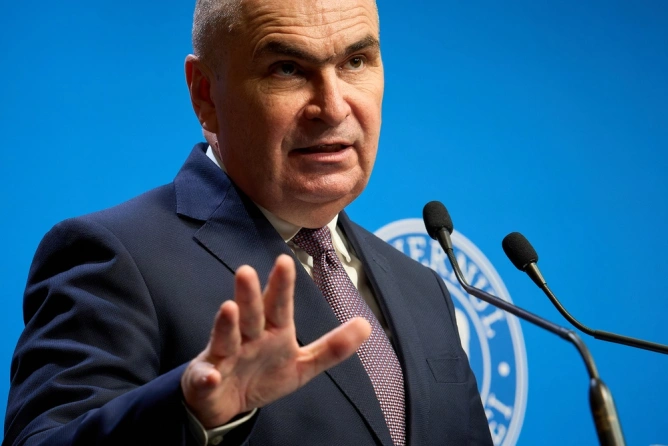
USR will submit draft laws for the abolition of six public institutions considered unnecessary, in the context of reducing budgetary expenditures.



Always see our news on Google
The USR announced its intention to submit draft laws for the dissolution of six public institutions that it considers to be "of demonstrably no utility, created and funded with citizens' money solely to ensure sinecures for the allies of the old parties".
Senator Cristian Ghinea stated that this decision comes after discussions on the state budget for 2026 and the promises from the governing coalition to reduce public spending.
The targeted institutions include:
1.Academy of Scientists: "Pseudo-academy, with 199 members (with monthly allowances between 837 and 1,675 lei) and 67 employees. Members include numerous former politicians, dignitaries, individuals with criminal convictions, or associated with repressive structures of the former communist regime, which compromises any claim to academic excellence. The approximately 12 million lei that would be saved by dissolving the AOSR can be redirected to research programs with demonstrable impact".
2.Academy of Medical Sciences: "Pseudo-academy under the Ministry of Health, with 160 full members (in stark contrast to the 8 positions held by the medical sciences section of the Romanian Academy). Full members receive a lifelong monthly allowance equal to the average salary in the economy, even though the ASM has not had relevant public positions since 2012 and has not played any visible role during the COVID-19 pandemic, one of the most severe health crises in recent history. Estimated savings: over 3.5 million lei annually".
3.Academy of Technical Sciences: "Self-defined as an 'academy', the institution does not produce research, does not develop relevant projects, and has no impact on industry or technical education, having the sole purpose of paying allowances for its 95 members (55 full members, 40 corresponding members). The proof lies in the fact that 99.25% of the annual budget of ASTR (of approximately 4 million lei) is used for members' allowances, salaries, and operating expenses".
4.Institute for Advanced Studies in Culture and Civilization of the Levant: "Another structure with global academic claims, but without results, which operates almost exclusively from subsidies received from the state budget. In 2025, it had a budget of 3.36 million lei, of which 2.7 million lei was spent on salaries and 0.5 million lei for goods and services. 0 lei for publications".
5.Romanian Institute for Human Rights: "A phantom institute, without real impact in the field of human rights, but with constant funding from public money. IRDO is led by a board of directors consisting of 7 members, a director, and a deputy director, for a staff of approximately 22 employees, of which 7 are administrative personnel. In over 30 years of existence, IRDO has had only two directors, without term limits, without performance criteria, and without real transparency obligations. In 2025, it had a budget of 1.5 million lei, of which approximately 1 million lei was for salaries, the rest for current expenses".
6.Institute of the Romanian Revolution of December 1989: "Another pseudo-institute, without a real contribution to historical knowledge. Since its establishment in 2004, the IRRD has been organized as a political structure, not as a research institute: the first 25 members of the National College were appointed directly by Ion Iliescu, having lifetime status. The same Ion Iliescu was also the first president of the institute, a position he held until 2021. IRDD has nearly 40 employees, and in 2025 it had a budget of 2.3 million lei".
Each of these institutions is criticized for its lack of impact and efficiency, and their dissolution could save millions of lei annually, money that could be redirected to programs with demonstrable results.
The USR emphasizes that it will continue to insist on this initiative to hold the parties in Parliament accountable.
Sources





Latest News
21:54
21:39
21:25
21:22
21:04
See more news
NEWS ON THE SAME TOPICS

.webp)






.webp)