EXCLUSIVE | Informat.ro Barometer – INSCOP Research: The agenda of Romanians for 2026: economic priorities and security concerns



Always see our news on Google
In a context marked by economic and geopolitical uncertainties, the continuous increase in the cost of living, and the ongoing conflict near Romania's borders, the year 2026 is perceived as one with multiple challenges from the perspective of the citizen's agenda, as highlighted by the latest Barometer Informat.ro – INSCOP Research data.
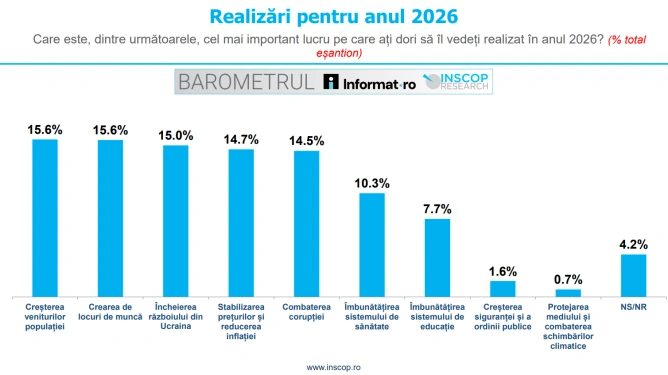
15.6% of respondents indicate that the main objective is increasing incomes, the same percentage being recorded for job creation. Additionally, 15% of participants mention the end of the war in Ukraine as the most important expectation for this year. Other identified priorities include stabilizing prices and reducing inflation (14.7%), combating corruption (14.5%), and improving the healthcare system (10.3%). Improving the education system is mentioned by 7.7% of respondents, while increasing safety and public order is indicated by 1.6%, and protecting the environment and combating climate change by 0.7%.
The socio-demographic analysis highlights significant differences among various categories of respondents regarding priorities for 2026. Increasing incomes is indicated as the main objective especially by PSD (Social Democratic Party) voters (18%) and AUR (Alliance for the Union of Romanians) voters (20%), by individuals with primary education (22%), as well as by residents of small urban areas (20%). Similarly, job creation is mentioned in a higher proportion by AUR voters (23%), by young people under 30 years old (21%), by individuals with primary education (26%), and by respondents from small urban areas (20%) and rural areas (20%). The data indicate an association between the two priorities among AUR voters, individuals with primary education, and residents of small urban areas. At the same time, young people under 30 are more concerned about job creation (21%) than about increasing incomes (15%), considering that they are at the beginning of their professional lives, just entering the labor market.
The end of the war in Ukraine is considered a priority especially by PNL (National Liberal Party) voters (26%) and PSD voters (20%), as well as by individuals over 60 years old (20%). Although socio-demographic categories reach similar levels of concern when it comes to stabilizing prices and reducing inflation, high percentages are noted among the active population in the labor market, regardless of the sector of activity (24% for public sector employees and 22% for private sector employees). In contrast, combating corruption seems to be an objective that continues to be valued by the right-wing electorate, namely USR (Save Romania Union) voters (25%) and PNL voters (20%), individuals with higher education (21%), and residents of Bucharest (22%) and large urban areas (20%).
Thus, the percentages show that in 2026, economic priorities clearly dominate the public agenda, with a need for financial stability and jobs, felt more strongly among those categories that have a higher exposure to the consequences of the financial vicissitudes affecting Romania.
Methodology: The data from the seventh edition of the BAROMETER Informat.ro – INSCOP Research were collected between January 12-15, 2026. Research method: interview via questionnaire. The data were collected using the CATI method (telephone interviews), with a simple stratified sample volume of 1100 individuals, representative of significant socio-demographic categories (gender, age, occupation) for the non-institutionalized population of Romania, aged 18 and over. The maximum allowable error of the data is ± 3%, at a confidence level of 95%.
Latest News
17:11
17:03
17:00
16:59
16:54
See more news
NEWS ON THE SAME TOPICS
.webp)