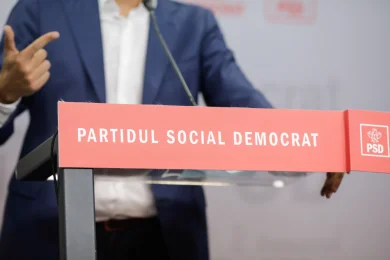
PSD ANALYSIS and the budget for 2026: how closely is the party positioning itself against European social democracy?


.webp)

Always see our news on Google
In the budget negotiations for 2026, the PSD asserts its profile as a national center-left party, focused on the solidarity package and support for local authorities, but positions itself as more value-conservative and fiscally pragmatic than many Western social-democratic parties, which insist more strongly on expanding the welfare state and on new fiscal resources at the national and European levels.
Context: the current identity of PSD
The PSD officially defines itself as a "modern center-left party, promoter of social equity and solidarity," attached to democratic, national, religious, traditional, and cultural values, with a pro-European orientation and commitment to Euro-Atlantic cooperation. Recent statutory changes mark the assumed abandonment of the "progressive" party label, with leaders like Sorin Grindeanu insisting on the idea of a "national and balanced" party that rejects "ideological experiments." Doctrinally, the PSD seeks to recover the conservative and ethno-national electorate that has gravitated towards parties like AUR and SOS Romania, while maintaining a platform for social redistribution and public investment.
At the same time, the PSD remains the main mass party in Romania, with a solid electoral base among pensioners, public sector employees, and local communities dependent on budgetary investments and infrastructure funds.
Budget negotiations: PSD's stakes
In the current negotiations regarding Romania's budget for 2026, the PSD concentrates its political pressure on the solidarity package and the funding of programs aimed at municipalities. Social democrats are asking for approximately 10 billion lei: 3 billion for the solidarity package, intended for targeted aid for vulnerable categories, and approximately 7 billion for covering the Anghel Saligny and PNDL programs, already approved for local investments. The refusal of the Ministry of Finance to fully allocate these amounts has caused blockages in the governing coalition, with the PSD publicly warning that the rejection of its proposals could generate an "unjustified and irresponsible political blockage" with a negative impact on budget execution.
Thus, the party signals two central priorities: protecting the targeted social aid package and maintaining funding for local infrastructure, key for its territorial power networks. Meanwhile, discussions are taking place in the context of the 2024-2026 fiscal-budgetary strategy, which foresees the need for a gradual reduction of the deficit and clear constraints on budgetary maneuvering space, including by limiting the growth of budgetary revenues as a share of GDP. The PSD thus maneuvers between internal pressure for increased social and investment spending and macro-fiscal commitments assumed at the European level.
How PSD positions itself against other social-democratic parties
At the European level, the social-democratic family, the S&D group in the European Parliament and its member parties, advocates for a consolidated European budget, above the 1% threshold of GNI, supported by new "own resources," such as pollution taxes, a wealth tax, or a financial transaction tax. Their agenda emphasizes funding for the green and digital transition, maintaining social cohesion, and integrated social conditionalities across all lines of expenditure, including through explicit monitoring of expenditures with social impact. From this perspective, the declared objective is to create a budget that prioritizes the creation of quality jobs, investments in research, innovation, training, and strengthening key public services.
In Spain, the government led by the socialists of PSOE, under Prime Minister Pedro Sánchez, has set as priorities for the new political cycle competitiveness, dignity of work, strengthening the welfare state, housing, equality, and peace, announcing "ambitious social budgets" that will expand public investments and social protection. At the same time, the Spanish executive has sought to protect or expand social measures even in the context of returning to budgetary discipline rules, for example by facilitating the use of local surpluses for "financially sustainable" social policies and investments. In Germany, the SPD faces reverse pressures, being involved in coalitions that prepare cuts to social spending and the reduction of some assistance programs, which fuels internal debates regarding the legitimacy of cuts in a context of increasing military spending.
The PSD aligns itself with the social-democratic family through rhetoric on social equity and the need for protective measures for vulnerable categories, now reflected in the insistence on the solidarity package. At the same time, the party remains less vocal than S&D or PSOE regarding the introduction of new progressive fiscal resources, at the national or European level, preferring a more cautious approach, focused on redistribution within existing budgetary constraints and prioritizing programs with direct political and electoral impact.
Budget, austerity, and the welfare state: convergences and differences
The European debate on the fiscal policy of social democracy is marked by the tension between commitment to the welfare state and the constraints imposed by strict fiscal rules. Recent analyses show that social-democratic parties have contributed, in various contexts, to austerity reforms of the welfare state, justifying cuts or restructurings through discourses about sustainability and efficiency. The S&D group has tried to correct this trend by introducing a "social footprint" in the new European fiscal rules and by excluding national co-financing for EU projects from the calculation of net expenditures, to create additional space for public investment.
In Romania, the 2024-2026 fiscal-budgetary strategy foresees a gradual reduction of the deficit and maintaining budgetary revenues at approximately 32-33% of GDP, which limits the margin for structural budgetary expansion, regardless of the government. The PSD thus operates within a framework where promises of increased social spending must be tightly negotiated with the Ministry of Finance and coalition partners, and the solidarity package becomes a political signaling tool, not a change in budgetary paradigm. Unlike the SPD in Germany, which explicitly accepts the idea of cuts to social spending to comply with the "debt brake" and to strengthen Germany's economic position, the PSD insists on protecting targeted social programs, without assuming the discourse of a "reform autumn" with visible cuts in the area of social protection.
On the other hand, the way PSD links solidarity to local infrastructure programs is particularly different from parties like PSOE in Spain, which place a clearer emphasis on expanding universal social rights and strengthening national public services, from health to education and housing. In the case of PSD, the coherence between social discourse and the actual distribution of resources continues to be mediated by the logic of local networks and the need to maintain control over investment programs aimed at municipalities.
PSD's positioning within the social-democratic family
Compared to the European social-democratic mainstream, the PSD is situated in an intermediate zone: doctrinally, it claims to be center-left, but with a national identity marked by conservatism in value terms; budgetarily, it promotes social packages and public investments, but hesitates to explicitly support the progressive fiscal instruments proposed at the European level for financing the expansion of the welfare state. At the same time, it remains a pro-European and pro-Euro-Atlantic cooperation actor, in line with the S&D positioning on the role of the EU in managing green and digital transitions and social crises, but filters these options through a rhetoric strongly anchored in national identity.
The current budget negotiations in Romania highlight this ambivalence: the PSD presents itself as a guarantor of social solidarity and support for local communities, but also articulates its claims within a restrictive fiscal framework, without proposing a structural change of model, such as sustained growth of budgetary revenues or the introduction of new taxes on large fortunes or pollution, as promoted by European social-democratic platforms. In this context, the PSD appears more as a defensive actor, trying to protect already assumed social measures, rather than as a promoter of a large-scale fiscal change, like that supported by the European social-democratic family.
*****Synthesis made with the help of a data monitoring flow provided by the media monitoring platform NewsVibe Romania. The analysis, data, and images presented have been enhanced with the help of Machine Learning and Artificial Intelligence tools
Latest News
22:59
22:55
22:44
22:40
22:40
See more news
NEWS ON THE SAME TOPICS