ANALYSIS Economic relaunch, between concrete proposals and vague statements




Always see our news on Google
The coalition promises a "relaunch of investment" in an economy that, without these measures, would barely grow by about 1% in 2026, and the real effect will depend on the speed of implementation and the credibility of fiscal policy.
PSD – the "growth engine" package
PSD proposes a relaunch program focused on large production investments, strong tax incentives, and subsidies for jobs.
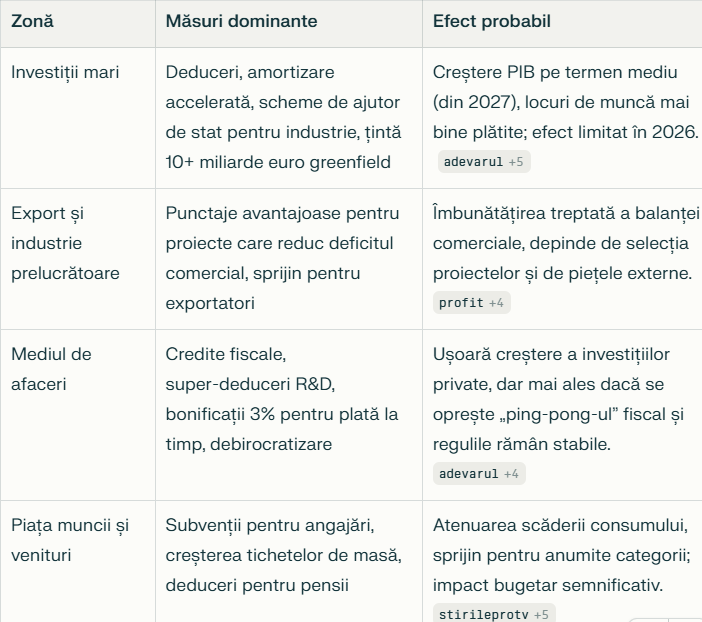
Declared goals: economic growth of over 3% in 3 years and over 5% in 5 years, over 120,000 new jobs in industry and high-tech sectors, reduction of the deficit and regional disparities.
Instruments: tax credits of up to 50% of the investment value in underdeveloped areas, accelerated depreciation, exemption from tax on reinvested profits, super deductions for R&D and for companies that list on the stock exchange, a 3% bonus for timely tax payments.
Social labor market measures: monthly subsidies for hiring young people and mothers returning to work, increasing the value of meal vouchers, additional deductions for private pensions.
Estimated effects: • If the package is implemented fully and quickly, it could raise growth from ~1% (the current official scenario) to 2–2.5% in 2026, through a boost in investments and exports, but the "3%+" effect is more realistic from 2027 onwards (it takes time for new capacities to open and operate).
• 120,000 additional jobs is an ambitious target: achievable only if large industrial projects are actually signed and financed; otherwise, it remains an optimistic campaign scenario.
• Salary subsidies for young people and mothers and the increase in meal vouchers would support disposable incomes and mitigate the contraction of consumption in the short term, but would put additional pressure on the deficit if not covered by new revenues generated by investments.
PNL – competitiveness, exports, EU funds
PNL links its proposals to the same package but emphasizes the trade balance, added value, and absorption of European funds.
• Priorities: supporting exporting firms, encouraging the manufacturing industry, facilitating private investments, and restructuring state aid schemes to correct the trade deficit.
• The budget for 2026 is built with investments of approximately 20 billion euros (public + EU funds), with the government promising "record investments" financed half from the PNRR.
• However, official forecasts speak of a "prudent" growth of about 1% in 2026, with declining inflation and a reduced positive contribution from net exports.
Estimated effects:
• If the 20 billion euros in investments actually materialize (not just budgeted), the growth impulse could reach an additional 1–1.5 percentage points, but historically the execution rate is below 100%, so the likely effect is more modest.
• The focus on exports and the manufacturing industry could gradually improve the current account deficit, but the impact on the trade balance will be seen in several years, not in one or two quarters.
• Tax incentives and simplification of support schemes can increase business confidence, but the effect is conditioned by the stability of the rules (without new waves of taxes).
Absentees: AUR, USR, UDMR, POT
AUR, USR, UDMR, and POT have not come up with alternative relaunch packages as detailed and quantified as PSD–PNL; they mainly express criticism of austerity and fiscal instability.
• AUR and USR draw attention to the tax burden and budget cuts, but without an integrated program like "10 billion for investments, X jobs," so their impact is more political than macroeconomic at this moment.
• UDMR and POT are mentioned as having specific proposals in negotiations (e.g., detailed adjustments in the package), not parallel economic visions that would significantly change the macro trajectory.
Estimated effects:
• Without concrete alternative plans, the role of these parties is more to influence the final form of the PSD–PNL package or public perception, rather than to generate another "growth trajectory" in 2026.
Public figures, employers, unions – "course correctors"
The business environment, through organizations like AOAR or employer confederations, proposes its own set of measures: tax simplification, reducing bureaucracy, stability of rules, and an additional package of approximately 10 billion euros in private investments.
• If a significant part of these proposals is adopted, the combined effect with the government plan could push growth above the 1–1.1% scenario of the European Commission, towards 2%+, but with the risk of a difficult-to-control deficit.
• Unions and social organizations press for income protection, pension indexing, and reducing the impact of austerity, which could temper fiscal adjustments but risk narrowing the space for investments if credible additional revenues do not appear.
Conclusion on the economic context
Official and European forecasts speak of a very modest growth year in 2026, around 1–1.1%, hampered by fiscal consolidation, even with the relaunch package.
The PSD–PNL package can transform this stagnation into a moderate relaunch if investments and fiscal facilities are quickly turned from promises into contracts and construction sites, but the internal targets (3%+ in 3 years, 5% in 5 years) are visibly more optimistic than the assessments of the European Commission and many economists.
Analysis conducted with the support of Perplexity
Latest News
23:03
22:44
22:40
22:37
22:34
See more news
NEWS ON THE SAME TOPICS