ANALYSIS. The natural gas market enters in April 2026 with "aligned" prices at risk, not at cost



Always see our news on Google
The offers appearing on the ANRE page for April 1, 2026 — between 0.32 and 0.41 lei/kWh including VAT — are not just a set of new prices. They are, in fact, a signal. A signal that the supply market no longer prices energy based on the cost of goods, but based on the size of risk, commercial prudence, and — for some players — a clear return to high margins.
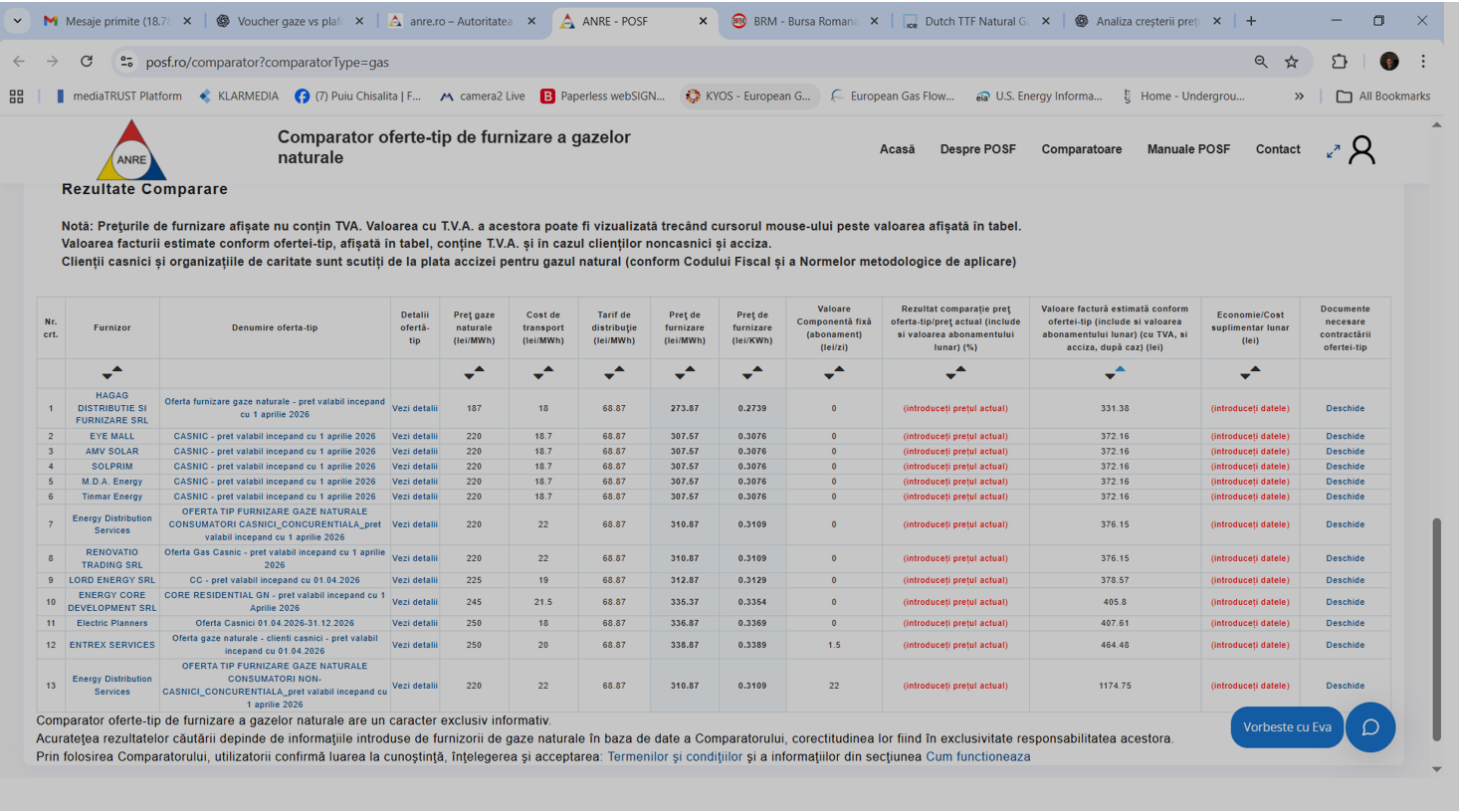 When the costs of natural gas, considering the traded price on the Romanian Commodity Exchange for the second and third quarters of 2026, are 0.31 lei/kWh, when the costs of natural gas, considering the traded price on the European Gas TTF for 2026, are 0.29 lei/kWh, when the billed price in December 2025 was 0.29 lei/kWh, an offer of 0.32 lei/kWh means a 3% increase compared to the capped price. It is an almost neutral move: perhaps a higher administrative cost, a portfolio adjustment, a normal update. In contrast, the upper end of the range, 0.41 lei/kWh, means +32% compared to the capped price — and here we are no longer talking about adjustments, but about a brutal repositioning.
And the natural question is: why, in a market where the product is the same, does the difference reach almost a third? The answer is not found in natural gas itself, but in the way suppliers calculate survival and profitability after several years in which the "normal" of the market has been replaced with exceptions: volatility, interventions, caps, unpaid subsidies, cash flow pressure, and a lesson learned the hard way by many — that a low price today can mean massive losses tomorrow.
When the costs of natural gas, considering the traded price on the Romanian Commodity Exchange for the second and third quarters of 2026, are 0.31 lei/kWh, when the costs of natural gas, considering the traded price on the European Gas TTF for 2026, are 0.29 lei/kWh, when the billed price in December 2025 was 0.29 lei/kWh, an offer of 0.32 lei/kWh means a 3% increase compared to the capped price. It is an almost neutral move: perhaps a higher administrative cost, a portfolio adjustment, a normal update. In contrast, the upper end of the range, 0.41 lei/kWh, means +32% compared to the capped price — and here we are no longer talking about adjustments, but about a brutal repositioning.
And the natural question is: why, in a market where the product is the same, does the difference reach almost a third? The answer is not found in natural gas itself, but in the way suppliers calculate survival and profitability after several years in which the "normal" of the market has been replaced with exceptions: volatility, interventions, caps, unpaid subsidies, cash flow pressure, and a lesson learned the hard way by many — that a low price today can mean massive losses tomorrow.
In this context, we observe that commercial margins are widening. If currently we see margins of around 4%, for 2026 offers appear that suggest the equivalent of margins rising to about 22%. Of course, part of this "margin" is, in reality, a risk envelope: imbalance costs, losses, financing, non-collections, uncertainties. But part becomes clear, some suppliers are no longer chasing volume, but clean and predictable profit.
And when the final price increases, the fiscal effect inevitably appears. VAT does not "change" proportionally, but as an amount on the bill increases directly proportionally with the base. Therefore, a 32% increase in the final price also leads to an increase of approximately 32% in the amounts paid as VAT. For the consumer, this means a simple thing, not only that they pay more to the supplier, but they also pay more to the state. The bill becomes heavier from both directions.
In parallel, the gas market for 2026 offers another relevant clue. Data shows a price of 0.16 lei/kWh on BRM, compared to 0.127 lei/kWh on TTF. A difference of about 26%, which suggests that Romania continues to internalize a "premium" price compared to the European hub: either due to liquidity reasons, market structure, internal constraints, or due to costs and perceived risk, or due to greed. Gas is not just a separate commodity; in Europe, it remains one of the main benchmarks for the marginal price of electricity. In other words, this spread can be seen in the chain, even if it does not fully explain the large increases in electricity retail.
What is important to understand is that these offers for 2026 do not necessarily show an explosion of the real cost of gas, but rather a paradigm shift, suppliers foresee the future as a period in which "cheap" means "dangerous". And the consumer finds themselves in the middle of a market where the price reflects not only kilowatt-hours but also the fear of instability, the desire for profit, and commercial freedom.
In the end, the range of 0.32–0.41 lei/kWh is not just a difference of 9 bani. It is a difference of economic model. Some suppliers will quote, others will margin and select. For consumers, this means that, in 2026, the most important thing will not be gas — but the lack of attention to the offer.
What this means for the client:
- Higher payments for a 2-room apartment of: 150 – 1500 lei/year
- Higher payments for a house of: 300 – 3000 lei/year
 This situation is primarily due to the way in which (not) the preparation for the removal of the gas cap was managed. These offers, if they had been made gradually, mandatorily, month by month in the last year, without the pressure of blocking transactions on BRM in recent months, without "we continue", "we do not continue" capping that has pushed up the commodity gas price in Romania, with the obligation to publish the supplier's commercial margin on the bill, with a clear commitment "we give back the surplus VAT, from the price increase in recent years to the consumer", we would have had fair prices in Romania and these should have been lower than the capped price.
The speed with which contracts for April 1, 2026, will be realized, due to all these analyses upon analyses, which have artificially created this time crisis, pushes Romanians to "swallow" these prices by tacitly signing contracts without knowing what prices for gas.
Latest News
13:08
12:56
12:45
12:39
12:33
See more news
NEWS ON THE SAME TOPICS