ANALYSIS. From capping to "managed price" - economic effects of a difficult transition




Always see our news on Google
Prime Minister Ilie Bolojan announced on Wednesday that the current price cap scheme for natural gas will be replaced, for a duration of one year, with an "administered price" mechanism, designed as a transitional solution towards the complete liberalization of the market.
At the same time, the Prime Minister of Romania argues that the start of natural gas exploitation in the Black Sea, estimated for the year 2027, will lead to a decrease in gas prices for consumers in Romania, suggesting that due to imports, gas is expensive in Romania.
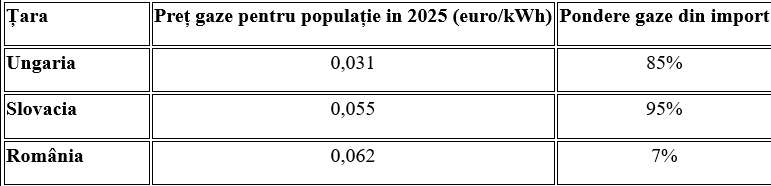
A comparative analysis of natural gas prices in Romania and neighboring countries shows, however, a different reality. Although the countries in the region are dependent on imports for 85-95%, they will record, in 2025, final prices for the population lower than those in Romania, even under the conditions of a capped price on the domestic market. In this context, the argument for increasing domestic production – intended to cover approximately 7% of import needs – would represent a solution for reducing gas prices in Romania that proves to be unfounded.
According to official statements, during the transition period, the price of gas will be administered throughout the entire chain of producer, distributor, and supplier and will apply to all household consumers and thermal energy production plants (CETs), with the aim of ensuring tariff stability for one year. For other consumers, namely non-household ones, prices will be left at market levels.
The administrative setting of prices for a part of consumers will generate major distortions in the market.
This approach favors certain players and disadvantages others, while the real costs will be transferred to other consumers. In practice, all household consumers, regardless of income level (including those with incomes over 3,000 euros per month), will benefit from a fixed price, while non-household consumers will bear the costs associated with this scheme.
To illustrate the effects, we can perform a simplified calculation:
a) The reappearance of "smart tariffs"
Assuming that the administered price for the population will be maintained at the current level of the capped price, namely 0.31 lei/kWh including VAT, and that the price of gas from domestic production will remain at 120 lei/MWh, the differences between distribution tariffs will lead to significant profit margins for suppliers. In this way, the state will facilitate who wins and who loses. For some suppliers, the administered price will mean margins of about 2%, insufficient to cover operational costs, which could lead to bankruptcy in a few months. For others, the price will generate margins of up to 24%, representing a gain favored by the Prime Minister's proposal.
b) Impact on industry and the services sector
By maintaining the free market exclusively for non-household consumers, they will end up bearing both their own costs and part of the financial burden of household consumers. Suppliers will purchase gas for them from the free market, and prices will naturally increase as a result of attempts to recover losses generated by administered prices for household consumers.
In the cold season, the additional gas consumption is mainly driven by the population, and this demand is largely covered by gas purchased in 2026 at prices up to 83% higher than the administered price for gas from domestic production. These costs will be transferred to the industry, leading to significant price increases for industrial consumers.
In a simulation based on gas prices on the Romanian Commodity Exchange for the year 2026, adding the average costs associated with covering the costs generated by peak consumption from the population, transport and distribution tariffs (estimated for Bucharest at 90 lei/MWh) and a commercial margin of 6.5% (equivalent to the BNR interest rate), lei/MWh. This means an increase of about 15% compared to the price paid by industry in 2025, with direct effects on production costs and, implicitly, an estimated increase of about 2% in electricity prices.
Beyond the deeply unfair nature, this cross-subsidization raises serious legal questions.
c) Increasing poverty
The proposed measure actually favors consumers with high incomes. Natural gas and electricity represent about 15% of the minimum consumption basket for a decent living. The indirect increase in energy prices, determined by the transfer of costs to the industry, will raise the value of the minimum consumption basket – currently estimated at 11,370 lei per month for a family with two adults and two children – by approximately 568.5 lei per month.
For a family living on the minimum wage, this increase means an increase in expenses of about 11%, while for a family with an income of 30,000 lei per month, the impact is only 1.8%. Thus, a measure presented as support for vulnerable individuals ends up disproportionately benefiting high-income households.
d) The myth of Black Sea gas
The exploitation of natural gas involves constant extraction throughout the year, regardless of the season. Under the conditions in which summer consumption in Romania is low, the storage needs are already covered by onshore production. Therefore, during peak consumption periods, such as in January 2026, additional imports will be necessary to ensure the continuity of supply to consumers, considering the contractual obligations regarding offshore gas. Consequently, it is most likely that the exploitation of gas in the Black Sea will not eliminate all imports.
In a system where prices are administratively set, "by pen", real competition disappears, and cost efficiency becomes impossible. Instead of stabilizing, costs will continue to rise, with negative effects on the economy and living standards, even if gas comes from the Black Sea.
Latest News
07:42
07:33
07:32
07:19
22:52
See more news
NEWS ON THE SAME TOPICS