How much could the price of natural gas decrease after the start of gas exploitation in the Black Sea




Always see our news on Google
It is plausible that, after the start of production in the Neptun Deep project (starting in 2027), a downward pressure will appear on the price of gas in Romania — especially on the cost and internal supply side. However, it is not guaranteed that the price for the end consumer (household) will decrease – it depends on many factors (demand, regulation, infrastructure, taxation, import prices).
An estimate that takes into account that demand and/or supply does not explode due to other reasons could bring a moderate reduction in wholesale prices of 5-20% compared to the current level, in the medium term (2027-2028).
There are several factors that could determine that the exploitation of offshore natural gas in the Black Sea area, especially through the Neptun Deep project (Romania), could have an impact on gas prices after 2027 — but also many uncertainties that make a clear prediction difficult.
Why gas prices in Romania could decrease:
1. Significant increase in gas production in Romania:
- it is expected that Neptun Deep will start production in 2027 and will add about 8 billion cubic meters/year;
- domestic gas production could nearly double by 2030 in Romania, against a backdrop of domestic gas demand that will remain around 10-11 billion cubic meters/year;
- a larger supply of domestic gas can, in theory, reduce dependence on imports (which are often more expensive) and thus influence prices downwards in the domestic market.
2. Good connectivity and infrastructure:
- Romania has expanded gas networks to accommodate offshore gas volumes
- a more integrated market (with exports, competition, possibly more sources) reduces logistical and transaction costs, which can contribute to more competitive prices.
Why it is not guaranteed that gas prices will decrease:
1. Domestic and external demand
- if domestic demand in Romania increases (for example, through new gas plants, replacing coal with gas in existing plants), then part of the production will be absorbed internally, and the impact on price may be smaller. If all gas plants are put into operation, a consumption increase of about 25% is estimated by 2030.
- if exports become significant, reference prices for exports can set the internal level – if the export receives a higher price, the internal price may remain at imposed/fixed or competitive levels.
2. Fiscal and regulatory policy
- taxes, royalties, offshore legislation, and how the gas market is regulated can influence the final cost of gas.
- if the state continues to impose other taxes or higher taxes on offshore gas, the cost for the producer increases, which can keep the price higher.
3. Global / geopolitical market
- gas prices are influenced by international factors: supply, liquefied natural gas (LNG) prices, EU energy policy, etc. Even if local costs with gas are low, if the import price is high or competition is reduced, the internal price may not decrease.
4. Impact on the end consumer
- even if the wholesale price decreases, it does not automatically mean that the end consumer price will decrease significantly — regulations, taxes, transport and distribution tariffs can reduce the impact.
Considering the available data, it is plausible that, after the start of production in the Neptun Deep project (starting in 2027), a downward pressure will appear on the price of gas in Romania — especially on the internal supply side.
The gas market does not operate according to the simple logic of abundance. Gas extracted from the Black Sea will not be reserved exclusively for Romanian consumers nor will it be sold at a "patriotic" price. It will enter an integrated European market, where producers naturally seek the best available price. If Bulgaria, Hungary, or other regional markets offer a higher price, the gas will go there.
Moreover, Romania is preparing to consume more gas, not less. The new gas power plants built to replace coal will absorb significant volumes of additional production. Estimates show that domestic demand could increase by about 25% by 2030. In other words, a good part of the promised surplus is already "sold" before it is extracted.
There is then the problem that politicians constantly ignore: the price of gas represents only a part of the bill paid by the consumer. Transport and distribution tariffs are rising, taxes are changing, and costs imposed by regulations are becoming increasingly important. Even if gas as a commodity becomes cheaper, the final bill may remain at the same level or even increase.
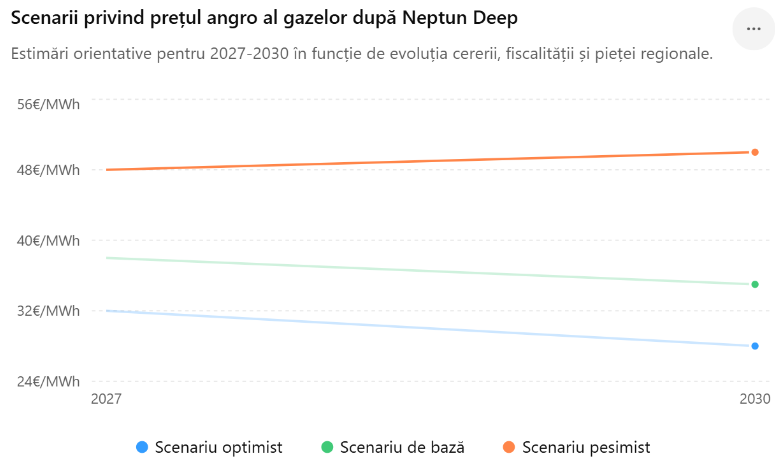
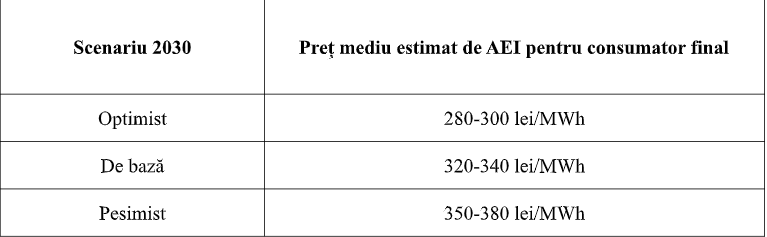
Economic models created for the period 2027-2030 indicate three possible scenarios. In
the optimistic scenario, the wholesale price of gas could drop to 27-32 euros/MWh after the entry into
production of Neptun Deep. The final price paid by households could reach around 280
lei/MWh, which is approximately 10% lower than the capped price for the population.
This is the reality that public discourse avoids. Gas from the Black Sea does not guarantee much lower bills. It offers Romania more energy security, reduces dependence on imports, and can generate significant revenues for the economy and the Romanian budget. But between the strategic advantage and the direct benefit for the consumer, there is a huge distance.
The real question is not whether Romania will extract gas from the Black Sea. The real question is who will benefit from the value created by these resources: consumers, the Romanian economy, or just the state budget and foreign companies.
If the state continues to treat energy as a source of taxes and additional revenues, Romanians may discover in 2028 that they live in a country that produces more gas than ever, but in which bills are not much lower. And then the promise of "cheap gas from the Black Sea" will fall into the same category as many other energy promises, good for electoral campaigns, but without any connection to the reality in the consumer's pocket.
Latest News
07:35
22:52
22:34
22:28
21:56
See more news
NEWS ON THE SAME TOPICS