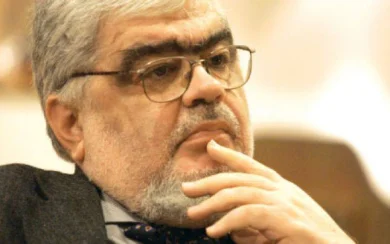
Andrei Pleșu: Notes, States, Days



Always see our news on Google
A few days ago, I received from Mrs. Daniela Georgescu the volume of interviews she recently published with Vremea Publishing House (With God through the Besieged City. Dialogues of Survival). As someone who believes in fateful encounters and communication, more than in the monomania of solitary reflection, I read it with affectionate inner engagement. Not that solitude cannot also be a formative experience. But without openness to otherness, without self-exposure, without the miracle of revelatory encounters, individual development risks suffocating within its own horizon... I inevitably recall my own book of interviews (Face to Face. Encounters and Portraits), beginning with its first lines in the introductory note: “I learned much from books—someone once said—but I learned everything from a few people. To a great extent, we are the sum of the encounters we have had.”
An interview implies a multitude of preconditions, of positively edifying motivations. It is not the search for a “photo” alongside a celebrity. It is the search for a partner serving as a clarifying authority. It may be the result of candid admiration (and I always add, grumpily, that the younger generations seem less prepared to admire, preferring to relativize), it may also be a fortunate coincidence, or the fruit of a diffuse but tireless sounding-out, and it may even be the secret result of a fateful path, set in motion by an authority difficult to define... When I wrote a book about angels, I often thought that angels, as embodiments of mediation between God and man, also create formative mediations between people and their own destiny. Mrs. Georgescu’s book brings into our questioning partners of subtle stature, from Ioan Aurel Pop to Teodor Baconschi, from Vladimir Tismăneanu to Adrian Papahagi, from Radu Preda to Vasile Bănescu, from Monica Pillat to Ana Blandiana or George Ardeleanu, from Daniel Gheorghe to Marian Vîrban and Monica Papazu. You read one book and journey through several lives... Obviously, what always matters is what questions you have to ask, how authentic you are in your perplexities, how receptive you are to the “other.” When questions and answers are well harmonized, the reader becomes an assumed “witness” to his own searches... Congratulations to Mrs. Daniela Georgescu.
July 22, 2026
In an amusing book by Robert Schnakenberg (The Secret Lives of Great Writers, also published in Romanian in 2017), I find a troubling reference to the great Tolstoy. Here it is: “Tolstoy remained an iconoclast until the end of his days. On his deathbed, friends implored him to make peace with the Russian Orthodox Church. Tolstoy would not even hear of it: ‘Even in this valley of the shadow of death,’ he said, ‘two and two do not make six.’ These words are mistakenly interpreted as his last words. In reality, Tolstoy’s last words were much more cryptic, though less profound: ‘But the peasants... How the peasants die!’”
Undated (from my youth)
Radhakrishnan’s commentary on a passage from the Isha Upanishad:
“Immanence is no less ‘full’ than transcendence. It is simply not the original fullness. It is a derived fullness. The derivation, however, is bound up with the Reality from which it derives. It ‘participates’ in the latter’s fullness, so that one might equally say: fullness taken from fullness is still fullness, just as full as the fullness from which it was taken. In Christian terms: God is fully present in His creation. In Hindu terms: Brahma is simultaneously transcendent and immanent.”
Common-sense grumbling: the derivation is a “part.” The “derived fullness” is a “reflection,” it is “autonomous,” meaning it tends to stop relating to the whole. Transcendent fullness does not depend on derived fullness, only the reverse. Or does it?
Latest News
13:27
13:25
13:19
13:09
13:01
See more news
NEWS ON THE SAME TOPICS