EU has connected civilian and military maritime surveillance networks, but regular data exchange is still being prepared



Always see our news on Google
The European Union has established the technical link between civilian and military maritime surveillance networks, but regular information exchange between them is still being prepared, according to the first joint report by the European Commission and the High Representative on implementation of the maritime security strategy revised in 2023. Presented on 3 November, the document reviews naval operations, infrastructure protection and measures against the shadow fleet. It records progress but also shortcomings: the ships and aircraft made available to EU operations remain below the established requirement, while some systems and regional centres are still under development.
In brief The CISE networks, for civilian authorities, and MARSUR, for military cooperation, have been technically connected since October 2024. Regular exchanges between them are being implemented, with a target deadline of the end of 2026. In June, CISE had 14 operational nodes, including a Romanian one, and another eight in preparation. The Commission’s assessment indicates accumulated sanctions against more than 700 shadow-fleet vessels and approximately 100 actors facilitating their activities. This is not the announcement of a new sanctions package, and listing does not automatically grant the right to board a vessel on the high seas. The report credits Operation ASPIDES with close protection for more than 760 commercial vessels and monitoring of more than 2,000 since its launch. Protection and monitoring are distinct activities; European naval operations continue to receive fewer assets than they require. Funding for two regional hubs for cables and maritime surveillance, in the Baltic Sea and the Mediterranean, was approved in June. Separately, Romania and Bulgaria are leading preparations for the concept of a Black Sea security hub; the report does not present it as an already operational centre. In September, the Council approved five defence projects of common interest. The Commission indicates indicative total investments of up to €72 billion for maritime and seabed defence and €5 billion for drones and counter-drone systems. These figures do not represent expenditure already incurred or EU grants awarded in full.
The report examines three years of implementation of the strategy and action plan approved by the Council in October 2023. The six lines of action seek to strengthen activities at sea, cooperation with partners, maritime situational awareness, risk management, capability development and personnel training. The European institutions’ assessment includes contributions from 15 Member States; it is an implementation review, not an independent measurement of the effect of each initiative on security.
The issue at stake is the link between authorities observing the same sea but operating under different mandates and systems. Border police, fisheries-control authorities, customs services and naval forces may hold complementary information about a vessel or incident. Sharing that information can help identify suspicious activities and protect infrastructure, without requiring each institution to build the entire situational picture separately.
CISE, the common information-sharing environment for maritime information, entered its operational phase on 1 July 2024, with support from the European Maritime Safety Agency. In June 2026, it had 14 operational nodes and eight in preparation. The 14 nodes do not represent 14 countries: the list includes 11 national nodes from ten countries, including Romania, and three belonging to EU agencies. Italy has two separate nodes.
The technical connection between CISE and the military MARSUR network was completed in October 2024 through a bridge hosted by the EU Satellite Centre. The report specifies, however, that regular exchanges between the networks are still being implemented and should begin by the end of the year. The technical link therefore does not amount to a permanent flow of civilian and military data already available to all participants.
There are also limitations concerning information sensitivity. Some states are reluctant to transmit data on critical infrastructure through an unclassified system. A CISE version for information classified EU RESTRICTED is planned by the end of 2026. Separately, the upgrade of MARSUR to the EU SECRET level is envisaged through a one-year project scheduled to start in the first quarter of 2027.
The expansion of MARSUR III should be understood in the same context. The inclusion of nodes for the EU’s military planning and conduct structure and for naval operation headquarters has been authorised. The report describes the installation of one node and the preparation of others, not the completion of connections for all these structures. MARSUR is already used for exchanges between participants, but this expansion remains under way.
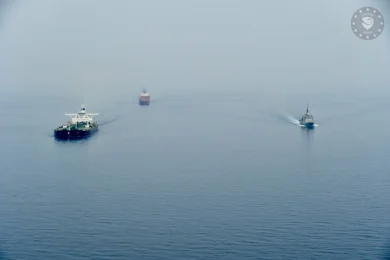
At sea, the assessment covers Operation ATALANTA in the western Indian Ocean, IRINI in the Mediterranean and ASPIDES, launched in February 2024 to protect navigation amid threats in the Red Sea. The report credits ASPIDES with close protection for more than 760 commercial vessels and monitoring of more than 2,000 since the start of its mandate. Monitoring tracks the situation and risks, while close protection involves direct support for navigation; the two figures should not be added together as the number of escorted vessels.
The Commission and the High Representative also acknowledge that the naval and air assets provided by states remain insufficient compared with operational requirements. Coordinated maritime presence was maintained in the Gulf of Guinea but ended in the north-western Indian Ocean, where attention and resources are focused on ATALANTA and ASPIDES. The assessment does not describe a uniform expansion of the European presence across all regions.
The operations’ mandates have also been adapted to track the shadow fleet and report suspicious activities near subsea infrastructure. These monitoring and reporting tasks are distinct from powers to intervene against a vessel. They do not automatically authorise operations to intercept any vessel considered suspicious.
In its presentation, the Commission indicates sanctions against more than 700 vessels and approximately 100 actors facilitating the activity of the shadow fleet, used to circumvent restrictions. This is a cumulative total of measures, not a new list adopted with the report. The document records six flag-verification boardings carried out by IRINI through August 2026, following an update to its rules in the spring. ATALANTA was given the same task in July.
The law of the sea limits such interventions. On the high seas, merely listing a vessel under sanctions does not confer a general right to board it. The conditions set out in international law must be met, for example the existence of reasonable grounds to suspect that the vessel is without nationality. Flag verification, sanctions enforcement and seizure of a vessel are different stages and powers.
Protecting subsea cables is another priority. The European plan of February 2025 was followed by a toolbox for cable security, and in June 2026 funding was approved for two regional hubs, in the Baltic Sea and the Mediterranean. Finland is leading preparations for the Baltic hub. The European maritime exercise held near Helsinki in September tested the protection of subsea infrastructure and information exchange. Funding and testing do not mean that all envisaged capabilities are already operational.
For Romania, the report also has a direct regional dimension. In addition to participating in CISE, Bucharest and Sofia are leading preparations for the concept and priorities of the Black Sea security hub proposed in May 2025. The initiative is separate from the two cable hubs. In Ukraine’s case, European support for developing a joint maritime security centre and situational-awareness capabilities has an end-2028 horizon.
Practical cooperation included nine multipurpose maritime operations in the western Black Sea, the Baltic Sea, the English Channel and the southern North Sea, as well as the Adriatic. These bring together national authorities and EU agencies responsible for maritime safety, fisheries control and borders. The report also describes exercises, training for coast guards, counter-narcotics efforts and support through satellite observation. The number of operations is not a count of new military missions.
Over the longer term, the Union is seeking to develop common maritime defence capabilities. On 28 September, the Council approved five European defence projects of common interest, including maritime and seabed defence, IMSD, and the project for drones and counter-drone systems, DECODER. Their status gives them access to funding through the European programme for the defence industry; it does not certify that the equipment will be delivered.
For the two projects, the Commission presents indicative total investments of up to €72 billion and €5 billion, respectively. These are estimates of the scale of investment, not amounts already paid from the EU budget. The same gap between decision and operational deployment runs through the assessment: connecting networks, funding hubs and approving projects create additional tools, but their effectiveness depends on actual data exchange, the availability of assets and cooperation between authorities and infrastructure operators.
,
Latest News
21:23
21:08
20:52
20:43
20:42
See more news
NEWS ON THE SAME TOPICS