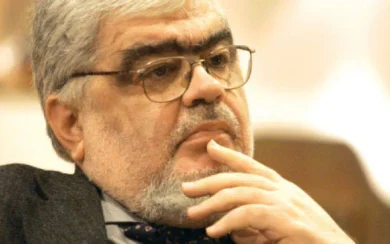
Andrei Pleșu: Another Kind of Apoliticism



Always see our news on Google
Every schoolchild knows that “apoliticism” is equivalent to nonparticipation in the power struggles of political parties. Those who have decided to be “apolitical” are thus distinguished by neutrality, by suspending electorally colored opinions, by a voluntary disengagement from the political sphere. There is, however, a secondary meaning of the term: a lack of political relevance. Not everything a politician does can be read in political terms. When he showers, visits his parents, or cooks for friends, the politician is apolitical. That is, he is a person like everyone else.
It is, however, cause for wonder or legitimate irritation when politicians behave “apolitically” precisely when they are doing politics. That privative “a” with which the word in question begins can sometimes signal, especially on the Romanian public stage, a way of doing “politics” without the “polis,” without concern for the “city,” driven by motivations that have nothing to do with the interests of the community. My feeling is that, here in Romania, most politicians are “apolitical” in this sense. Politics is, for them, a readily available means of acquiring power, while power is the optimal means of obtaining influence, wealth, and public prominence (useful for their own vanity or for the lucrative embellishment of their CV). No connection whatsoever with the “polis,” with the communal organism.
Very many of our politicians engage in political struggle under the sway of strictly personal emotions: idolatry for one leader, hatred for another, revenge, fear of the judiciary, gang spirit, etc. A certain liberal Member of the European Parliament once missed out on a ministerial post because of the country’s president. Ergo: he conducts anti-presidential politics. A certain artist did not receive a studio from the Mayor of the Capital. Ergo: he will be the ally of everyone who is against the scoundrel, regardless of what he undertakes. An admirer of a certain politician turns overnight into that same politician’s mortal enemy because he was dismissed from an important position. A last-minute liberal, servile and bombastic, suddenly turns against his party leader simply because he is not given as much attention as he would like or because he is betting on the advantages of another alliance. Another cannot forgive a former “colleague” for winning, against him, the election for the presidency of his political organization. Private rancor, envy, jealousy, career calculation, boundless ambition, the memory of some old conflict, petty backstage frustrations, the battle for the same position, and other such “human,” all-too-human, psycho-physiological circumstances become the underlying substance of political action, the hidden engine of superficial “convictions,” the rationale for an alliance or a rupture. The rhetoric is “political,” the substratum is egocentric. The words are intense and radical; their source is an impure fermentation, a swamp of vengeful impulses. I will say nothing about the inflation of promotions based on kinship and complicity, the fabrication of laws designed for personal or group benefits, or electoral manipulation through well-funded press offices, so that one’s own image is paradisiacal while that of one’s opponents is pestilential.
This type of behavior, although it unfolds within the perimeter of political “life,” is, by definition, apolitical, because it brackets out the life of the city, the imperative of the “common good.” I am not, of course, advocating politicians stripped of their bones, from whom every trace of human sensitivity and private baggage has been erased. The issue is one of proportion, the inner strength not to put yourself first when matters of state are at stake. No one, I repeat: no one, among those who bustle year after year through the corridors of the local corridors of Power, gives me the impression of possessing such strength. They are all second-rate servants of their own destiny. That is, apolitical.
Latest News
12:19
12:08
11:45
11:31
11:15
See more news
NEWS ON THE SAME TOPICS