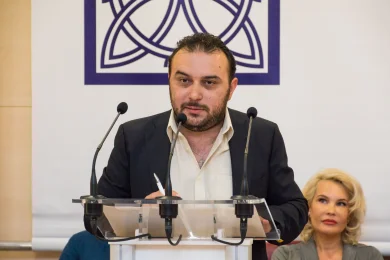
Antonio Momoc, Dilema.ro: Communist nostalgia and authoritarian fascination in the era of digital communication




Always see our news on Google
Communism is not always remembered as a repressive regime, but as a predictable socio-political system: the oral history interviews I coordinated together with Zoltán Rostás, included in the volume "Small Activists," reveal the regret and appreciation of small PCR activists for a regime in which "you knew what was coming tomorrow," even if tomorrow meant, in the 1980s, cold, rationing, and fear. In a post-communist society marked by economic insecurity, precariousness, and anxiety, the selective memory of those who have descended the social ladder in the transition to neoliberal capitalism not only consoles but suggests that freedom can be negotiable when it becomes uncomfortable and economically unpredictable.
Not surprisingly, Ceaușescu remains a strong political brand in the Romanian imaginary. Surveys consistently indicate high percentages of favorable evaluations, including the label of a "respected leader on the international stage." A strong brand does not necessarily equate to sympathy for an ideology, but expresses disappointment with the current political leadership and attraction to a myth and a symbolic construction: authority, sovereignty, order – values that, in the collective mindset, are lacking in the representative figures of parliamentary democracy. The rhetoric of AUR and the narratives of candidates like Călin Georgescu do not directly claim the communist legacy, but selectively recover central elements of the Ceaușist imaginary: Romania's state sovereignty in relation to the USSR, the "independence" of a state from the communist bloc, a courageous president on the world stage, the savior leader, the nation besieged by "foreign interests" and corrupt elites. Georgescu's discourse, characterized by conspiratorial nationalism and authoritarian paternalism, proposes a regime that promises protection and order to the most vulnerable, articulated symbolically around the esoteric phrase "awakening the consciousness of the Romanian people." The populist political formations AUR, POT, SOS, which recover segments of the PRM and PP-DD electorate, instrumentalize communist nostalgia as a mobilizing political resource that normalizes messianic authoritarianism as a legitimate solution within the democratic electoral competition.
Nostalgia for the Ceaușist dictatorship is not uniformly distributed in electoral preferences nor does it produce the same political options. It fragments generationally and reconfigures differently, depending on experience, socialization, and information environment. Socially marginalized individuals and those least adapted to the transition to economic globalization and the dramatic changes generated by the technological revolution feel unrepresented by a political class little concerned with poverty and the lack of opportunities for most. Regardless of age, the mechanism is similar: frustration regarding the feeling of democratic unrepresentation pushes a significant part of the electorate towards authoritarian solutions. In this disappointed perspective of the current political system, only a regime of force can save the country, can reorganize the chaos of a disoriented society, and can reinstall the lost order from the myth of the "golden age," as theorized by Raoul Girardet.
For the older generations who lived through communism, nostalgia comes from the direct memory of a state-ordered life, from a contract between the individual and the party-state: security and social mobility in exchange for conformity and obedience. You were regimented in the Communist Party, you had a house and a job. The "golden age" compared to the "corruption of the political class" of the PSD-PNL-USR-UDMR government coalition fuels contemporary political mythologies: in conspiratorial narratives, in discourses about "betraying the national interest," "selling out to Brussels," "foreign interests," and suspicions about the elimination from electoral competition of providential leaders who "speak the truth that others hide." Dictatorship and authoritarianism as a moral solution to chaos.
For the younger generations who did not live through communism, the mechanism is different: their relationship with the past is one of delegated memory. Communism is known to children and teenagers mainly from the stories of grandparents and parents, from family clichés about "jobs," "state housing," and "lack of worries." Primary and secondary socialization through informal nostalgic narratives has a much deeper impact on the values and attitudes of the young in formation than civic education, the History discipline from textbooks, or journalistic information. The underfunded and discredited public education system, with all its systemic shortcomings, rarely corrects what children and teenagers "know" from home, from family. At the same time, to capture their attention and keep them engaged on digital platforms, the algorithms of social networks, where young people spend a significant amount of time, serve content that reinforces stereotypes and beliefs internalized in primary socialization groups.
Thus, some young people, affected by austerity, lack of opportunities, social injustices, inflation, and unemployment, do not imagine communism in its authoritarian form, but under the guise of the egalitarian utopia: the idea of a society without hierarchies, without class privileges, without social exclusion, in a logic similar to that described by George Orwell in Animal Farm. The promise of the "golden age" is not a national one, but a social one. Hence the attraction to populism and discourses that promise equality, instant justice, total redistribution, the elimination of social stratification, and universal assistance. Authoritarianism is declaratively rejected as a regime, but implicitly accepted as an instrument for achieving social good through dirigiste, interventionist, market control policies. Visible in recent forms of activism and radical left political organization, initiatives and public figures like Ana Ciceală or the SENS party express a legitimate critique of social inequalities, but often do so through a radical discourse that promises total, quick, unrealistic, and moralizing solutions. Institutional bureaucracy, economic constraints, tolerance, and pluralism of opinions are treated as secondary obstacles in the way of "social justice," and the state is imagined as an omnipotent agent of equalization. Dictatorship is not explicitly assumed, but is implicitly rehabilitated as a reflex and intransigent instrument of the "collective good."
The two nostalgias – national-communist and egalitarian-utopian – seemingly opposed, are fueled by the same economic and media context. The new rise of right and left extremism – reminiscent of the "rhinoization" of the 1930s – occurs in a digital ecology that favors emotion, radicalization, and antagonism. The algorithms of digital platforms reward outrage, penalize logical nuances, spread hate-filled messages, and isolate users in communities that stigmatize each other, enclave themselves, and exclude from the bubble those who do not fully confirm their own beliefs.
As Aristotle observed, tyranny is most easily reached through democracy. Not through force, but through the degradation of democracy from within, through demagoguery, through the popular preference for charismatic, seductive leaders and skilled orators in the public square. New digital technologies have made accessible to demagogues communication platforms for the "mass man" of Ortega y Gasset. In the online environment, left and right radicalisms validate and feed off each other. Ultra-progressivism has self-promoted through cancel culture as the ideal adversary for fascist ultra-conservatism. Right-wing extremism, in turn, legitimizes the excesses of politically correct language and ultra-progressivism that demolish statues. Each camp justifies its rigidity by the existence of the other. Within them, moderation cannot be accepted, and the democratic political center – as a space of compromise and accepted imperfection – erodes to the point of disappearance. Dictatorship subtly insinuates itself into public opinion and electoral preferences not through "special military operations," but through the war of perceptions with likes on Facebook, hearts on TikTok, deep-fakes in newsfeeds, manipulated video content, and recycled clichés.
In this media landscape of the transition from traditional media (old media) to new media (new media), from print and television to the Internet, from print to prompter, from literate thinking to copy-paste thinking, recycled communist nostalgia and repackaged egalitarian utopia function as two converging paths towards the same result: the loss of trust in representative institutions and the diminishing support for liberal democracy, until populist authoritarianism no longer needs tanks and coups, but only the consent of a tired society, seduced by the media spectacle and digitally surveilled, willing to applaud the circus of new tyrants and the loss of their own freedom.
Latest News
15:22
15:15
15:10
15:07
15:04
See more news
NEWS ON THE SAME TOPICS