Nostalgia for Ceausescu is a warning sign for Romanian democracy, CEPA cautions



Always see our news on Google
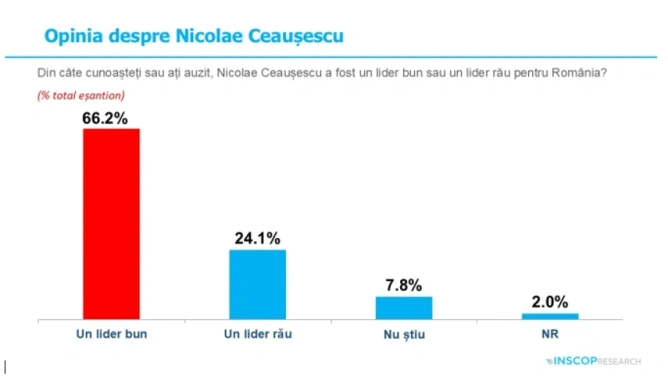
Nearly two-thirds of Romanians consider Nicolae Ceaușescu a good leader for the country, according to an INSCOP poll conducted in 2025 at the request of the Institute for the Investigation of Communist Crimes and the Memory of the Romanian Exile (IICCMER). The results form the basis of an analysis published by the Center for European Policy Analysis (CEPA), authored by former American correspondent in Central Europe William Echikson, who warns that idealizing the communist regime may weaken the consolidation of democracy.
According to the INSCOP poll, conducted between 25 June and 3 July 2025, 66.2% of respondents consider Ceaușescu to have been a good leader for Romania, while 24.1% view him as a bad leader. At the same time, 48.4% of Romanians believe that people lived better before 1989, 75.1% believe there was more public safety, and 65.1% say there was less corruption.
Favorable perceptions of the communist period do not stop there: 66.4% of those surveyed believe that the state took better care of its citizens, while 77.2% believe that Romania was richer before the Revolution. However, the poll also highlights an important contradiction: 80.9% of respondents acknowledge that before 1989 there was less freedom than today.
What the CEPA analysis says
William Echikson begins his analysis with his direct experience of communist Romania. During a visit in 1986, he describes a Bucharest with dark streets, nearly empty shops, and a population facing shortages. Three years later, after trying to contact a dissident, the journalist was detained and expelled by the Securitate.
On returning to Romania in the summer of 2026, Echikson says he was impressed by Bucharest’s transformation and by the opportunities available to young professionals, many of them educated abroad and experienced in technology. Nevertheless, he observed that nostalgia for communism persists even in families with high incomes and Western education, where grandparents fondly remember the supposed “security” of the 1970s.
The author explains this nostalgia through selective memory: for people affected by economic insecurity, the idea of a guaranteed job and housing provided by the state may seem attractive. The problem, he emphasizes, is that this image ignores political repression, control by the Securitate, the cult of personality, consumption restrictions, cold homes, power outages, and food rationing in the final years of the dictatorship.
Why the result is concerning
For CEPA, the poll does not necessarily mean that Romanians want a return to dictatorship, but it does reveal a vulnerability in collective memory. Idealizing an authoritarian regime can create favorable ground for populist messages that promise order, protection, and simple solutions to complex economic problems, sometimes at the cost of diminishing individual freedoms.
Echikson also links the phenomenon to the inequalities that remained after 1989. Although Romania has made significant economic and social progress, especially after joining NATO and the European Union, the benefits of development have not reached all communities evenly. The differences between the modernized capital and some rural areas lacking basic infrastructure can fuel discontent and make promises associated with the communist past seem more credible.
The analysis also draws attention to the way the past is presented in the public sphere. The author’s visit to the Spring Palace, the former residence of the Ceaușescu family, now a museum, leads him to argue that highlighting certain “achievements” attributed to the dictator, without adequately presenting the abuses and policies that generated shortages, can distort public perceptions of communism.
A warning for the entire region
In the context of publishing the poll, IICCMER described nostalgia for totalitarianism as a vulnerability that could even affect national security. Echikson believes that Romania’s experience deserves to be followed by the other former communist states in Europe as well, because economic progress alone is not sufficient to prevent the idealization of the authoritarian past.
The conclusion of the CEPA analysis is clear: Romania has gained freedom, opportunities, and a level of development far superior to that of the communist period, yet the results of the 2025 INSCOP poll show that a significant part of society continues to look back on that past with nostalgia. It is precisely this contradiction between today’s democratic reality and the idealized memory of communism that, in the author’s view, represents the main warning sign.

Latest News
17:32
17:11
17:00
16:52
16:50
See more news
NEWS ON THE SAME TOPICS