Informat.ro Barometer – Inscop Research: Minors' Access to Social Networks



Always see our news on Google
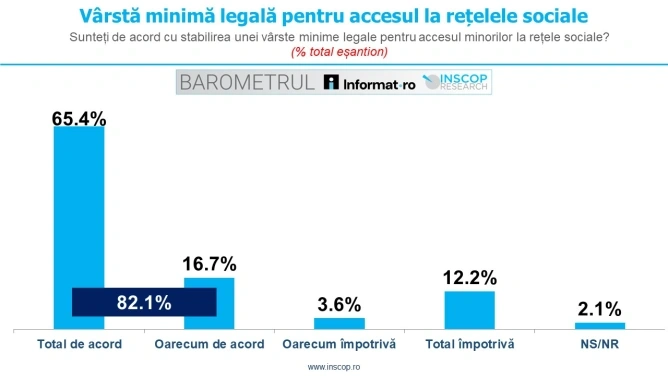
Safety on social networks has become a major priority for Romanian society, as the virtual environment is increasingly perceived as a space with significant risks. Data shows massive support for legislative intervention: 82.1% of Romanians agree with establishing a minimum legal age for minors to access social networks (65.4% totally agree and 16.7% somewhat agree), while only 15.8% of respondents oppose such regulation.
Support for this measure is extremely high among USR voters (89%), individuals with higher education (89%), and residents of large cities (89%). Additionally, the age group of 30-44 years, which includes the majority of parents with children active online, supports the initiative at a rate of 86%.
Regarding the ideal age threshold, opinions vary. Among those in favor of regulation, the majority (27.7%) believe that the minimum age for access to social networks should be 16 years, followed by 18 years (17.2%) and 14 years (16.6%).
This desire for regulation stems from a clear awareness of online dangers. Almost half of Romanians (48.6%) identify minors as the most vulnerable group in the face of social networks, a sentiment particularly shared by PNL voters (61%) and, surprisingly, even by young people under 30 (57%), who recognize the risks of the environment in which they grew up and with which they are familiar. Other groups considered to be at risk include the elderly (12.1%) and individuals with primary education (8.1%), but public attention remains focused on protecting the new generation.
In a period marked by misinformation and exposure to unfiltered content, Romanians see establishing age limits for access to social networks as a necessary method of protection. This broad consensus indicates that the safety of children in the virtual environment is viewed as a matter of collective responsibility, aimed at reducing vulnerability to the pressures and manipulations specific to the internet age.
Methodology: Data from the eighth edition of the BAROMETRUL Informat.ro – INSCOP Research were collected between March 2-6, 2026. Research method: interview via questionnaire. Data were collected using the CATI method (telephone interviews), with a simple stratified sample volume of 1100 individuals, representative of significant socio-demographic categories (gender, age, occupation) for the non-institutionalized population of Romania, aged 18 and over. The maximum allowable error of the data is ± 3%, at a confidence level of 95%.
Latest News
15:40
15:33
15:27
15:25
15:24
See more news
NEWS ON THE SAME TOPICS