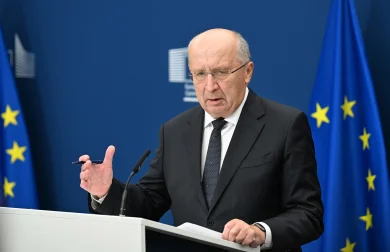
The European Commissioner for Defense Andrius Kubilius warns that Europe needs a "big bang" in defense to ensure its security.


Always see our news on Google
European Commissioner Andrius Kubilius has called for a profound transformation of European defense, arguing that simply increasing budgets is not enough and that the EU must make major institutional decisions to guarantee its security in a radically changed geopolitical context.
The European Commissioner for Defense and Space, Andrius Kubilius, stated at the Folk och Försvar – National Conference 2026 that the European Union is facing a historic choice in security matters, warning that without a profound reorganization of how it conceives defense, Europe risks remaining vulnerable to current threats.
In short
Russia is described as maintaining a war economy even in the event of peace.
The United States is urging Europe to fully assume the conventional defense of the continent.
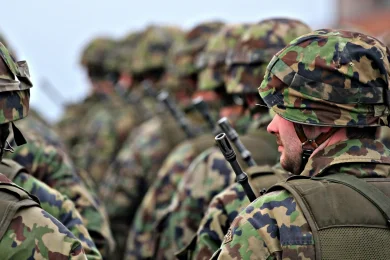
Kubilius criticizes the current fragmentation of European defense, described as a collection of "bonsai armies".
The Commissioner emphasizes the need for common European decision-making and command structures.
Ukraine is presented as the immediate test of the EU's strategic credibility.
In his speech, Kubilius started from the premise that Europe's security environment has fundamentally changed. He stated that Russia remains in a long-term confrontation logic and that, regardless of the evolution of the war in Ukraine, Moscow will continue to invest massively in military capabilities. At the same time, the commissioner pointed out that the United States is increasingly making it clear that Europe must take primary responsibility for the conventional defense of the continent.
In this context, Kubilius argued that Europe can no longer operate with the current defensive architecture, characterized by numerous but poorly coordinated national armed forces. He described this reality with the metaphor of "bonsai armies", forces that exist formally but are not prepared for a high-intensity conflict. According to the commissioner, the problem is not just the level of investments, but the lack of common organization and coherent political will.
The speech explicitly revived the idea of a permanent European military force and a strategic leadership mechanism at the EU level. Kubilius argued that the Union needs a structure capable of making rapid security decisions and coordinating existing capabilities, evoking the possibility of a European Security Council that would bring together member states and EU institutions in a restricted and operational format.
Ukraine occupies a central place in this vision. The commissioner stated that current support risks becoming insufficient and that the EU must be prepared to react if Russia refuses any credible peace solution. For Kubilius, the way Europe manages support for Ukraine represents the first real test of its ability to act as a security actor.
Kubilius emphasized that initiatives already launched at the EU level, such as the Defence Readiness 2030 agenda, financial instruments for defense, and strengthening the European defense industry, are important but incomplete steps. Without major political decisions regarding command, coordination, and common responsibility, these instruments risk remaining fragmented.
The speech at Folk och Försvar is part of a broader debate regarding the future of European defense, intensified after Russia's invasion of Ukraine and against the backdrop of changing strategic priorities of the United States. Although the idea of an integrated European defense has been formulated several times in recent decades, Kubilius's intervention marks a change in tone, from voluntary cooperation and coordination to integration and common political decision-making, without announcing a timeline or concrete legal mechanisms.
Latest News
23:08
22:58
22:57
22:55
22:54
See more news
NEWS ON THE SAME TOPICS