ANALYSIS Unique quota vs. progressive tax: who wins, who loses and what obstacles are predictable




Always see our news on Google
Romania has remained, together with a few Eastern states, in the restricted club of countries with a flat tax rate, while the rest of the European Union relies on progressive systems, with multiple brackets and high marginal rates. Against the backdrop of a chronic budget deficit and European pressures for fiscal consolidation, the idea of switching to progressive taxation is increasingly appearing on the political agenda, but it faces opposition from the business environment and the reluctance of a part of the political class. Behind the technical jargon, the stakes are simple: who pays more to the budget and who benefits at the end of the month, on the payslip.
1. Two fiscal philosophies: simplicity versus equity
The flat tax rate is based on the premise that applying the same percentage to all incomes is simpler, more predictable, and more investment-friendly. Romania, Bulgaria, Hungary, and Estonia are examples of economies that have used the flat tax rate to market themselves as "friendly" tax destinations in an increasingly complicated Europe. The model is attractive to investors and high or mobile income professionals, who quickly compare tax regimes and move their activities where the income burden is lower.
Progressive taxation starts from the idea that the tax burden should be linked to the ability to pay, and high incomes can support a higher marginal rate without severely sacrificing the standard of living. Most Western European countries – Germany, France, Italy, Spain, Belgium, the Netherlands, the Nordic countries – apply between 3 and 5 brackets, with maximum rates reaching 45–60% for very high incomes, complemented by local taxes or additional contributions.
From a taxpayer's perspective, the difference is not just philosophical: in a flat tax system, the effective tax rate increases mainly through social contributions, while in a progressive system, both income tax and social contributions increase with salary. For a state with a large deficit and rising social spending, progressivity becomes a tempting tool for redistribution and budget consolidation.
2. Where Romania stands in the European fiscal landscape
In 2026, Romania continues to apply a flat tax rate of 10% on salary income, supplemented by high social contributions: CAS 25% and CASS 10%, which pushes the total burden on labor very high in the low-income area. The International Monetary Fund notes that for low salaries, labor taxation in Romania is among the highest in the EU, while for the average salary, the burden is below the European average – meaning the system fails to be either efficient or progressive.
At the EU level, most countries have long abandoned the flat tax rate or have never applied it. Germany, France, Italy, Spain, Belgium, Austria, the Netherlands, the Nordic countries, Poland, or the Czech Republic use progressive systems, with large differences between the minimum and maximum rates. In contrast, in the "flat tax club" remain, in the EU, Romania, Bulgaria, Hungary, and to a certain extent Estonia, although even here more and more exceptions, deductions, and special treatments are appearing that complicate the image of absolute simplicity.
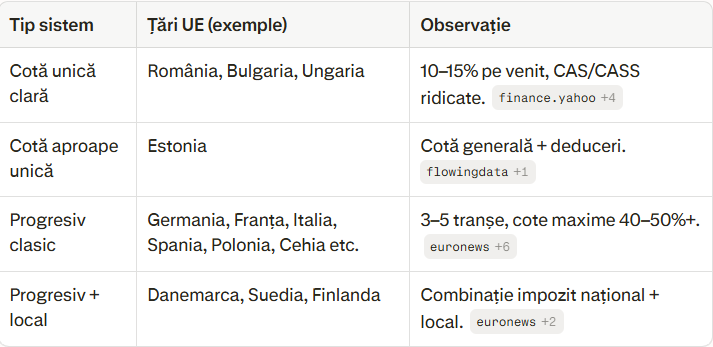
In recent years, the European Commission, IMF, and World Bank have explicitly recommended Romania to introduce elements of progressivity and to shift part of the tax burden from labor to consumption and capital, to support budget consolidation and reduce inequalities.
3. Who wins and who loses: the profile of the "winners" and "losers"
In a flat tax system, the main beneficiaries are medium and high incomes, which pay the same income tax percentage as low salaries, while social contributions play the main role in burdening the payslip.
Winners are professionals with above-average incomes, managers, IT specialists, finance, consulting, who in a "classic" progressive system would be taxed marginally at 30–40%.
Disadvantaged are low-income employees and vulnerable families, who end up bearing a relatively high tax burden compared to their income, especially in the absence of substantial deductions.
In a progressive system, generally, low salaries and part of the middle-income area win, especially where the lower bracket is taxed at 0–5%, or where there are deductions for children, rent, health, or education. High incomes lose, which fall into the upper brackets, where the marginal rate can reach 25–30% or more, depending on the model.
In Romania, international institutions highlight a paradox: labor taxation is too high for low incomes and too low for high incomes, and the lack of progressivity causes the system to fail in its redistributive role. Hence the recommendations to introduce two or three tax brackets (e.g., 15% and 25% in the IMF proposal) and to increase the tax on dividends, to close loopholes between salaries and capital.
4. Simulation: from flat tax to progressive tax, in three brackets
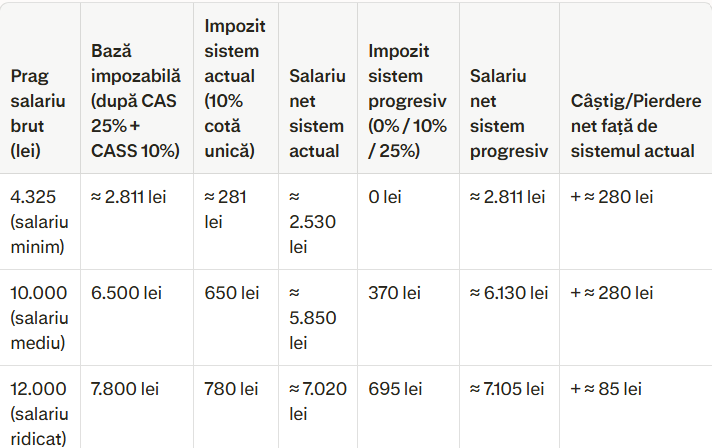
Even in the presented variant, the budgetary impact would be positive, because the large base of taxpayers with low and medium incomes would pay less tax, but would continue to bear CAS and CASS, while high incomes would contribute additionally compared to the "soft" scenario, and any rate adjustments can be calibrated to maximize collections.
5. Why part of the Romanian political scene opposes it
While the European Commission estimates that a three-bracket progressive system could bring up to 11.8 billion euros extra to the budget, a significant part of the Romanian political class and most of the business environment reject the idea. The Prime Minister has explicitly stated that Romania "is not yet ready" for a progressive system, citing the risk of discouraging investments and the administrative complication of collection.
Business organizations talk about losing the "brand" of a country with a flat tax rate, higher administrative costs for companies, additional pressure on salary structures and collective negotiations.
Behind these arguments lies a high level of public distrust: three out of four Romanians declare that they do not trust the state to spend efficiently any additional money collected from new taxes or rate increases. In the absence of a clear reform of public spending, any discussion about progressive taxation risks being perceived as "yet another tax increase to feed an inefficient state."
6. What would the administrative transition to progressive taxation entail
The transition from a flat tax to progressive taxation is not limited to changing some numbers in the Tax Code, but involves several structural changes.
Redesigning the Tax Code: defining brackets, rates, and a coherent system of deductions, avoiding the artificial migration of income from the salary area to micro-enterprises, PFA, or dividends.
Administrative capacity at ANAF: a real progressive system requires integrated databases, automatic checks, annual declarations, and a sufficiently high level of digitalization to manage millions of cases with different situations.
Changing taxpayer habits: taxpayers would need to get used to the annual income declaration, with adjustments and the idea that the payslip does not always tell the whole story of the tax owed.
Coordination with social policies: without a simultaneous adjustment of social assistance and other benefits, progressivity can create "poverty traps," where an extra leu in salary leads to the loss of higher benefits.
Last but not least, the transition to progressivity should be part of a broader package that includes reforms on VAT, excise duties, property taxes, and capital taxes – as proposed by the IMF and the European Commission – to shift the burden from labor and reduce pressure on low salaries.
7. Romania between two worlds
Romania is fiscally between two worlds: one of the flat tax, which helped attract investments and simplify the system in the early 2000s, and one of progressivity, towards which the reality of the budget deficit, international recommendations, and the need for social equity are pushing. Simulations show that a well-calibrated model of progressive taxation could better protect low and medium incomes without severely hitting the upper area, if accompanied by spending reforms and a more efficient tax administration.
When and if the political class will make the leap from rhetoric to reform depends, however, less on the calculation formulas and more on public trust that the extra money will be used for roads, hospitals, and schools – not to feed an oversized and inefficient state.
PFA and dividends: the great valve of the system
In Romania, the discussion about flat tax versus progressive tax cannot avoid the "valves" through which part of the labor income flows into other more advantageous forms: PFA, liberal professions, and dividends.
PFA: 10% tax, but social burden on thresholds
A PFA currently pays a 10% income tax applied to net income, to which social contributions (pension and health) are added based on certain income thresholds.
Income tax: 10% on net income (after deductible expenses). CASS 10%: owed if the annual cumulative income from independent activities and other sources exceeds the threshold of 6 minimum gross salaries; the contribution is calculated at fixed thresholds (6, 12, or 24 minimum salaries), not on the entire actual income. CAS (pension): not owed below a certain threshold; becomes fixed annually, depending on the income level (for example, a fixed annual contribution for incomes between approximately 9,720 and 19,440 euros and a higher contribution above this level).
The result is that for not very high incomes, the PFA can pay, as an effective percentage, less than an employee with the same gross, especially if they deduct real expenses and do not exceed thresholds that automatically raise CASS and CAS. This is why many professionals (IT, consulting, creative) prefer PFA or similar forms instead of a standard employment contract.
In a scenario with progressive taxation on salaries, maintaining the 10% tax on PFA income, with capped contributions, would create a robust optimization channel: some high-income employees would reprofile fiscally as PFA to avoid the upper bracket of 20–25%. Unsurprisingly, the IMF and other institutions recommend Romania to reduce the differences in treatment between dependent and independent labor, precisely to limit arbitration.
Dividends: from 8% to 10%, then to 16%
On the dividends front, Romania has already begun to tighten the screw. Until 2024, the tax on dividends was 8%. From January 1, 2025, the rate increased to 10% for dividends distributed after this date, with exceptions for those paid in 2025 from interim profits reported in 2024, which remain at 8%. For dividends distributed starting January 1, 2026, some legislative changes raise the tax to 16%, which directly hits entrepreneurs and small investors who have optimized their income through micro-enterprises.
At these tax rates, CASS is added for investment income if the threshold of 6 minimum gross salaries (24,300 lei in 2025, based on a minimum of 4,050 lei) is exceeded; the contribution is 10% applied to the threshold reached (6, 12, or 24 minimum salaries), not on the entire income, which creates a "squeeze" effect on the tax burden.
In practice, part of the high income from labor has already been moved to micro-enterprises + dividends, benefiting from the lower tax on distributions and the different treatment of contributions. The gradual increase of the rate on dividends (8% → 10% → 16%) and the lowering of thresholds for micro-enterprises are precisely the political response to this phenomenon.
The scenario of progressive taxation
If Romania were to introduce progressive taxation on salary income but maintain a 10% tax on PFA income (with capped contributions), 10–16% on dividends, with CASS calculated only at fixed thresholds, the evident risk would be an "evacuation" of part of the well-paid employee base towards alternative forms of remuneration. The IMF explicitly states that the introduction of progressive rates on labor must be correlated with increasing taxation on capital income (dividends) and reducing the differences compared to PFA, so that the system as a whole is fairer and does not create escape routes for high-income earners and good tax consultants.
In translation, the stakes are not just whether we will have 10% or 25% on salaries, but whether the state manages to treat all forms of income coherently – salary, PFA, micro, dividends – so that progressive taxation does not turn into a massive invitation to "optimization" for those who can afford to change the legal form of work.
In the current context, many economists and commentators emphasize that Romania is "a regressive state, with weak collection, but with progressive ambitions on paper," and without a serious reform of tax administration and public spending, the transition to progressive taxation risks becoming just "a beautiful theory in a deeply flawed system."
Analysis conducted with the support of Perplexity
Latest News
08:04
07:56
07:50
07:47
07:29
See more news
NEWS ON THE SAME TOPICS