EXCLUSIVE Transnistria: the strategic lever of Moscow and the security test for Moldova, the EU, and Romania



Always see our news on Google
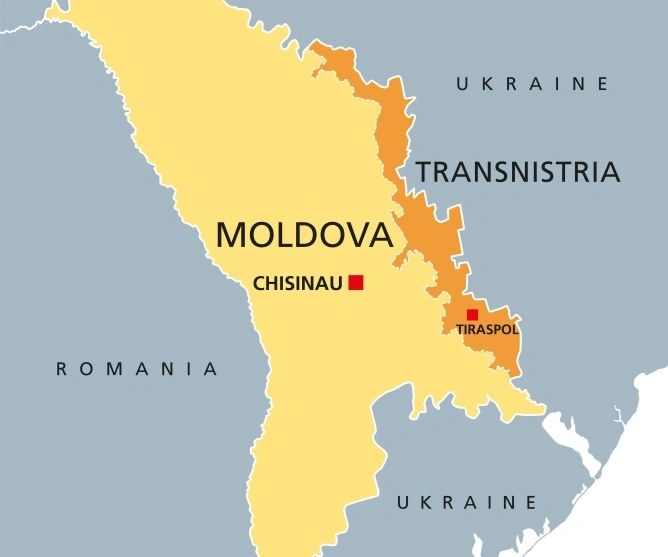
Maia Sandu's speech, in which she states that "in 1992 the aggressor was Russia, and today, in Ukraine, the aggressor is Russia" and demands "the firm withdrawal of Russian troops from the territory of the Republic of Moldova," moves Transnistria from the register of an "old problem" to the center of the discussion about sovereignty, security, and European integration. The conflict on the Nistru is no longer presented as an anomaly of transition, but as the first chapter of the same Russian strategy that manifests today in Ukraine, and the Russian military presence on the left bank of the Nistru is explicitly declared incompatible with the idea of peace and with the European project of the Republic of Moldova.
Why does Transnistria remain essential in the power architecture of Moscow?
Instrument for limiting the sovereignty of the Republic of Moldova
For Moscow, Transnistria is not an inert relic of the 1990s, but a calibrated control instrument over a state that has declared its European option. The fact that Russian troops are stationed on the territory of the Republic of Moldova, without the agreement of the constitutional authorities, introduces a structural risk in any major foreign policy decision from Chișinău, from accelerating European integration to deepening cooperation with NATO. The military presence functions as an informal veto: it does not formally annul options, but makes them more costly and riskier for a small state caught between an aggressive power and a still cautious West. Testimonies from former security officials in Chișinău, according to which Russia prepared the conflict in Transnistria as early as 1989 by training and arming the separatists, then intervening directly in the battles at Tighina, show that the region was designed from the beginning as a strategic lever, not as a secondary product of local tensions. From this perspective, maintaining the Russian contingent is not inertia, but the continuity of a deliberate option to limit the sovereignty of the Republic of Moldova.
Channel for testing the West's reaction
Transnistria also serves as a tool for testing the West's will. By maintaining a frozen conflict in a pro-European state at the EU's border, Russia observes how far Brussels and Western capitals are willing to go to concretely defend a partner outside NATO. The way Maia Sandu's statements are received and valued, from naming Russia as the aggressor to the demand for troop withdrawal, becomes for Moscow an indicator of the EU's limits of involvement in a file where there is no formal obligation for collective defense. In this sense, Transnistria is not just a local conflict, but a test case: how much political, economic, and possibly security support is the West willing to offer to a state pressured by Russia, but which still does not enjoy collective defense guarantees.
The Russian contingent: vulnerable military presence, but strong geopolitical symbol
Geographical isolation and operational constraints in the context of the war in Ukraine
The war in Ukraine has fundamentally changed the military significance of Transnistria. The region is separated from Russia by a territory of active conflict, where the Ukrainian army has both the interest and the capacity to block any land supply corridor to the Russian contingent. Under these conditions, the Russian troops across the Nistru are, in operational terms, almost isolated, and their real freedom of maneuver is severely limited.
Military experts in the region describe this contingent as a "captive garrison": present on paper and in political discourse, but without robust logistical support and without a realistic perspective of sustaining large-scale offensive operations. Any attempt at aggressive use, either against Ukraine or as a platform for military pressure on Romania, would expose these troops to a high risk of isolation and neutralization, without the guarantee of a strategic gain in measure.
From combat capability to strategic message role and blocking alibi
Although its offensive capability is limited, the Russian contingent still retains high strategic value as a symbol and alibi. The Russian flag, the format of so-called "pacification" and the de facto control of an unrecognized region, in a state that demands European integration, send a clear message: Russia is still militarily present in the immediate vicinity of the EU. For the Kremlin, the cost of maintaining this presence is relatively low compared to the advantage of having an open file through which it can justify blocking political developments in Chișinău.
Thus, the contingent becomes more of an instrument for legitimizing the status quo and maintaining a gray security zone than an instrument of force projection. Its value lies in the ability to block, slow down, and intimidate, not in the potential to trigger or win a major conventional conflict.
Chișinău is redefining its position: from "frozen" conflict to central national security file
Naming Russia as the aggressor and the explicit demand for troop withdrawal
The political discourse in Chișinău is moving from ambiguity to clarification. Maia Sandu explicitly links the war on the Nistru to the aggression in Ukraine, speaks of Russian propaganda and disinformation as a continuation of military aggression, and asserts that peace is incompatible with the presence of Russian troops in the Republic of Moldova. The Prime Minister speaks of the "price for sovereignty" paid in 1992, and the President of Parliament reiterates, in turn, the demand for the withdrawal of the contingent. This convergence of the main institutions transforms the Transnistria file from a technical negotiation issue into a central national security file. Russia is no longer evoked as a participant in a diplomatic format, but as an identified aggressor, responsible for the violent past and for the current pressures on the sovereignty and European path of the Republic of Moldova.
Integrating Transnistria into the European project of the Republic of Moldova, not on its periphery
In the political project plan, Chișinău no longer treats Transnistria as a painful parenthesis, but as a test of coherence of its own European path. The conflict of 1992 is presented in the press and in official statements as a founding moment of the independent Moldovan statehood, and integration into the EU is seen as a form of "justice" towards those who fought against the Russian intervention. Transnistria thus becomes a criterion for the seriousness of the Republic of Moldova's European project, not just an annex file. Moldovan security experts speak of a "paradigm shift" in approach: the focus shifts from sterile negotiations with the regime in Tiraspol to policies of economic, social, and legal convergence between the two banks of the Nistru, alongside political pressure for troop withdrawal. Initiatives such as official discussions about teaching exclusively in Romanian in schools in the region reflect this logic: Chișinău begins to project its state model over the entire internationally recognized territory, not just over the de facto controlled one.
European integration of the Republic of Moldova: Transnistria as a test of the credibility of enlargement
The condition of the withdrawal of Russian troops for lasting peace and effective sovereignty
When Maia Sandu links peace, European integration, and the withdrawal of Russian troops in the same message, she introduces a fundamental condition: there can be no lasting stability and effective sovereignty as long as part of the territory is militarily controlled by a foreign power. This is no longer formulated as an abstract desire, but as a precondition for normalizing security relations and for European integration. For the Republic of Moldova, the outcome is clear: the success of the European path will not be measured only in reforms and negotiation chapters, but also in how the Transnistria file will be managed. For the EU, the effect is symmetric: it can no longer promote Moldova's integration without also assuming a positioning towards the Russian military presence on its territory.
How this file forces the EU to decide how far it goes in defending a pro-European state under pressure
By clearly framing the issue, Russia as the aggressor, foreign troops on the territory of a pro-European state, a frozen conflict affecting integration, Chișinău forces the EU to clarify its own limits. Eastern enlargement is no longer just an institutional exercise, but a security one: how much concrete support is the Union willing to offer to a state that, although not a NATO member, is under direct Russian pressure and has a Russian contingent on its territory. In this sense, how the EU will integrate the Transnistria file into the criteria and timetable for enlargement will be not only a test for the Republic of Moldova but also for the credibility of its own commitment in the eastern neighborhood.
Romania and Transnistria: strengthened military security, strategic vulnerability through proximity
Military deterrence provided by NATO and the low probability of a conventional attack
For Romania, risk analysis begins with a fundamental element: NATO membership and strengthening the eastern flank. Allied presence, adapted infrastructure, and the framework for collective deterrence make a conventional attack launched from Transnistria against Romanian territory assessed by experts as a scenario with low probability. For Moscow, such a decision would mean opening a new front with the alliance at a time when its resources are heavily engaged in Ukraine. Geography and military realities on the ground, the isolation of Transnistria, the pressure from the Ukrainian army, NATO's capacity to react, make the hypothesis of a direct attack more of a theoretical scenario than a practical one. This does not eliminate the risk, but places it in a zone where deterrence continues to function.
Dependence on the stability of the Republic of Moldova and the risk of a regional crisis with direct effects across the Prut
The strategic risk for Romania comes from another direction: its dependence on the stability of a vulnerable neighboring state. The Republic of Moldova, with a frozen conflict on its territory, with Russian troops in Transnistria and constant political and informational pressures, is a potential starting point for a regional crisis. A major destabilization in Chișinău, through orchestrated pressures in Tiraspol, Russian interference, or internal crises, would have immediate effects on Romania: refugee flows, pressure on resources, internal political disputes with Transnistria at the center. In addition, how Romania manages its response to such a crisis will be closely monitored by EU and NATO partners. The ability to act quickly, coordinated, and coherently, beyond declarations, will matter in assessing Romania's role as a regional actor in security files.
Transnistria as a hybrid vector: informational, psychological, and political pressure on Romania
The potential of the file to fuel internal fears and narratives of vulnerability
Transnistria is already present in the Romanian public discourse not only as a foreign policy issue but also as a symbol of Russian aggression. The protest at the Russian Embassy in Bucharest, organized to condemn the aggressions in Transnistria, Ukraine, and Moscow's interference in internal politics, shows that the file is used as a central element in narratives about Russia and security in Romania. In a tense context, such themes can be amplified to fuel fears, distrust in institutions, and the perception of a permanent vulnerability. Experts in hybrid security emphasize that, from Moscow's perspective, it is more effective to use the Transnistria file to erode trust in NATO and in the Romanian state's capacity to manage risks than to risk a direct military conflict. Narratives about the "imminent war across the Nistru," if not counterbalanced by analyses and strategic communication, can become an instrument of destabilization in themselves.
The need for strategic communication and strengthening societal resilience
For Romania, the response cannot be limited to the military dimension. There is a need for responsible public communication that distinguishes between real risks and amplified perceptions, explains NATO's role, and integrates Transnistria into a broader analysis of regional security. Strengthening societal resilience, including the ability to filter disinformation and not to turn every development into an apocalyptic scenario, becomes part of the strategic response.
Transnistria – "geopolitical construction site" and barometer of regional tensions
Controlled stagnation as a deliberate strategy of Moscow
Often described by analysts as a "geopolitical construction site," Transnistria is intentionally kept in an unresolved status. A clear solution, in terms of Chișinău and the EU, would decisively reduce Moscow's capacity to influence the politics of the Republic of Moldova. A formal annexation, modeled after Crimea, would escalate the conflict with the West and incur additional costs. Controlled stagnation offers maximum flexibility: the conflict remains warm enough to block and cold enough not to impose major costs. For the EU and Romania, this strategy means a permanent risk, but below the threshold of an open war that is difficult to address politically, but with the potential to accumulate vulnerabilities over time. The tacit acceptance of this stagnation has a cost: it reinforces the message that Russia can indefinitely maintain gray security zones on the EU's periphery.
Developments around the region as an early warning system for Bucharest and Western partners
Transnistria also functions as a barometer of regional tensions. The increasing frequency of official calls for troop withdrawal, the emphasis on the discourse about Russian aggression, initiatives such as the demand for teaching in Romanian in schools in the region, and the reactions from Tiraspol and Moscow are indicators of the direction in which the file is moving. For Bucharest, treating these signals as part of an early warning system, not just as episodic news, is essential to anticipate and calibrate responses in a timely manner.
The stakes for Romania: from managing fear to building a sustainable regional solution
Supporting a more robust and more integrated European Moldova as a way to reduce risks
In practical terms, the most effective way to reduce the risks generated by Transnistria is not only to strengthen its own defense but also to support the consolidation of the Republic of Moldova. A Moldova with more robust institutions, with a more integrated economy in the European space, and with a coherent strategy for reintegrating Transnistria diminishes, over time, the utility of this region as a lever for Moscow. For Romania, investing in the stability and European path of Moldova is, directly, an investment in its own security.
Shifting from a concerned observer role to that of co-architect of stability east of the Prut
Remaining only at the level of recognizing risks means for Romania to accept a passive role in a file that directly affects its security. A mature approach involves assuming a role as a co-architect of solutions: articulated political support in Brussels for Moldova's European path, close cooperation on security and resilience, economic and energy projects that reduce dependencies on Russia. In this scenario, Transnistria is no longer just a source of anxiety, but a file in which Romania actively contributes to transforming a Russian lever into an increasingly ineffective instrument, in a region that is reconfiguring around European norms and guarantees.
Latest News
12:24
12:04
11:45
11:30
11:15
See more news
NEWS ON THE SAME TOPICS