SPECIAL Informat.ro / The scenarios of the evolution of gasoline and diesel prices in a Romania stuck between Brussels and the pump



Always see our news on Google
Romania has excise taxes on fuels significantly above the EU minimums and very little legal room to reduce them without a derogation, but it has some fiscal and parafiscal scenarios to mitigate the shock of rising oil prices caused by the war with Iran.
The level of excise taxes and EU rules
In 2026, the excise tax is approximately 3.06 lei/l for unleaded gasoline and 2.80 lei/l for diesel, according to the Ministry of Finance and the economic press.
Converted to euros, Romania reaches about 0.50 euro/l for gasoline and approximately 0.55 euro/l for diesel (around 551 euros/1,000 l), which is above the European minimum of 359 euros/1,000 l for gasoline and 330 euros/1,000 l for diesel established by Directive 2003/96/EC.
The directive imposes minimum rates, not maximums: states cannot go below these minimums without an explicit derogation from the Commission, and the Ministry of Finance has publicly explained that a reduction of the "half excise tax" type would directly violate the directive and expose Romania to infringement.
In short, Romania complies with the European framework but has chosen to position itself well above the minimum thresholds, which amplifies the impact of international quota increases on the final price at the pump.
Where Romania stands compared to other EU states
Recent data shows that Romania is in the upper half of the EU in terms of fuel taxation, while states like Bulgaria or Malta remain very close to the European minimums.
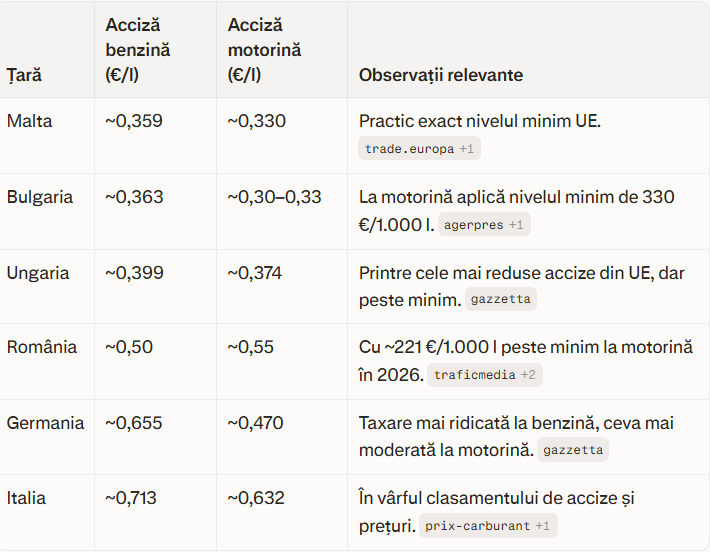 Romania is therefore above the border countries with minimum excise taxes (Bulgaria, Malta, partly Hungary) and below the taxation champions (Italy, the Netherlands, Denmark), but with a tax structure that places a disproportionate burden on diesel, which affects the competitiveness of transport.
Romania's scenarios for limiting price explosions
In the face of a supply shock generated by the conflict with Iran, Romania has a limited set of fiscal levers directed from Bucharest and a set of macro and structural levers anchored in the EU.
1. Direct fiscal scenarios
Temporary reduction of the excise tax, with derogation
A significant reduction below 330/359 euros/1,000 l would require a derogation from the Commission, similar to schemes adopted during the pandemic or after the Russian invasion of Ukraine.
Politically, this would mean opening a negotiation: an energy crisis argument triggered by the war in Iran, inflationary and competitiveness impact in the region; economically, such a step would involve budgetary losses of billions of lei annually, compensable only through other taxes or spending cuts.
Partial reimbursement of the excise tax for critical sectors
The excise reimbursement scheme for diesel for transporters, used in the past, allows for the formal maintenance of the "on paper" level above the minimum, but returns a portion to professionals (road transport, possibly agriculture, logistics).
UNTRR explicitly requests the reimbursement of about 60 bani/l, which would leave the net excise still above the EU minimum threshold, but would temper the migration of supplies to Bulgaria and Hungary.
Measures of the capping/compensation type at the pump
One option is direct compensation of the price at the pump (e.g., 50 bani – 1 leu/liter, covered by the budget), without formally changing the excise tax.
The budgetary cost is direct and high, but the mechanism is quick, easy to communicate politically, and can be calibrated monthly depending on oil quotes – in a scenario where Brent oil remains stable above 90–100 dollars/barrel, the compensation becomes difficult to sustain in the long term.
Adjustment of other fiscal components
The VAT rate on fuels (increased to 21% from 2026) is another lever: a temporary point reduction to 19% or even lower would cut several tens of bani/l, but would affect overall collections.
Another direction would be the elimination or reduction of some contributions/para-taxes (e.g., environmental components) for a crisis period, but these are largely conditioned by the green transition commitments assumed at the EU level.
2. Para-fiscal scenarios and public policy
Support schemes for vulnerable populations
Mobility vouchers or subsidies for commuting in peri-urban and rural areas heavily dependent on cars, to avoid the explosion of social inequalities.
Extending subsidies for public transport (local and rail) to transfer some of the pressure from gasoline/diesel to collective means.
Accelerating the transition to alternative fuels
More aggressive subsidization of the electrification of public transport, charging infrastructure, and hybrid or electric commercial fleets, as a structural measure to reduce dependence on imported oil.
In parallel, incentives for reduced consumption (ecobonuses for efficient cars, registration taxes linked to emissions, etc.), with a clear timeline, to avoid generating additional short-term shocks.
Regional coordination and use of strategic stocks
Coordinated use of reserve stocks and agreements with refineries in the region to cushion price spikes generated by shocks in supply chains.
Alignment with EU policies regarding capping the price of oil from certain regions and using common purchasing instruments (similar to gas) to increase negotiating power.
The impact of the war with Iran and Romania's options
The conflict in Iran and the risk of blockage in the Strait of Hormuz reintroduce a "geopolitical premium" in oil prices, comparable to episodes from 2019–2022.
Market scenarios:
Moderate escalation, without major export blockage: +10–20 dollars/barrel compared to pre-conflict levels, stabilizing in the 80–90 dollars/barrel range.
Serious disruptions of Iranian exports and those of allies: quotes to 90–100 dollars/barrel for Brent, making the scenario of gasoline over 9 lei/l in Romania realistic.
Blockage or systematic attack on infrastructure in the Gulf (global crisis scenario): episodic price jumps above 100 dollars/barrel, with extreme volatility.
In these scenarios, Romania cannot influence the global price of oil, but it can: cushion the shock to the final price through the mix of excises, VAT, and reimbursement schemes; protect the competitiveness of key sectors (transport, agriculture, logistics) through partial excise reimbursement; redirect as much urban traffic as possible to public transport and alternatives less dependent on oil.
Outlook for oil prices in 2026
The "base case" forecasts of international agencies, formulated before the complete escalation of the conflict, indicated for 2026 a Brent price in the range of 56–65 dollars/barrel, against the backdrop of oversupply and slowing demand. EIA anticipates an average price of about 56 dollars/barrel for Brent in 2026, with global stocks increasing, which would be theoretically favorable for Romania.
Fitch Ratings works with a hypothesis of 65 dollars/barrel, also based on a comfortable supply scenario and moderated demand.
The war with Iran, however, introduces an asymmetric risk upward, and any serious disruption of exports from the Gulf can temporarily push quotes well above these levels, even if, structurally, the trend remains one of a "descending plateau" as the energy transition advances.
Conclusions
In an economy already weakened by inflation and fiscal consolidation, the imported shock through oil prices risks hitting simultaneously the purchasing power of the population and the competitiveness of firms, especially in a country on the edge of the European Union, dependent on road transport and with excises significantly above the European minimum. Romania cannot change the barrel quote nor the basic architecture of the European Directive on excises, but it can decide how to distribute the cost of this shock among the budget, companies, and consumers – and how coherently it uses fiscal, parafiscal, and public policy tools.
The real decision is not whether to "cut" the excise tax, but how to calibrate a credible mix of temporary measures (compensation, targeted reimbursement, possible negotiated derogations with Brussels) and structural reforms (energy efficiency, alternatives to oil) so that Romania does not remain captive, at every geopolitical crisis, in the fire-fighting logic of a providential emergency ordinance. Without such a framework, every new jump in quotes – whether it comes from the Strait of Hormuz or another conflict zone – will mean the same predictable spiral: exploded prices at the pump, social pressure, fiscal improvisations, and, ultimately, an ever-increasing bill for an economy already caught "in the middle" between the rules of the Union and the reality at the pump.
Analysis conducted with the support of Perplexity
Latest News
14:32
14:28
14:18
14:15
14:04
See more news
NEWS ON THE SAME TOPICS