EXCLUSIVE Romania, in the vision of the press from Russia: The top topics from the last two weeks



Always see our news on Google
In the last two weeks, the Russian press has paid attention to Romania through a relatively wide range of topics, from NATO security to the Black Sea and American military presence, to energy files, migration, sports, and history, with a mixed tone: from alarmist and critical in the geopolitical register, to neutral or positive in the socio-economic and sports area. The data was collected by the media monitoring platform NewsVibe, during the period of February 14 - 27, 2026. The report identified 194 articles published in the Russian press during this period.
During the analyzed period, Romania and Romanians appear in several dominant thematic axes. Romania is presented as a member state of the European Union involved in debates regarding the financing of Ukraine and in discussions about alternative energy and logistics routes. The country is placed at the center of an "energy vertical corridor" connecting Greece, Bulgaria, Romania, Moldova, and Ukraine, being described as an important technical link in supplying the region with gas and electricity.
Romania is constantly evoked as a location for NATO military infrastructure and American presence, especially in articles discussing the strengthening of the eastern flank and risks for Russia. Another recurring thread regards Romania as a transit country or destination for migrants, refugees, children leaving Ukraine, and foreign fighters passing through the region. In parallel, Romania appears in sports and cultural materials, through international competitions organized on its territory, through well-known Romanian coaches, and through the evocation of military campaigns from World War II.
The most discussed topics about Romania
Security, NATO, and military presence
A comprehensive piece broadcast by RIA Novosti cites James Carafano, an American military expert, who states that the military presence of the United States in Romania will be maintained and even expanded, in the context of the war in Ukraine and tensions on NATO's eastern flank. In this article, Romania is described as part of a network of bases and infrastructures that allow Washington to project its power in Eastern Europe and in the Black Sea region.
The register is critical of the Western strategy, and interviewed Russian commentators emphasize that the expansion of this presence amplifies "the risks to Russia's security," a formulation frequently used in news and broadcasts on Russia-24. Romania appears as a "platform" and "support point" for NATO, being placed in the same category as Poland and the Baltic states.
In other materials, broadcast on federal channels and news portals, Romania is mentioned in connection with reconnaissance flights of the alliance, with military infrastructures in Transylvania and Dobrogea, and with the role of monitoring the Black Sea and the Ukrainian border, without providing technical details, but insisting on the geographical proximity to Russia. These references reinforce the image of a country deeply integrated into NATO's defensive architecture.
Romania in the energy and economic file
The Russian press gives significant space to developments in European energy, including in agencies like RIA Novosti and in specialized economic publications. In analyses discussing the reduction of electricity supplies to Ukraine by some Central European states, it is mentioned that the administration in Kiev will have to redirect imports through Poland and Romania, which would put pressure on the technical capacities of the networks and increase costs.
Romania is also evoked as a state that has hosted some of Moldova's gas reserves, in materials that revisit the episode of storing Moldovan gas in Romania in the context of the interruption of supplies from Gazprom, a concern addressed in regional policy and energy comments. These articles present it as a provider of energy security for Chișinău.
Several economic analysis texts describe Greece's ambition to become Europe's gas hub by expanding a "vertical corridor" that includes Bulgaria, Romania, Moldova, and Ukraine, with references to interconnection projects and LNG terminals. In these materials, Romania is presented as an active participant in the project and as a state benefiting from investments in infrastructure, without being directly criticized, the criticism being directed more towards the overall strategy of the European Union to reduce dependence on Russian gas.
In another register, Russian economic and legal publications note the situation of a Russian company involved in an offshore project in the Black Sea, in Romania's economic zone, in connection with invoking major force and the processes for exiting the concession. The focus is on the impact on the Russian company and the reaction of the Romanian authorities, and the language remains technical.
Migration, refugees, and war routes
Romania also comes into the attention of the Russian press through the lens of the flows of people generated by the conflict in Ukraine. In an interview broadcast on the Vesti news channel, a representative of the Russian authorities criticizes Kiev for the lack of transparency regarding the fate of children taken out of Ukraine through special programs. In this context, Poland and Romania are listed among the main destination countries, and the interlocutor states that "it is an extremely fertile ground for pseudo-voluntary organizations that operate on gray schemes" and that "there is no clear data on where all these children have gone."
Although the accusation directly targets the authorities in Kiev and the networks operating on Ukrainian territory, the repeated mention of Poland and Romania introduces a note of suspicion regarding the routes through which children reach Europe. The formulations are picked up and commented on in political talk shows and debate programs on federal channels, where Romania appears as part of the relocation circuits managed by the West.
In another series of materials, broadcast by both news sites and Russia-24, the departure of foreign fighters from Ukraine, especially Latin American mercenaries, to Mexico and their countries of origin is described. Journalists report that they usually take the Ukraine-Romania or Ukraine-Poland route and then fly to Latin America. Romania is thus presented as being integrated into a geography of violence and transnational networks.
Romania in sports and culture
A significant part of the mentions about Romania has a neutral or favorable tone regarding sports and culture. In the field of e-sports, specialized sites and channels like RuHub report on a major Counter-Strike 2 tournament organized in Cluj-Napoca, presenting the Romanian city as a modern host, with adequate infrastructure and a large audience.
In football, the Russian sports press, including portals like Sport-Express and Match TV, mentions several times the name of Cristian Chivu, who is presented as a respected Romanian coach for the results obtained with Inter Milan. The articles highlight his playing style and success, which implicitly projects a positive image of the football school in Romania.
In the historical register, press agencies and television stations publish obituaries dedicated to Soviet veterans and former agents of the special services, in which the military campaigns of World War II are recalled. Romania is included in the series of countries liberated by Soviet troops, alongside Ukraine, Moldova, Hungary, Bulgaria, and Czechoslovakia, through formulations like "it contributed significantly to the liberation of Ukraine, Moldova, Hungary, Romania, Bulgaria, and Czechoslovakia." These texts reiterate the classic Soviet narrative about the common victory against Nazism.
The general tone in the Russian Press
Analyzing the 194 articles from the period of February 14 - 27, 2026, several clear features emerge regarding how Romania is represented in the Russian press. 173 (89%) have a neutral tone, 15 (8%) negative, and 6 (3%) have a positive tone.
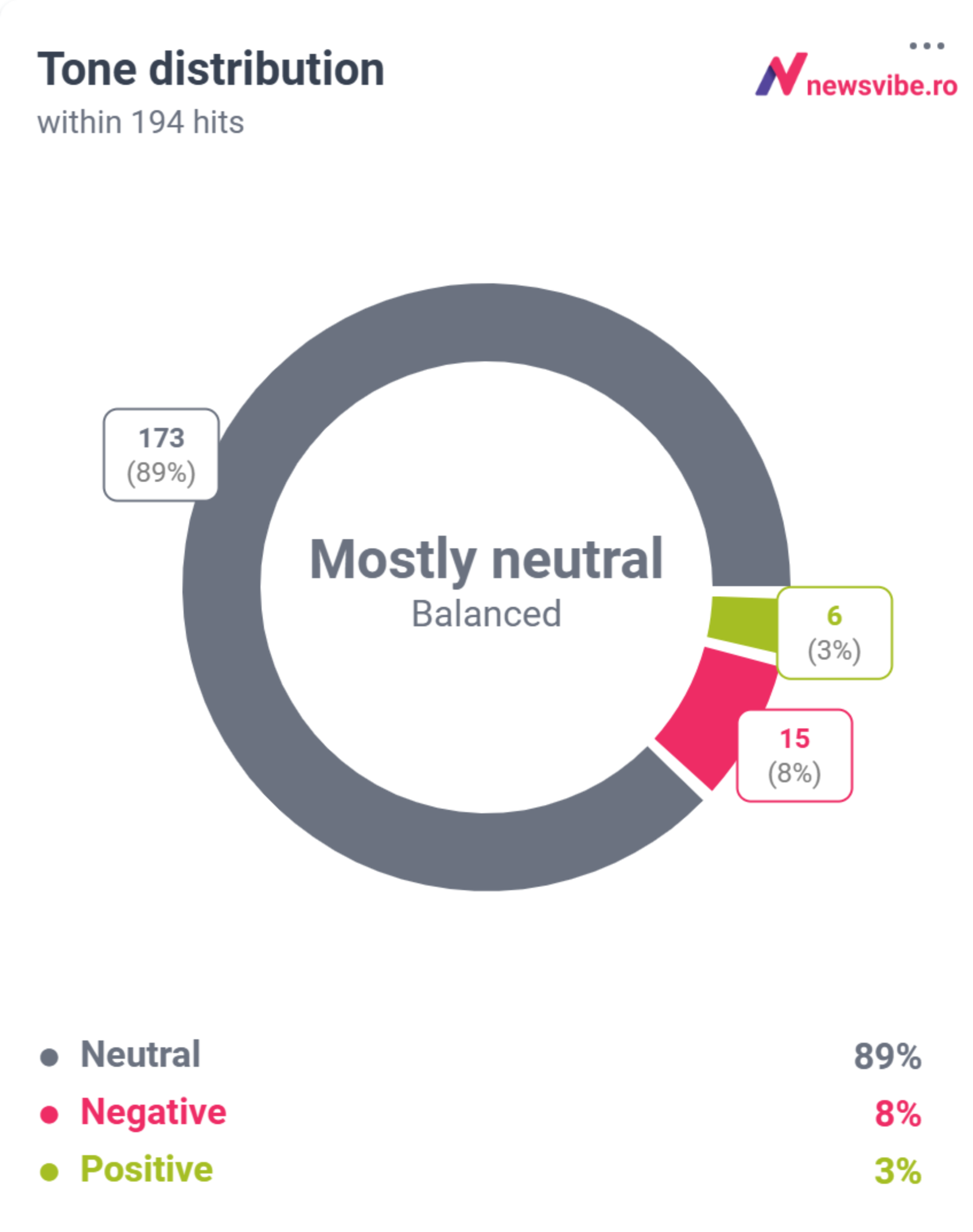
Graph: NewsVibe
The tone is predominantly critical and alarmist where Romania is linked to NATO, to the military presence of the United States, and to support for Ukraine. In contrast, when economic, sports, or historical themes are addressed, the language becomes technical, neutral, or even laudatory, which gives a mixed, fragmented image of Romania.
Implications for Romania
The data from the 194 analyzed articles reveal a dynamic in which Romania is constantly present in the Russian press, but most often in a background role for broader themes related to NATO, energy, migration, and regional security. The coverage remains essential for the Russian narrative about the eastern flank of the Alliance, in which Bucharest is positioned as a strategic infrastructure of the West at the Black Sea and in proximity to Ukraine.
The Russian press anchors Romania in the security register through articles from RIA Novosti and federal channels, which explicitly discuss the American military presence and NATO's role in the region. Romania is described as part of a network of bases and infrastructures that allow Washington to project its power in Eastern Europe and in the Black Sea region, and Russian commentators note that this development amplifies "the risks to Russia's security."
The broader strategy of re-framing the eastern flank is also visible in how energy routes and supply crises are treated. Economic publications and press agencies emphasize the energy interdependence between Romania, Moldova, and Ukraine, whether they talk about redirecting electricity to Kiev or about storing Moldovan gas on Romanian territory. The technical tone of these reports hides a subtle narrative: Romania appears as a link in a complex European infrastructure, perceived as fragile and vulnerable to political decisions and market shocks.
Overall, the media coverage during this period suggests that Russia sees Romania more as an executor of Western policies than as an autonomous actor with its own agenda. The dominant narrative fixes it as a pawn of NATO and the European Union on the eastern flank, with a role as a military platform, energy hub, and transit corridor for human flows. This positioning serves the Kremlin's broader strategy of presenting the expansion of Western influence in Eastern Europe as a structural threat to Russia's security.
*****Synthesis made with the help of a data monitoring flow provided by the media monitoring platform NewsVibe Romania. The analysis, data, and images presented have been enhanced with the help of Machine Learning and Artificial Intelligence tools
Latest News
22:59
22:55
22:44
22:40
22:40
See more news
NEWS ON THE SAME TOPICS


.webp)