SPECIAL Informat.ro / Romania, in the European press: The top topics from the last two weeks in the European press, about Romanians and Romania


Always see our news on Google
Romania and Romanians remain on the agenda of the European press, and the data from the last two weeks show a shift from an almost one-dimensional security file to a mixed package of themes, where energy issues, climate crisis, cross-border crime, and sports performance intersect. The analysis based on NewsVibe data for the period of August 1-14 indicates 7,100 materials and shows that the attention on Romania focuses on the vulnerability and role of the country as a NATO frontier state, directly exposed to security incidents related to the war in Ukraine; the energy crisis caused by the drought on the Danube, which highlighted the fragility of the country's critical infrastructure, with consistent mentions in Germany, Spain, the United Kingdom, and Greece.
The Energy Crisis at Cernavodă
The most widely discussed topic of the week in the European press is the complete shutdown of Romania's only nuclear power plant at Cernavodă, against the backdrop of the historic drop in the Danube's water level. The BBC published two materials on this subject, showing that the two reactors of 706 MW at the plant, which together provide about 20% of the country's electricity production, were successively disconnected from the grid – the first on July 28, the second on Thursday, August 13. The plant's director, Romeo Urjan, told the AFP agency, quoted by the BBC, that no restart is anticipated in the next ten days.
The subject has been widely covered by the German press (t-online, ntv), Spanish (El País), and Greek (Proto Thema). The German reports describe, in a technical register, the series of measures taken by the Romanian authorities to artificially increase the water level, the sinking of barges loaded with stone, and the controlled blasting of a portion of rock from the riverbed, with an estimated effect of only a few centimeters of additional level.
The Spanish daily El País, in an article titled, translated, "Romania Completely Paralyzes Its Only Nuclear Power Plant Due to Low Danube Levels," specifies, based on information from the Romanian Ministry of Energy, that the 1,400 MW of installed capacity covered 20% of the electricity demand of a country of 19 million inhabitants, and that the drop in the Danube's flow has reached the lowest levels in the last 40 years.
Drone Incidents at the Border of Romania
A second thematic group, relevant to regional security, concerns a series of drone-related incidents in the Black Sea and Danube area. The German press, through t-online, reported on a drone that exploded at the border between Romania and Bulgaria, identified by the Bulgarian Ministry of Defense, according to preliminary analysis of the debris, as a "decoy" model ("Maja"), frequently used by Ukrainian forces; the explosion occurred about 100 meters from Romanian territory, near the Trans-Balkan pipeline. The Bulgarian foreign minister requested explanations from the Ukrainian ambassador, and the Ukrainian side classified the incident as unintentional.
Separately, the German press, through t-online, described the controlled destruction by divers of the Romanian Navy of two Russian-manufactured drones adrift in the Black Sea, about 100 kilometers from the port of Constanța and near the Neptune Deep gas pipeline, highlighting Constanța's role as a transit point for military goods and a significant part of Ukrainian agricultural exports.
The German press, through Deutsche Welle (DW), completed this picture with a report of a Russian attack on the Ukrainian port of Ismail, on the Danube, near the border with Romania, the largest Ukrainian hub for grain exports, an attack that damaged port infrastructure and caused a fire, also affecting the electricity supply in the southeastern areas of the city. I did not identify, in the monitored sources, a report from the Greek press on this specific subject, which is why I recommend further verification of this statement before publication. The collection of these materials presents Romania as a NATO border state, directly exposed to the consequences of the conflict in Ukraine, in a factual tone, focused on security and defense aspects.
The Drought on the Danube and World War II Wrecks
A related subject, with notable coverage, concerns the appearance, as a result of the drought, of German World War II shipwrecks at the border between Serbia and Romania, some containing, according to reports, unexploded ordnance. The Greek press picked up the information citing the British publication The Guardian, mentioning the discovery of a partially visible shipwreck on a sandbank normally submerged, as well as a military motorcycle. The subject is treated in a descriptive register, of historical interest, but remains connected to the same hydrological cause affecting the Cernavodă plant.
Cases of Crime Involving Romanians
The British press has published several materials involving Romanian citizens, in a critical tone. One case concerns the 17-year prison sentence of Adina Mihai and her partner, Madalin Dumitru, for the murder of two men and the poisoning of two others with a sedative substance (GBL), in a context described as "false escort" and entanglement with sedative substances. A second material describes a tent encampment occupied by people from Romania and Bulgaria on Euston Road in central London, associating its presence with local shoplifting and an incident of stabbing that occurred nearby, on Endell Street. The Greek press also picked up a case of jewelry theft worth £70,000 from a British store, with the victim stating that the criminals spoke, as she perceived, Romanian or Albanian.
Romanian Presence in European Sports Competitions
Sports have generated several materials in which Romania appears in a factual context, related to competitive results. The Spanish press (Marca) mentioned the performance of swimmer David Popovici at the European Championships in Paris, described as the benchmark against which young Spanish swimmer Luca Hoek measures himself. The Greek press reported on a rowing event at the World Youth Championship in Bulgaria, where the Romanian crew won the gold medal, just 61 hundredths of a second ahead of the Greek crew, which took silver.
General Tone in the European Press:
Of the 7,100 articles, 3,300 (47%) have a negative tone, 2,400 (34%) have a neutral tone, and 1,400 (19%) have a positive tone.
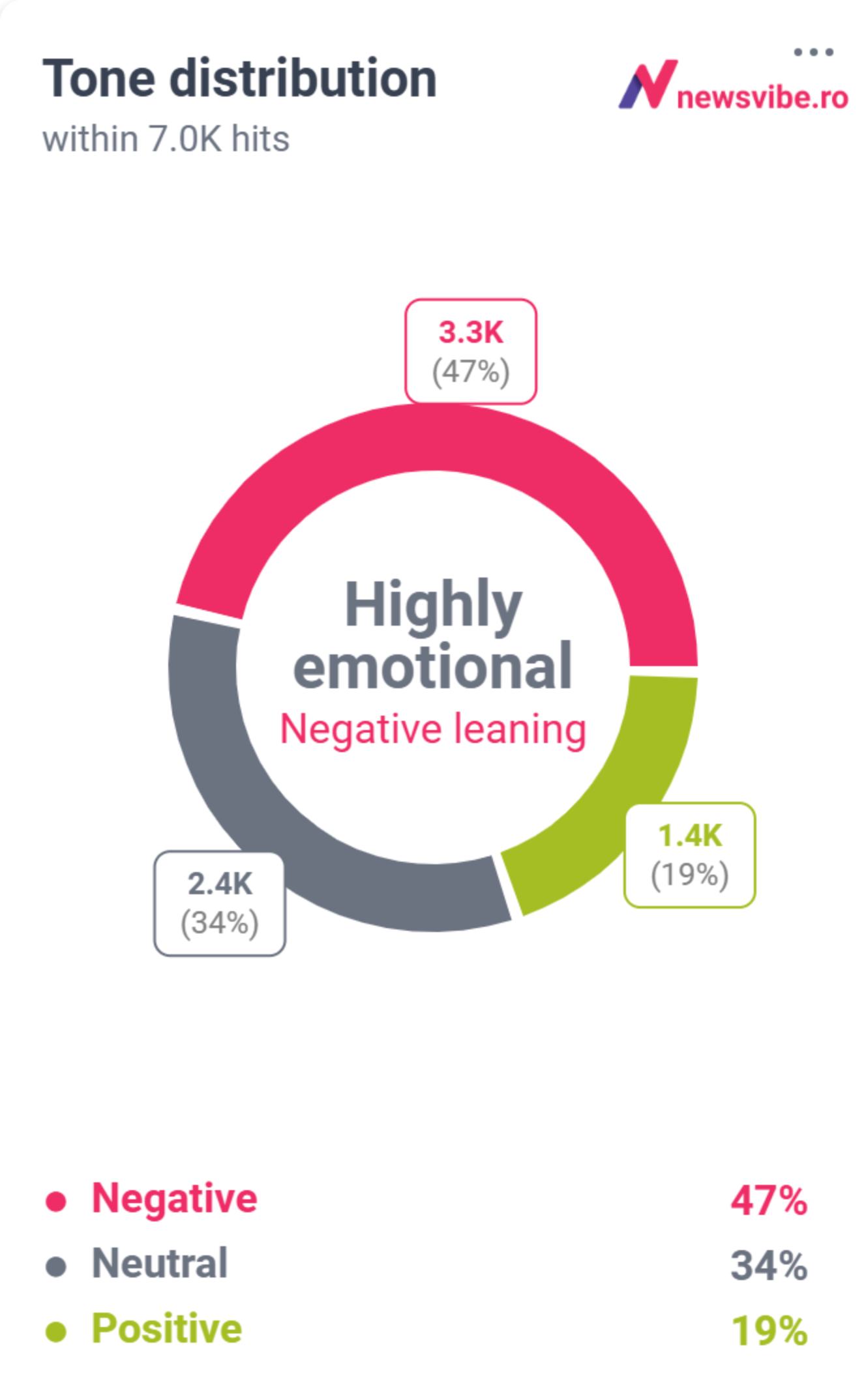
Graph: NewsVibe
****Summary created with the help of a data monitoring flow provided by the NewsVibe Romania media monitoring platform. The analysis, data, and images presented have been enhanced with the help of Machine Learning and Artificial Intelligence tools.
Latest News
13:31
13:17
13:06
12:55
12:41
See more news
NEWS ON THE SAME TOPICS