SPECIAL Informat.ro / Romania, in the European press: The top topics from the last two weeks in the European press, about Romanians and Romania


Always see our news on Google
In the last two weeks, Romania and Romanians have made it onto the agenda of the European press primarily through a package of security and defense themes. This includes Russian drones crashed on Romanian territory, the explosion of a maritime drone in the port of Constanta, and the megacontract for rearmament with Rheinmetall, complemented by political reflections regarding the installation of a technical government in Bucharest. Analysis based on NewsVibe data for the period from May 23 to June 5 indicates 2,500 materials, showing that attention is now focused on the vulnerability of Romania as a NATO frontier state and its repositioning as an industrial actor in the European security architecture, with consistent mentions in the United Kingdom, France, Germany, Italy, and international agency press.
The explosion of the drone in Constanta
The explosion of the drone in Constanta quickly became one of the main news stories about Romania in the European press, with different emphases depending on the publication, but with the same underlying conclusion: Romania is a NATO frontier state directly exposed to the effects of the war in Ukraine. In the United Kingdom, the tabloid site Express presents the incident in a dramatic key, under the title "Drone explosion in Romania – Emergency in the port of Constanta, mass evacuations," describing "a major emergency" after "a maritime drone exploded in Romania," with "thick plumes of smoke" and "mass evacuations" around the port.
In France, the daily Le Figaro publishes the article "Romania: a maritime drone explodes in the port of Constanta, authorities activate an emergency plan," citing Digi24 and the Romanian Ministry of Defense. The newspaper explains that "an alert was triggered Friday morning in the port of Constanta, following the explosion of a maritime drone," that the incident occurred "near docks 77 and 78" and that the authorities "had activated an emergency plan," with no victims reported initially, while the ministry specifies that "the maritime drone is of the type used in the war in Ukraine."
Additionally, the incident is also reflected by the international agency Reuters, which in its news about maritime drones in the Black Sea reported that the Romanian army "destroyed a maritime drone that posed a threat to navigation in the Black Sea," citing the Romanian Ministry of Defense and placing the episode in the broader context of attacks launched by Russia against Ukrainian infrastructure on the Danube and the Black Sea. Other specialized publications, such as MarineLink or Counter-IED Report, have also picked up this information, reinforcing Romania's image as a frontline actor in maritime security risks.
Overall, Express amplifies the emotion and sensationalism, Le Figaro remains in the realm of security chronicle, while Reuters and niche press encode the episode in the standard language of military reports. In all these materials, Romanian authorities appear in at least a neutral light, often slightly favorable, by emphasizing the activation of emergency plans, the neutralization of the drone, and the absence of human casualties.
The incident with the Russian drone in Galati
A major episode, with direct relevance to how Romania's vulnerability is perceived abroad, is the incident in Galati, when a Russian drone crashed over a residential block in a border town of a NATO state. The international agency Reuters reports that a Russian drone, loaded with explosives, crashed into a residential building in Romania, injuring at least two civilians. In its correspondence, Reuters emphasizes that the episode represents a "worrying" stage of the conflict, as it directly hits civilian infrastructure on the territory of a NATO ally, and notes that the North Atlantic Alliance confirms the Russian origin of the drone and is closely monitoring the situation, even as it tries to temper fears of a deliberate attack against Romania.
In the Francophone space, the economic magazine Challenges explains, in a dedicated article, that the authorities in Bucharest officially announced that Romania was hit by a Russian drone that struck a residential block in the town of Galati, located near the border with Ukraine. Challenges specifies that two people were slightly injured and emphasizes the unprecedented nature of the situation, presenting this attack as the first time such a device has hit a residential building in Romania. The magazine also notes that Bucharest publicly condemned Moscow's gesture as a "serious and irresponsible escalation" and that European institutions condemned the incident.
News channels in the French-speaking space, such as France 24, replay images of the hit block and talk about a "Russian drone crashed on a building in Romania," highlighting the reaction of Romanian authorities, who demand a firm response from allies and signal that such incidents increase the risk of the conflict spreading onto the territory of a NATO member state. In the Francophone online ecosystem, viral clips and posts summarize the case with phrases like: "drones in Romania, media accuses Russia, the European Union condemns, Romania expels the Russian consul from Constanta, and the explosive load fully hit the building."
Viewed through this exclusively international lens, the Galati episode positions Romania in the direct line of a Russian attack on a town within the territory of a NATO state. At the same time, Bucharest's reaction is presented in a firm key aligned with the positions of the European Union and the North Atlantic Alliance: public condemnations, qualifying the incident as an escalation, diplomatic measures such as the expulsion of the Russian consul from Constanta.
The 5.7 billion euro contract with Rheinmetall
Against this backdrop of security pressure, the German niche press in the IT industry notes Bucharest's decision to place a megacontract with Rheinmetall. IT Boltwise, in an article titled "Romania orders 5.7 billion euros worth of armaments from Rheinmetall," explains that Romania "has launched a rearmament volume worth billions of euros towards Rheinmetall, which includes combat vehicles, air defense systems, ammunition, and ships, with deliveries scheduled until 2030."
The site emphasizes that "the agreement provides for a significant expansion of capabilities in Romania" and that, thus, "the industrial base of European security is visibly shifting towards production in the immediate regional vicinity." At the same time, IT Boltwise explicitly links this decision to the drone attacks on Romania, noting that "on the night from Thursday to Friday, a Russian drone hit a residential building in Galati, injuring civilians, and shortly thereafter Romanian authorities announced the signing of the 5.7 billion contract with Rheinmetall." The type of impact and the reference to "the shift of the security industrial base towards Romania" suggest a potential wider echo in the debate in Germany regarding strengthening the eastern flank and relocating arms production in proximity to risk areas.
Political crisis and the technical government of Eugen Tomac
In Italy, the publication East Journal, a political and analytical site focused on Central and Eastern Europe, is the one addressing the political crisis in Bucharest. The material of the publication explains that "Romania opens a new political phase by appointing Eugen Tomac as Prime Minister, a decision by President Nicușor Dan," after the fall of the government led by Ilie Bolojan.
East Journal emphasizes that "the choice comes after the dismissal of the former head of government, Ilie Bolojan, dismissed by his former social-democratic allies and far-right forces" and that the new mandate takes place "in a complex political context, characterized by the absence of an agreement between the main parliamentary forces for the formation of a new stable majority." In this presentation, Tomac is described as "the leader of the People's Movement Party (PMP) and a Member of the European Parliament" tasked with forming "a technical government, with a clearly defined 'non-political' approach, oriented towards institutional stability."
The General Tone in the European Press:
Of the 2,500 articles, 1,600 (64%) have a neutral tone, 649 (26%) have a negative tone, and 251 (10%) have a positive tone.
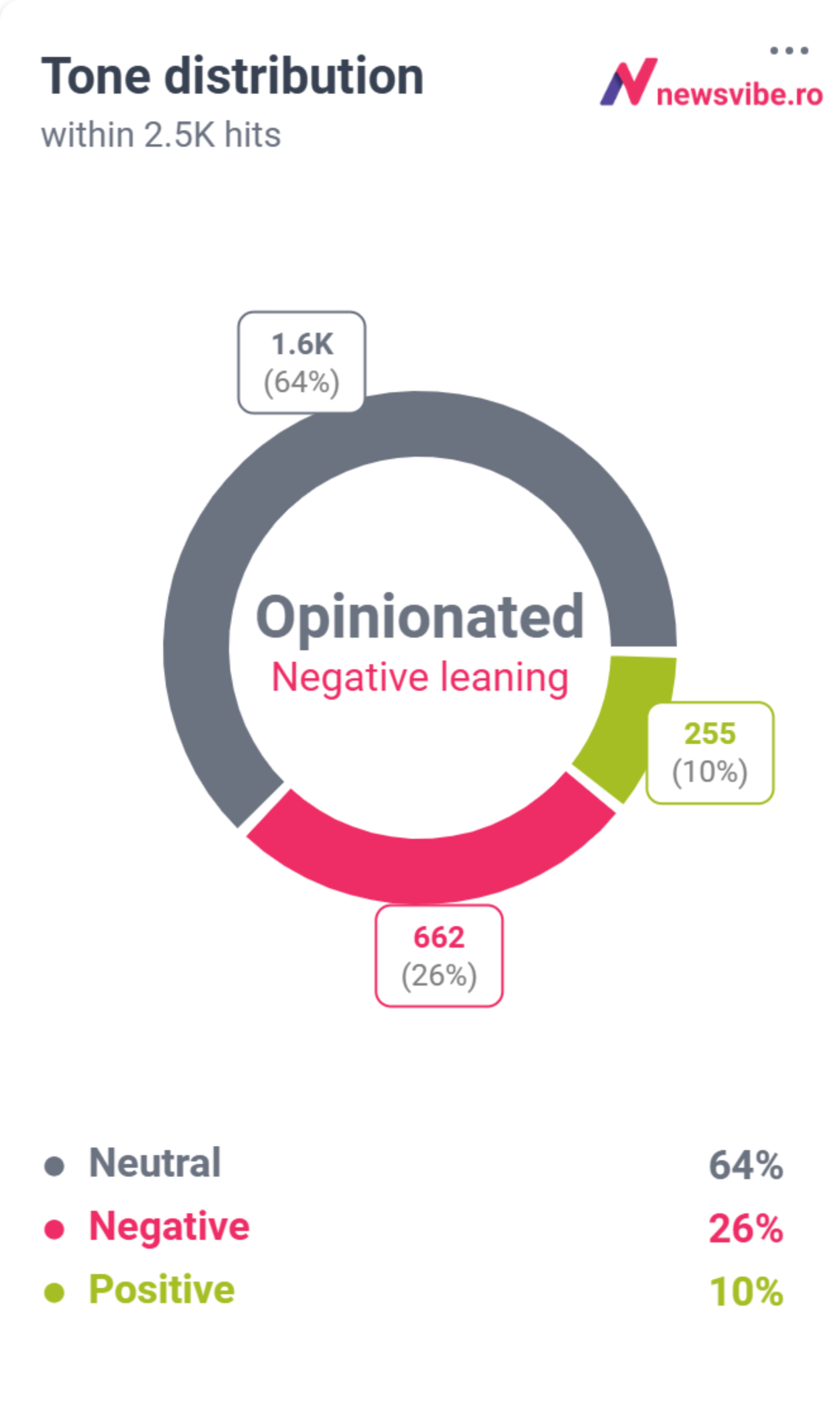 Graph: NewsVibe
****Summary created with the help of a data monitoring feed provided by the media monitoring platform NewsVibe Romania. The analysis, data, and images presented have been enhanced with the help of Machine Learning and Artificial Intelligence tools.
Latest News
21:38
21:24
21:11
20:59
20:42
See more news
NEWS ON THE SAME TOPICS