EXCLUSIVE Romania, in the vision of the press from Russia: The top topics from the last two weeks


Always see our news on Google
Romania has appeared in the Russian press in the last two weeks primarily as a NATO platform used for actions perceived as "military provocations" against Russia, but also as a possible unification pole for the Republic of Moldova, in a narrative framework dominated by suspicion and criticism towards the West. The analysis also includes a ranking of the most discussed topics based on this data, highlighting key publications such as Aif-Moscow, RIA Novosti, and Komsomolskaia Pravda, which portray Romania as a state on NATO's eastern flank involved in escalating regional tensions. The data was collected by the media monitoring platform NewsVibe, during the period of May 9 - 22, 2026. The report identified 411 articles published in the Russian press during this period.
Romania as a NATO platform against Russia
The strongest and most impactful narrative thread is one in which Romania appears as a space used by NATO for actions considered "military provocations" against Russia. This framework is particularly fueled by articles quoting former Pentagon advisor Douglas Macgregor, picked up by publications such as Aif-Moscow, RIA Novosti, and Komsomolskaia Pravda.
In a piece by Aif-Moscow, Macgregor claims that "attacks on Russia are conducted through the Baltic states or through Romania, over the Black Sea" and qualifies this situation as "very dangerous." The same wording is echoed by RIA Novosti, which adds that Russia would not threaten European states, but that "aggressive actions and the European Union's policy risk provoking a proportional response from Moscow." Komsomolskaia Pravda amplifies the message, emphasizing the idea of the "absurdity" of political decisions in the EU and explicitly mentioning Romania among the states through which attacks on Russia would be facilitated.
Through these texts, Romania is framed as NATO infrastructure and as a geographical vector of danger, not as an actor with its own political initiative. Criticisms are focused on the "unbalanced, unreasonable, and dangerous leadership of the EU," with names like Kaja Kallas brought to the forefront, and Romania automatically appears in the same field of responsibility, as a state on the eastern flank involved in these policies.
The Republic of Moldova between "historical injustice" and unification with Romania
The second major subject in which Romania is constantly invoked represents the debate about the unification of the Republic of Moldova with Romania, filtered in the Russian press through a critical lens towards Maia Sandu. Two materials, one in the generalist Russian press and another in RIA Novosti, are central to this narrative thread.
An article describes how Maia Sandu would go so far with the desire for European integration that she would sacrifice "including the sovereignty of her own state," interpreting her statements as questioning the existence of Moldova as an independent state. The president is quoted as saying that "many support the idea of unification with Romania, not just to correct a historical injustice, but primarily for the sake of security and for Moldova to remain part of the free world." The context set by the publication emphasizes the idea that, just like in Ukraine or Armenia, the leadership would choose to approach the EU at the expense of cooperation with Moscow, while "many inhabitants would demand exactly the opposite."
In another news piece, RIA Novosti reports on Maia Sandu's intervention at the GLOBSEC forum in Prague, where she acknowledges that supporters of unification with Romania "do not represent the majority" in the Republic of Moldova, although part of the diaspora would want this. RIA reminds that Sandu previously stated, in a British podcast, that in the case of a referendum she would vote for unification with Romania, against the backdrop of the "complicated international situation" and the difficulties Moldova faces as a sovereign state.
In these texts, Romania is explicitly mentioned by Maia Sandu, and the Russian press reinterprets key quotes as alarming regarding "loss of sovereignty" and a political project lacking majority support. The result is a portrait in which Romania appears as the recipient of a potential "disappearance" of Moldova as a state, while the pro-Western leadership of Chișinău is described as disconnected from a significant part of the population.
Romania and the downing of the drone over Estonia
Romania and the downing of the Ukrainian drone over Estonia have been frequently presented in the Russian press, which emphasized the political message of the incident and Romania's role in the NATO mission, without going into additional technical details. An article from Aif-Moscow shows that the destruction by NATO forces of a Ukrainian drone over Estonia, intended for an attack on Russia, is interpreted by the German publication Junge Welt as "a clear warning" to Kiev regarding the inadmissibility of using NATO airspace for attacks against Russia. The text notes that, according to the Estonian Ministry of Defense, the incident occurred when a Romanian aircraft on Baltic Air Policing mission shot down the drone, and the authorities in Tallinn informed Ukraine that they had not granted permission to use Estonian airspace.
Another report, also published by Aif-Moscow, emphasizes that the downing of the drone by a NATO aircraft confirms, in the author's view, Russia's previous complaints regarding the use of civilian vessels in the Baltic Sea for strikes in the Saint Petersburg area. The news again specifies that the Ukrainian drone was shot down by a Romanian aircraft and that fragments fell into a marshy area, the site being investigated by the Estonian Security Police.
In another report, RIA Novosti mentions the same episode in the context of statements by Swedish Prime Minister Ulf Kristersson, who calls for NATO to assist Ukraine in guiding drones. The agency notes that, prior to these statements, the Estonian Minister of Defense, Hanno Pevkur, announced that a Romanian aircraft had shot down a Ukrainian drone over Estonia and demanded explanations from Kiev, emphasizing that only NATO member states have the right to use the country's airspace.
Overall, the tone of these Russian materials is ambivalent: on one hand, NATO is presented as a responsible actor sending Ukraine a signal of limitation by not accepting the use of its airspace for attacks against Russia; on the other hand, the episode is inscribed in the broader narrative of "escalation" and the risk that allied territory, including Romanian territory, could become a platform for military actions directed against the Russian Federation. Romania appears as an active military state within NATO, yet its role is predominantly described in technical terms, with emphasis placed on the political message sent to Kiev and on Moscow's concerns.
General Tone in the Russian Press
When Romania is associated with NATO, with the war in Ukraine, or with "attacks on Russia," the tone becomes predominantly negative and alarmist, focusing on "military provocations" and the risk of a harsh response from Moscow, especially in articles from Aif-Moscow, RIA Novosti, and Komsomolskaia Pravda. In topics related to the Republic of Moldova, Romania appears as a state in front of which Chișinău would cede sovereignty, and Maia Sandu is criticized for her openness towards unification with Romania, suggesting a rift between leadership and the population; the tone is critical, but focused more on pro-Western leaders than on Romania itself.
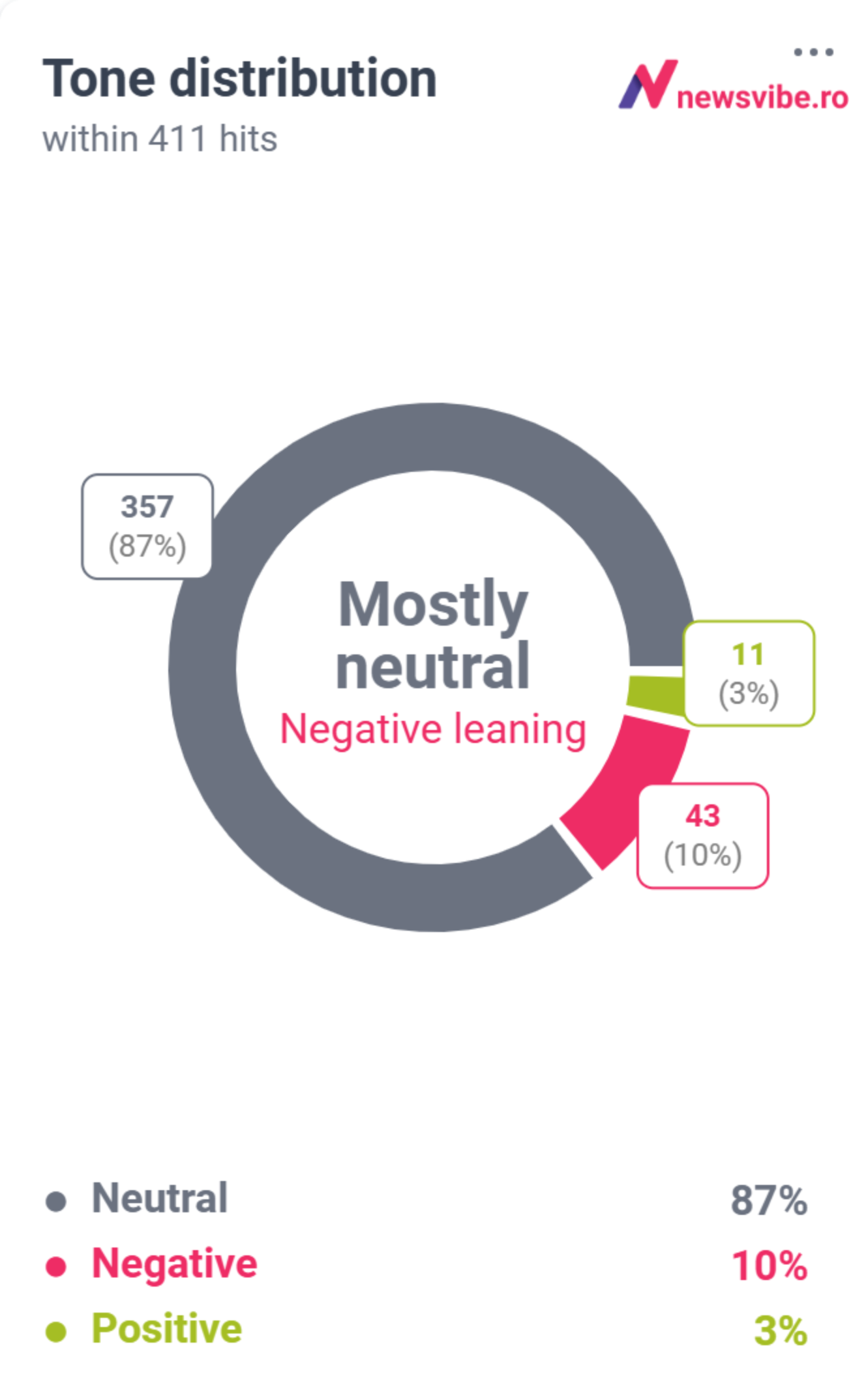
Analyzing the 411 articles published during the period of May 9 - 22, 2026, several clear features emerge regarding how Romania is represented in the Russian press. Of these, 357 (87%) have a neutral tone, 43 (10%) a negative tone, and 11 (3%) a positive tone.
 *****Synthesis made with the help of a data monitoring stream provided by the media monitoring platform NewsVibe Romania. The analysis, data, and images presented have been enhanced with the help of Machine Learning and Artificial Intelligence tools.
Latest News
18:30
18:20
18:06
17:50
17:50
See more news
NEWS ON THE SAME TOPICS