ANALYSIS Two weeks of respite: the US–Iran armistice at the Strait of Hormuz and the new map of global security



Always see our news on Google
The armistice agreed upon by Washington and Tehran is, for now, just a ceasefire in a war that has redrawn military balances in the Gulf and accelerated the fragmentation of the global order, without resolving Iran's nuclear and regional stakes.
The terms of the armistice: what was actually negotiated
From the parallel announcements from Washington, Tehran, and Islamabad, it appears we are talking about a 14-day armistice, with mandates and narratives interpreted differently by each side.
Suspension of airstrikes: The US will halt its air campaign against Iranian targets, conditioned on the respect of the ceasefire and the opening of the Strait of Hormuz.
The "safe" opening of the Strait of Hormuz: Washington speaks of "complete, immediate, and safe opening," while Tehran insists that the armistice actually confirms its dominant control over the strait.
The Iranian package in 10 points: American non-aggression, recognition of uranium enrichment, lifting of sanctions, a transit regime in Hormuz favorable to Iran, protection for allies (Hezbollah, etc.) and a declarative commitment not to manufacture nuclear weapons.
The political format involves US-Iran negotiations in Islamabad, under Pakistani mediation, with complementary roles of other regional mediators (Egypt, Turkey, Qatar).
The formula is deliberately ambiguous: the US presents it as a "deal" for reopening energy routes, while Iran sees it as an armistice on winning terms, maintaining its regional pressure capacity.
What are the chances of achieving lasting peace
Experts and analysis institutes are more likely to speak of a "window of de-escalation" rather than a clear prelude to peace.
Factors favoring a more stable agreement:
Very high war costs for all parties: strikes on Iranian infrastructure, as well as Iranian attacks on Israel and Gulf states, have generated panic in energy markets and internal political risks in Washington, Tehran, and Arab capitals.
Pressure from external actors (EU, China, Gulf states) for stabilizing Hormuz and oil prices.
Involvement of the UN and mediating states (Pakistan, Qatar, Egypt) trying to transform the armistice into a phased diplomatic process.
Factors pushing towards the resumption of confrontation:
Total ambiguity regarding the status of the Iranian nuclear program and the limits of ballistic capabilities.
Exclusion of key fronts: Hezbollah and the Lebanese theater remain gray areas, with the risk that an incident there could collapse the armistice.
Domestic politics: Trump has an interest in presenting the agreement as a maximal victory, while Tehran presents it as a step towards recognition of its regional role; each has little room for visible concessions.
In pragmatic terms, the chances of a permanent peace agreement are moderate to low in the short term: the armistice may be extended or "frozen," but the conflict architecture (nuclear, missiles, regional proxies) remains intact.
How the global security architecture has changed
The war in Iran and the armistice accelerate three trends: regionalization of conflicts, great power competition, and militarization of energy routes.
Strengthening the de facto axis of the US-Israel-Gulf states against the Iranian projection, with increased military cooperation and demand for American security guarantees in the GCC.
Opportunities for Russia and China: the redistribution of American resources from Europe and the Indo-Pacific to the Gulf offers them maneuvering windows in the Black Sea and in Taiwan/East Asia.
The vulnerability of the multilateral order: the UN remains marginal in decisions of war and peace, and mediation is taken over by ad-hoc coalitions (Pakistan, Qatar, Turkey), a symptom of a post-unipolar world.
Africa, South Asia, and Latin America feel the conflict primarily through energy price shocks and inflation, but also through increased political risk premiums for investments, which amplifies North-South disparities.
Who wins, who loses – direct actors
Table – political-military balance of direct actors
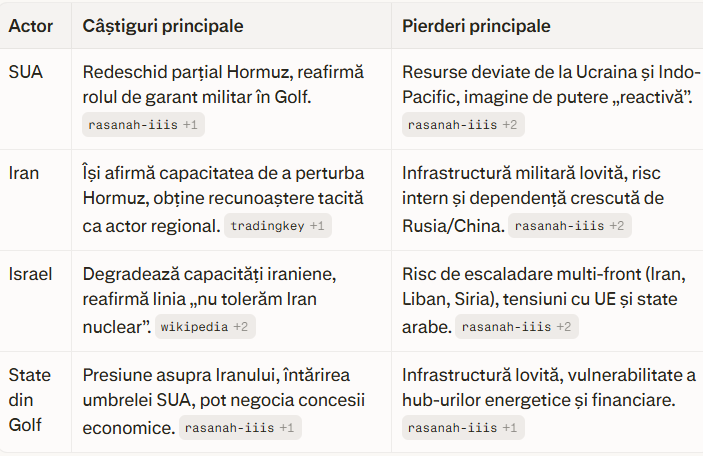 Symbolically, Iran has demonstrated that it can simultaneously strike targets in Israel, the Gulf, and in proximity to American bases, which strengthens its profile as a disruptive power, despite the damages suffered. The US and Israel have demonstrated the ability to penetrate Iranian defenses and neutralize strategic assets, but without being able to impose a political "surrender."
Indirect actors: EU (Romania), China, Asia, Australia
Table – impact on indirect actors
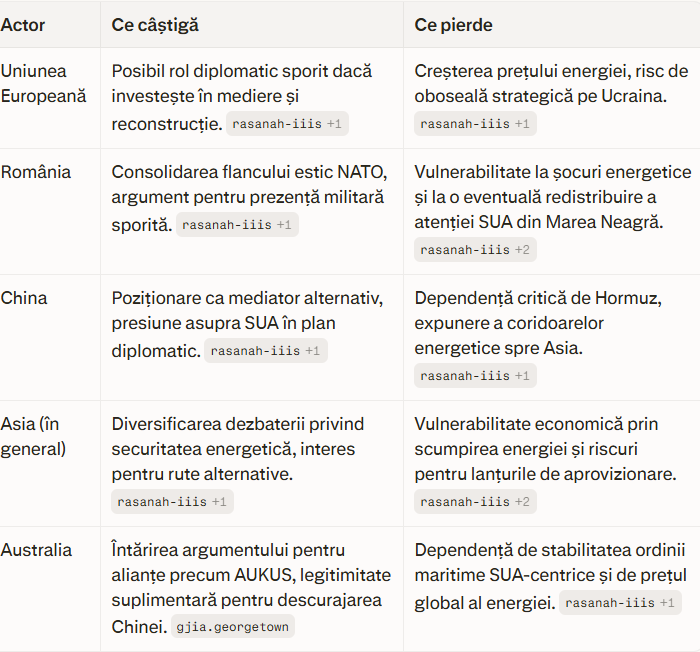 For the EU, including Romania, the big question is whether it can simultaneously manage two major crises – Ukraine and the Gulf – without fracturing internal cohesion and without facing public fatigue regarding external commitments. For China, the dilemma is between political solidarity with Tehran and economic dependence on the Gulf monarchies, which demand firmer guarantees against Iranian expansion.
Long-term economic and security effects
Think tanks and specialized analyses are already talking about a "Hormuz risk premium" that will remain structured in energy prices, even in the scenario of relative de-escalation.
In the long term, several trends are predictable:
Reconfiguration of energy routes: acceleration of investments in infrastructures that bypass Hormuz (pipelines through Saudi Arabia, UAE, Iraq-Turkey, East-Med corridors) and in LNG, which may weaken the de facto monopoly position of this choke point for international transport.
Further militarization of maritime routes: more naval escorts, multinational exercises, and security agreements in the Gulf, with possible frictions between American, European, Chinese, and possibly Russian patrols.
Pressure for energy transition in Europe and Asia: extreme volatility in oil and gas prices becomes an additional political argument for accelerating renewable energies and energy efficiency.
Multiplication of "connected" conflicts: any major crisis in Ukraine, Taiwan, or the South China Sea will now also be read through the lens of the impact on energy markets already strained by the Iranian precedent.
For Romania, the combination of exposure on the eastern flank and vulnerability to shocks in global energy markets transforms energy security policy (interconnections, diversification of suppliers, Black Sea) into a matter of national security relevance, not just economic.
Analysis conducted with the support of Perplexity
Latest News
23:01
22:57
22:53
22:50
22:43
See more news
NEWS ON THE SAME TOPICS







.webp)