



SPECIAL Informat.ro / Top International Politics Stories of the Past Week: The Crises That Shaped the International Agenda


Always see our news on Google
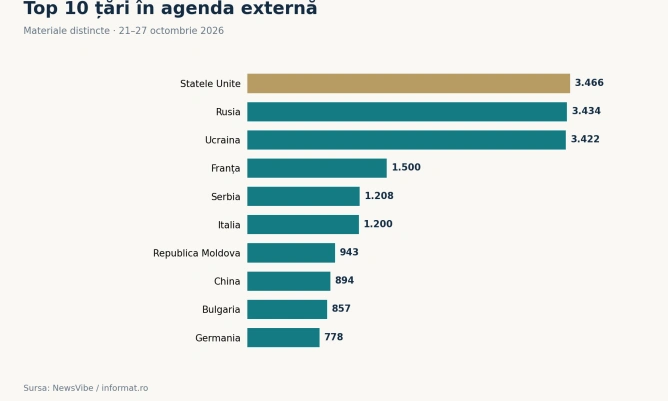
The week's international agenda was dominated by the war in Iran and its energy risks, the consolidation of military and economic support for Ukraine, as well as the reconfiguration of security alliances in the Middle East and the Horn of Africa. The data was collected by the NewsVibe Romania media monitoring platform between September 29 and October 5, 2026, identifying more than 10,000 articles published in the global press. The ranking of international policy topics is based on the number of mentions and their visibility in press articles from the past seven days, taking into account the estimated impact of each item and the recurrence of the subject across distinct sources.
The War in Iran and Energy Pressure
The war in Iran remained the topic with the greatest potential for global spillover because it combines nuclear risk, military confrontation, and the vulnerability of energy routes. The US administration acknowledged that the decision to launch the war was made with full awareness of the risks to energy flows and the possibility of short-term price increases.
The political justification put forward by Washington is that the world cannot accept a nuclear-armed Iran. Within this framework, the immediate economic costs are presented as subordinate to a broader strategic objective: preventing the development of Iran's nuclear capability. US Energy Secretary Chris Wright stated that President Donald Trump accepted the possibility of higher energy prices, considering this a necessary cost for limiting the nuclear threat.
At the same time, the United States is trying to convey that it has tools to limit the economic effects of the conflict. The administration is relying on increased domestic production and refining, larger energy flows through the Strait of Hormuz, and the use of strategic reserves. The G7 countries agreed to release 100 million barrels of fuel from strategic reserves over a period of four months, with an emphasis on easing pressure on diesel.
Diesel is one of the sensitive issues of the moment. It supports road transport, agriculture, logistics, and a significant part of industrial activity. A prolonged increase in its price can fuel inflation and quickly become a domestic political issue, including in states not directly involved in the conflict.
Developments in Iran show that energy is not merely a secondary consequence of the war. It is becoming a dimension of the confrontation. Any expansion of hostilities or new attacks on energy infrastructure in the Gulf could affect supplies and prolong market volatility. The US administration is ruling out neither the military option nor the diplomatic track, indicating that the outcome of the conflict remains open.
Ukraine: Military, Energy, and Industrial Support from Germany
The war in Ukraine has entered a stage in which external support is simultaneously defined as a defense measure, an investment in infrastructure, and industrial cooperation. German Chancellor Friedrich Merz's visit to Kyiv on October 4 confirmed this approach.
Germany announced a support package worth more than 1.3 billion euros. Of this amount, 1 billion euros is earmarked for military aid, including capabilities to defend against air threats and military technology. Another approximately 350 million euros is allocated to Ukraine's energy sector: generators, repairs to substations, and work on infrastructure damaged by Russian attacks ahead of winter.
The structure of the package is important. It reflects the reality that Ukraine needs not only weapons but also the capacity to keep its power grids and essential services operational. Attacks on infrastructure turn energy into a central component of the war. Maintaining electricity supplies becomes part of civilian and military resistance.
At the same time, Germany and Ukraine announced agreements totaling 8.5 billion euros, related to cooperation in security, production, procurement, and joint projects. This dimension shows that support for Ukraine is increasingly linked to European industrial capacity and the production of defense equipment.
The political message conveyed in Kyiv is that Ukraine's security and Germany's security are interdependent. Friedrich Merz presented the aid as a response to the intensification of Russian attacks on Ukrainian cities and infrastructure. In the same logic, Volodymyr Zelenskyy insists that support for Ukraine must be understood as an investment in Europe's stability and protection.
The Middle East: Gaza and New Defense Arrangements
The Israel–Hamas conflict returned to the spotlight through reports concerning tensions in the relationship between the Biden administration and the Israeli government in the spring of 2024. Brett McGurk, a former Middle East adviser, reported that President Joe Biden was considering “fairly drastic” measures against Israel after the attack in which seven aid workers from the World Central Kitchen organization were killed.
According to the account, suspending arms deliveries to Israel was among the options discussed. The action did not go as far as a complete halt to arms transfers, although some deliveries of heavy bombs were put on hold. The decision was also influenced by information that Iran was preparing an unprecedented air attack on Israel, a situation that forced Washington to prioritize the defense of its ally.
The return of this issue shows how difficult it can be to manage the relationship between the United States and Israel during a protracted conflict. On the one hand, Washington seeks to maintain security guarantees for Israel. On the other hand, the diplomatic costs and political pressure generated by the war in Gaza may limit the room for maneuver of US administrations.
At the same time, states in the region are seeking new mechanisms for military cooperation. The Political and Defense Strategic Committee of the Mecca Pact is due to meet again in Riyadh. The agreement brings together Turkey, Saudi Arabia, and Pakistan and stipulates that an attack on one of the signatories will be treated as an attack on all.
The Riyadh meeting aims to discuss recent developments and advance the process of institutionalizing the alliance. The foreign and defense ministers, as well as the chiefs of staff of the three states, are expected to attend. The immediate context is also marked by Houthi attacks on Saudi Arabia and broader regional tensions.
For now, the pact has political and defensive value rather than a fully defined operational role. Nevertheless, it signals an attempt by regional powers to build their own security architecture. Discussions about possibly expanding the agreement to other states show that the formula is regarded as more than strictly trilateral cooperation.
Alliances Reshaping the Horn of Africa
In the Horn of Africa, Egypt is hosting a meeting attended by the leaders of Eritrea, Sudan, and Somalia. The El-Alamein summit is taking place against the backdrop of renewed fighting in northern Ethiopia and worsening diplomatic tensions between Addis Ababa, Cairo, and Asmara.
The stakes of the meeting go beyond simple diplomatic coordination. Ethiopia accuses Egypt, Eritrea, and Sudan of supporting a rebellion against the federal government. At the same time, the four participating states are seeking to consolidate an alliance that could include broader military cooperation.
The dispute over the waters of the Nile remains one of the structural causes of the tensions. For Egypt, access to the river's waters is vital. For Ethiopia, managing water resources is linked to development and strengthening its regional position. The conflict over resources thus overlaps with political rivalries, military tensions, and concerns about internal stability.
The situation in the Horn of Africa shows how a local conflict can turn into a regional crisis when three elements intersect: access to resources, competition for influence, and the formation of security blocs. In the absence of de-escalation, any expansion of the fighting in Ethiopia could place the entire regional balance under pressure.
Implications for Romania
For Romania, the context of the past week primarily highlights European energy vulnerability. The war in Iran and the risk of disruption to flows through the Strait of Hormuz could generate volatility in oil and refined-products markets. Even without a direct disruption to supplies, pressure on international prices may have economic consequences for European states.
Second, the new German support for Ukraine underscores that the war on Europe's eastern border remains the main regional security issue. The energy component of the German package is particularly relevant: attacks on civilian infrastructure can have strategic effects comparable to those of operations on the front. For Romania, Ukraine's stability and its ability to keep essential infrastructure operational are directly linked to the security of the Black Sea region.
*****Summary prepared with the help of a data-monitoring feed provided by the NewsVibe Romania media monitoring platform. The analysis, data, and images presented were enhanced with the help of Machine Learning and Artificial Intelligence tools.
Latest News
17:15
17:15
17:15
17:15
17:02
See more news
NEWS ON THE SAME TOPICS







.webp)

.webp)


