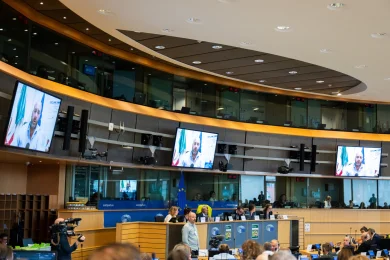
The project that prohibits euthanasia of healthy dogs is entering into debate in the Legal Commission of the Senate / The main amendments to the law for managing stray dogs.




Always see our news on Google
After the horrors discovered in dog shelters in Vrancea and Giurgiu, today in the Senate committees a modification of OUG 155/2001 regarding the management of stray dogs enters into debate, shifting the focus from killing dogs to prevention, sterilization, and the responsibility of authorities and owners, trying to avoid reproduction and the continuation of businesses with euthanizers and in other privately funded shelters from public money.
Euthanasia: from exception to "system solution"
After the case of "Ionuț", when in 2013 a 4-year-old boy died from dog bites on private land, Romania adopted a law that allows the euthanasia of dogs within 14 days, even of healthy ones, if they are not adopted or claimed.
Under current legislation, unclaimed or unadopted dogs within 14 days can be euthanized by the mayor's decision, the term being linked to "accommodation capacities and budget availability." Thus, according to the legislation, if there is accommodation capacity and budget availability, these dogs can be kept in the shelter. However, in practice, this mechanism has fueled million-euro contracts for shelters that have killed tens of thousands of healthy dogs, such as Vetmedan in Suraia or Aspa Ivets in Giurgiu.
The new project, submitted in 2025, explicitly prohibits the use of euthanasia as a method of managing the dog population and strictly limits it to incurably sick dogs, in extreme suffering, diagnosed upon entering the shelter and euthanized only based on a written medical report. The list of incurable diseases will be established and updated by the College of Veterinarians, which would remove arbitrary formulations of the type "disease" crossed out with correction fluid on euthanasia records, as happened in Suraia.
The "mass euthanasia" mechanism disappears after 14 days
Article 7 of OUG 155, which allows the euthanasia of unclaimed dogs after the 14-day period, is practically abolished in its lethal part. Paragraphs 2, 3, and 4 are repealed – those that gave the mayor the power to establish the euthanasia term by decision, "depending on accommodation capacities and budget." Only a rewritten Article 7 remains based on protection logic:
In the first 7 days, dogs can be claimed by the owner; from the 8th day, they can be claimed or adopted by individuals or legal entities from the country and abroad; adoption is free, and dogs can no longer be euthanized simply because they have exceeded a stay term in the shelter.
The 14-day term thus ceases to be a demarcation line between life and death and becomes only an administrative stage of claiming and adoption, not a threshold for mass killing, as has happened in documented private shelters.
Sterilization becomes the central tool of the law
Instead of euthanasia as a numerical control tool, the project pushes sterilization to the forefront, funded and monitored at the local and county level. All local councils, county councils, and CGMB would be required to allocate at least 0.1% of their budget annually for sterilization, identification, and registration, including of dogs without owners. The text rewrites article 13²: sterilization becomes mandatory for both owned and stray dogs, with exceptions for those with special regimes (purebred dogs, working animals, animals whose health condition does not allow intervention). Additionally, clinically healthy dogs, accepted by the community and non-dangerous, must be sterilized, microchipped, tattooed, and then returned to the territory, not euthanized.
Shelters: from "euthanasia factories" to a controlled and transparent network
The project also changes the institutional architecture that allowed the emergence of "dog slaughterhouses" with public money.
Animal protection structures will be established at the county council level and in county seat municipalities, required to create a management plan for a minimum of 5 years and to take over the coordination of inefficient local shelters.
Management services will be prioritized in direct management mode, and delegation to NGOs becomes a strictly conditioned exception: a minimum of 5 years of continuous activity, zero history of euthanizing healthy dogs, and no individuals previously involved in animal abuse.
For shelters, the project imposes:
complete medical treatment (deworming, vaccination, sterilization) for all housed dogs, not just for those "desired" for adoption; the obligation of body cameras during capture, transport, and delivery to the shelter; mandatory records not only on paper but also in digital format, published on the institutions' websites, with the number of dogs captured, adopted, euthanized, substances used, and the person who performed the procedure.
This type of transparency would have made it harder to hide the blatant discrepancies between the amount of T61 purchased and the number of dogs euthanized, as seen at Vetmedan, where the average dose would barely have killed a Chihuahua, not 20-kilogram dogs.
From "euthanasia as a business" to public responsibility
Investigations in Suraia, Giurgiu, Prahova, or Suceava have shown how a legislative framework designed after the 2013 tragedy was diverted into an economic model where each dead dog meant a free spot and an additional contract. The amendment project for OUG 155 tries to reverse the logic: public money for prevention, not for lethal injections, healthy dogs returned to the territory and monitored, not incinerated en masse, and shelters placed under a county umbrella with plans, indicators, and periodic checks. While the current law "tolerates" the euthanasia of healthy dogs after an administrative term, the new text redefines it as a last medical gesture, in a framework where local authorities can no longer pay, comfortably, dog slaughterhouses under the label of "managing strays."
Synthesis made with the help of a data monitoring flow provided by the media monitoring platform NewsVibe Romania. The presented analysis was enhanced with the help of Machine Learning and Artificial Intelligence tools.
Read also:
Latest News
22:48
22:43
22:38
22:20
22:15
See more news
NEWS ON THE SAME TOPICS