The EU-Ukraine corridors ensured 70% of Ukraine's imports in April 2026



Always see our news on Google
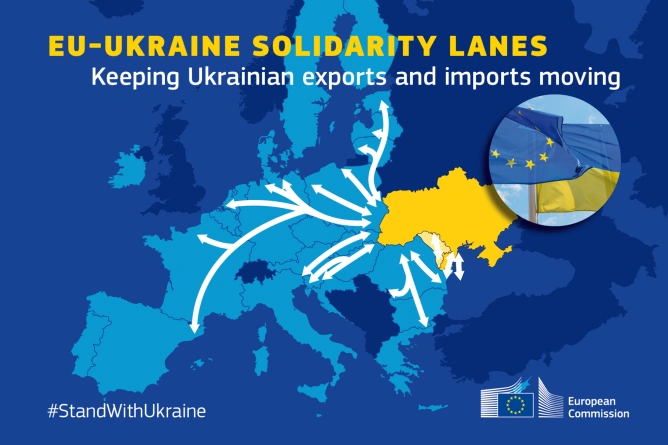
The EU-Ukraine solidarity corridors remained in April 2026 one of Ukraine's main trade routes, ensuring approximately 70% of imports and half of non-agricultural exports. Data published by the European Commission shows that since May 2022, these routes have supported trade exchanges estimated at 282 billion euros.
The European Commission announced that, in April 2026, the EU-Ukraine solidarity corridors ensured approximately 70% of Ukraine's imports, while the ports on the Black Sea covered about 30%. For non-agricultural exports, the corridors and maritime routes had similar shares, of about 50% each. For grain, oilseeds, and related products, the situation was different. In April 2026, approximately 10% of these exports passed through the solidarity corridors, while about 90% went through the Black Sea.
In short
The solidarity corridors ensured in April 2026 approximately 70% of Ukraine's imports.
For non-agricultural exports, the share of the corridors was about 50%, at the same level as the routes through the Black Sea.
Exports of grains and oilseeds primarily used Ukrainian ports on the Black Sea, which covered approximately 90% of these flows.
Since May 2022, the corridors have allowed the export of approximately 220 million tons of Ukrainian goods and the import of approximately 104 million tons of goods into Ukraine.
The total value of trade conducted through the corridors is estimated at approximately 282 billion euros.
According to data from the European Commission, since their launch in May 2022, the solidarity corridors have allowed Ukraine to export approximately 220 million tons of goods. Of this amount, approximately 101 million tons were agricultural products, including about 93 million tons of grains, oilseeds, and related products.
Non-agricultural exports made through these routes reached approximately 119 million tons. The Commission mentions, among these, ores, oil, and related products.
The corridors have also played an important role for Ukraine's imports. Since May 2022, they have allowed the entry into Ukraine of approximately 104 million tons of goods, including fuel, vehicles, fertilizers, military assistance, and humanitarian aid.
The total value of trade conducted through the solidarity corridors is estimated at approximately 282 billion euros. Of this amount, Ukrainian exports account for approximately 74 billion euros, while imports account for about 208 billion euros.
The solidarity corridors were created after the large-scale invasion of Ukraine by Russia and the blockade of Ukrainian ports. They provided alternative routes for exports and imports through rail, road, and inland waterways, with the involvement of EU member states, Ukraine, and Moldova.
The European Commission presents these routes as part of the EU's solidarity response to Ukraine. They are used for the export of grains, iron ore, oil, and other products, as well as for the import of goods necessary for the economy and Ukraine's resistance efforts.
Data for April 2026 shows that the role of the corridors varies depending on the type of product. For imports, they remain the dominant route. For non-agricultural exports, they share flows with the Black Sea. For agricultural products, the Ukrainian maritime corridor launched in August 2023 has become the main route.
The Commission notes that the new corridor of Ukraine to the Black Sea has strengthened its role over time. In April 2026, approximately 4.6 million tons of grains, oilseeds, and other related products were exported through this route.
The EU-Ukraine solidarity corridors were launched in May 2022, after the blockade of Ukrainian ports affected Ukraine's usual trade routes. Between May and July 2022, they represented the only option for Ukrainian agricultural exports.
In August 2022, the Black Sea Grain Initiative, mediated by the UN, allowed the resumption of some maritime grain shipments. Russia ceased its participation in this initiative in mid-July 2023, and the mechanism was interrupted.
In August 2023, Ukraine launched a new corridor in the Black Sea for commercial vessels entering and exiting Ukrainian ports. Its role has increased, especially for agricultural exports.
The European Commission states that the activity of the solidarity corridors aims to reduce bottlenecks, increase capacity, improve traffic management, simplify border controls, and invest in infrastructure or logistics equipment. In the long term, the corridors are linked to the reconstruction of Ukraine and its integration into the European single market.
Latest News
10:50
10:39
10:17
10:15
10:09
See more news
NEWS ON THE SAME TOPICS
















.webp)