A report estimates that Palantir paid under 21.7 million dollars in corporate tax on earnings of 1.66 billion and is moving European profits to the USA.



Always see our news on Google
The CICTAR and EPSU analysis supports that the European subsidiaries of the American company maintain low margins, while payments for services and licenses transfer revenues to the parent company, which did not pay federal corporate tax in the United States in 2025. The report does not accuse Palantir of illegal activities but calls for tax audits and stricter conditions for awarding public contracts.
Palantir reported a pre-tax profit of $1.657 billion in 2025, but reported global net corporate tax payments of less than $21.7 million and no federal corporate tax paid in the United States, according to an analysis published by the Centre for International Corporate Tax Accountability and Research in partnership with the European Federation of Public Service Unions. The authors argue that a large part of the profits made through international operations is recorded in the U.S., while European subsidiaries are compensated through formulas that leave them with low taxable margins. In summary
1. Palantir reported revenues of $4.475 billion and a pre-tax profit of $1.657 billion in 2025, equivalent to a margin of 37%. The accounting tax expense was $22.7 million, and net corporate tax payments were below $21.7 million.
2. The company did not pay federal corporate tax in the United States and paid approximately $2.5 million at the state level. The report estimates that Palantir's deferred tax assets could offset federal tax on the next $16.5 billion of profit.
3. Approximately 26% of Palantir's revenues came from outside the U.S., but only 4% of pre-tax profit was recorded abroad. The report interprets the difference as a sign of profit shifting to the American parent company.
4. In the United Kingdom and Germany, subsidiaries were compensated in 2024 for services provided to the parent company at cost plus a 7% margin. In Spain, payments for licenses to Palantir Technologies Inc. reached €13.8 million, representing 71.5% of the subsidiary's revenues.
5. CICTAR and EPSU call for a reevaluation of public contracts with Palantir, auditing of subsidiaries, and requiring companies receiving national contracts to record respective revenues in local subsidiaries. Palantir received detailed allegations before publication but did not respond to the report.
Palantir is an American company that develops platforms for integrating and analyzing large volumes of data. Its products are used by militaries, intelligence services, police, administrations, hospitals, and private companies.
The Gotham, Foundry, Maven, Apollo, and Artificial Intelligence Platform can bring together information from separate systems and transform it into tools for analysis, planning, and decision-making.
The company was founded in 2003 and is led by CEO Alex Karp, while co-founder Peter Thiel serves as chairman of the board. Initial investors included the In-Q-Tel fund, associated with the Central Intelligence Agency of the United States.
Palantir has expanded its operations through contracts with security and defense institutions in the United States, and in recent years has rapidly grown in Europe. The report identifies group entities in the United Kingdom, the Netherlands, Italy, Germany, Sweden, France, Poland, Denmark, Switzerland, Norway, Spain, Austria, Lithuania, and Belgium.
The CICTAR analysis focuses on the relationship between expansion through public contracts and the company's tax contribution. The authors believe that European administrations need to examine whether revenues obtained from taxpayer-funded contracts generate taxable profits in the states granting those contracts.
The report was produced in partnership with the EPSU trade federation and unions from several European states. The conclusions represent the authors' assessment and not a decision of a tax administration or a court.
Palantir received a series of detailed allegations before publication and the opportunity to respond, but did not provide comments, according to the report.
The authors note that they use expressions such as "tax avoidance" to describe various strategies, many of which are legal. The document does not make a concrete accusation of illegal activity but identifies areas that they believe authorities should examine.
Palantir has recorded rapid growth in revenues and profits. Revenues rose from just over $1 billion in 2020 to nearly $4.5 billion in 2025.
In 2025 alone, revenues increased by approximately $1.6 billion, or 56%. The report links this development to federal American contracts and demand for the company's artificial intelligence platforms.
Pre-tax profit rose from $237 million in 2023 to $489 million in 2024 and to $1.657 billion in 2025.
The pre-tax margin thus rose from 11% in 2023 to 17% in 2024 and 37% in 2025. The gross margin for 2025, excluding stock-based compensation, was 84%.
In that same year, the company recorded a global tax expense of $22.7 million. This corresponds to an effective accounting rate of approximately 1.4% of pre-tax profit.
Cash reporting indicates net corporate tax payments of $21.686 million. The difference between this amount and the accounting tax expense arises because taxes recorded in accounts and the money actually paid in a year are not always identical.
Of the amount paid, approximately $2.5 million represented state-level taxes. No federal corporate tax was paid in the United States.
The report shows that 2025 was the third consecutive year without federal corporate tax for Palantir. The authors believe that this situation could continue for several more years, even if the company's profitability remains high.
One of the main reasons is the volume of deferred tax assets. Palantir reported net deferred tax assets of over $3.5 billion at the end of 2025.
These assets include accumulated losses from previous years and other deductions that can be used to reduce future taxable profits. The report estimates that, at a federal rate of 21%, they could offset tax on profits of approximately $16.5 billion.
At the current profit rate, the company could avoid paying federal tax for nearly a decade, in the absence of tax changes or other factors. This estimate is made by the report's authors and does not represent a forecast issued by Palantir or the American tax administration.
Deferred tax assets include reported operational losses of approximately $2.6 billion. Of these, approximately $1.8 billion come from foreign losses, mainly from the United Kingdom, which can be carried forward without a time limit.
Employee compensation through stock represents another important component. The company records an expense when it grants shares or options, but the tax deduction is established when they effectively become the employee's.
If the value of the shares increases between these two moments, the tax deduction can be much larger than the initial accounting expense. The strong increase in Palantir's stock price has thus produced additional tax benefits.
The company's shares rose from approximately $15 at the beginning of 2024 to over $200 in October 2025, before dropping to around $138 in May 2026.
Since its listing, Palantir has granted an average of approximately $744 million annually in stock-based compensation to employees, directors, and consultants, according to the report's calculations.
In 2025, the increase in tax reserves associated with stock-based compensation was one of the main reasons for the increase in deferred tax assets.
The company also benefits from research and development credits. The report indicates including accumulated tax credits of approximately $152 million in California.
Tax changes adopted in the United States in 2025 allowed for the immediate deduction of certain internal research expenses and amounts that had previously been spread over several years. Palantir has used a significant portion of its tax assets related to research, but the total value of tax protection has continued to grow.
The report separately examines the difference between the location of revenues and that of profits. The United States generated 74% of Palantir's revenues in 2025, the United Kingdom 10%, and the rest of the world 16%.
In contrast, 96% of pre-tax profit was recorded in the United States and only 4% in all other jurisdictions.
This difference is also compared with the distribution of employees. Approximately 28% of the company's 4,429 employees worked outside the United States, generating 26% of revenues, but their activity was associated with only 4% of profit.
The situation has changed rapidly. In 2023, 26% of pre-tax profit was recorded outside the U.S., and in 2024 the share dropped to 13%.
The report interprets the reduction to 4% as a signal that a larger portion of international profit is being shifted to the American parent company.
The pre-tax margin of American operations reached 47.7% in 2025, after 22.5% in 2024. For operations outside the United States, the margin was 6.3%, nearly unchanged from 6.4% in the previous year.
The authors argue that the difference cannot be fully explained by a much higher productivity of American employees. They analyze for this purpose the financial situations of European subsidiaries for 2024.
The documents are available for ten states, while Switzerland does not publish comparable information, the Belgian subsidiary was only established in 2025, and the entity in the Netherlands operates as a branch of the British company.
European subsidiaries generally report high personnel costs and low margins. The authors believe that they operate in many cases as service providers for the parent company, instead of directly recording revenues from local contracts.
A subsidiary can receive its costs plus a predetermined margin for marketing, technical implementation, development, and support. The main contract revenue and associated profit can remain with the American entity.
This formula is known as "cost plus" and is used by many multinational groups. Transactions must comply with the principle that affiliated companies are compensated under conditions comparable to those between independent companies.
The report does not claim that the use of the method is automatically illegal. The criticism concerns the level of the margin and the cumulative effect of transactions on taxable profits in Europe.
In the United Kingdom, the declared main activity of the subsidiary includes providing marketing services, sales, development, technical implementation, and support for the parent company.
Compensation for these services was calculated in 2024 at cost plus a 7% margin, the same rate as in 2023.
For comparison, Palantir's global pre-tax margin was 17% in 2024 and rose to 37% in 2025.
The British subsidiary reported revenues of £247.3 million and a pre-tax profit of £25.3 million, equivalent to a margin of approximately 10%.
The tax expense was £2.1 million, and the effective rate was 8.2%, compared to a legal British rate of 25%.
The report applies a hypothetical margin of 15% to the revenues declared by the subsidiary and estimates that the profit would have been £37.1 million, and the tax approximately £9.3 million. The estimated difference compared to the reported tax expense is £7.2 million.
The 15% methodology is an estimate by the authors, not an official tax recalculation. They chose a lower margin than the global profitability in 2025, believing that a portion of the revenues must legitimately return to the parent company.
The report acknowledges that the method is imperfect. The accounts of the subsidiaries do not always include all revenues from local contracts and also lack sufficient information to accurately establish the functions, assets, and risks of each entity.
In the United Kingdom, Palantir had public contracts valued by the report at at least £670 million in 2026.
These include a seven-year contract worth £330 million for the federalized data platform of the national health system and a three-year contract worth £240 million with the Ministry of Defense.
The company also received a pilot contract with the British financial oversight authority, valued at approximately £30,000 per week, for analyzing information related to fraud, money laundering, and insider trading.
Revenues attributed by Palantir's consolidated reporting to British clients were $304.6 million in 2024, while the accounts of the British subsidiary indicated less than £158.9 million from British sources.
The authors believe that the difference may indicate that approximately one-third of British sales were recorded directly in the United States and not through the local subsidiary.
In 2025, revenues from British clients rose to $427.4 million, over 40% more than in the previous year.
The British subsidiary had 749 employees and personnel costs of £173 million in 2024. Approximately £61.9 million represented stock-based compensation.
These costs reduce the accounting profit of the subsidiary and can produce tax deductions. The report specifies, however, that a portion of the tax benefit cannot be used immediately, as it is greater than the available profit.
The United Kingdom does not appear among the states where Palantir paid the highest cash taxes in 2025, even though it represents the company's largest foreign market.
The largest external tax payments reported by Palantir were approximately $5.8 million in South Korea, $4.8 million in Japan, $2.8 million in France, and $1.7 million in Germany. All other external jurisdictions received approximately $4.1 million combined.
The report also draws attention to the application of the global minimum tax. The British subsidiary reported an additional tax of approximately £23,000 in 2024 to bring the effective rate in line with international rules.
The authors argue that the exemption of multinational companies based in the United States from certain components of the minimum tax will eliminate such additional payments in the future.
The report states that the "side-by-side" international agreement reduces the impact of the rules on Palantir. The British government's estimate is cited, stating that the change would reduce tax revenues by approximately £700 million annually, while the Netherlands would lose approximately €120 million.
In Germany, the subsidiary reported revenues of €49.5 million and a pre-tax profit of €2.1 million in 2024, equivalent to a margin of 4.2%.
The tax expense of €641,000 corresponded to an effective rate of approximately 31%, close to the legal rate. However, the report considers that the rate is applied to a profit base that is already reduced.
Approximately €32.4 million of the German subsidiary's revenues, or 65% of the total, came from technical and support services provided to the parent company. Compensation used a margin of 7% over costs.
Applying the hypothetical margin of 15%, the report estimates a profit of €7.4 million and a tax of €2.2 million. The difference compared to the reported tax expense would be approximately €1.6 million.
In Spain, the subsidiary reported revenues of €19.3 million and a pre-tax profit of €561,000, representing a margin of approximately 3%.
The company recorded a tax expense of €147,000, close to the legal rate when calculated on the reported profit.
The report shows that the subsidiary paid €13.8 million to the parent company for licenses. This amount represented 71.5% of its revenues and was approximately 24.5 times greater than the pre-tax profit.
The authors consider these payments the main mechanism through which the profit of the Spanish operation is transferred to the United States.
Applying the hypothetical margin of 15% produces an estimated profit of €2.9 million and a tax of €722,000. The calculated difference by the report is approximately €599,000.
The Spanish subsidiary received a €16.5 million contract from the Ministry of Defense in 2022 for managing the databases of the military's information center, without a public tender, according to sources used by the authors.
In France, the situation is different. The subsidiary reported revenues of €54.5 million, a pre-tax profit of €4.7 million, and a tax expense of €1.6 million in 2024.
The effective rate of approximately 33% exceeded the legal French rate, and the margin of 8.7% was closer to the international level than in other European states analyzed.
The report links this situation to an audit conducted by the French tax authorities. The audit for the years 2020 and 2021 resulted in an additional corporate tax obligation of €2 million and employee participation contributions of €430,000.
The company has extended the findings of the audit to the year 2022, recording an additional €377,000 in tax and €433,000 in employee participation obligations.
CICTAR believes that more active enforcement of tax rules and the existence of a workers' council have contributed to a tax base closer to actual activity.
The report estimates a tax difference for France of approximately €544,000 by applying its hypothetical margin of 15%, much lower than the differences calculated for the United Kingdom or Germany.
In Norway, the subsidiary reported revenues of €6.1 million, a profit of approximately €400,000, and a tax expense of €99,000.
Approximately 72% of revenues came from services provided to the parent company, also compensated with a margin of 7% over costs.
Costs associated with stock options granted to Norwegian employees, estimated at approximately €8.9 million, were recorded in the accounts of the parent company in the United States and not in the salaries of the Norwegian subsidiary.
In Denmark, the subsidiary reported revenues of €4 million, a pre-tax profit of €379,000, and a tax expense of €84,000.
Personnel costs represented approximately 91% of the gross result, and the subsidiary described its main activity as providing services to the parent company.
Sweden reported revenues of €13.7 million and a pre-tax profit of €1.1 million, while Poland, Italy, and Lithuania had smaller operations.
In Italy, over 89% of reported revenues came from the parent company. Only approximately €139,000 were described as revenues from contracts with the public administration.
In the Netherlands, Palantir operates through a branch of the British company and does not publish separate financial statements for local operations.
The report states that this structure hinders the assessment of revenues, profits, personnel, and taxes from a market where Palantir has worked for several years with police, defense, intelligence services, and other institutions.
The Dutch government is urged to examine why the operation can continue as a branch of a British entity and to request separate financial information.
The report also includes the dimension of European investments in the company. A hundred banks, asset managers, insurers, and European pension funds held Palantir shares worth at least $27 billion at the end of 2025.
Among the largest mentioned investors are Norges Bank, with approximately $5.1 billion, Amundi, with $3 billion, Legal & General, with $2.5 billion, Barclays, with $2.2 billion, and Deutsche Bank, with approximately $2 billion.
The authors call on institutional investors to examine the risks associated with the company's activities, its security contracts, and its position on human rights and taxation.
The report's recommendations go beyond the Palantir case and concern tax policy and public procurement applicable to multinational technology companies.
The first recommendation is to reevaluate existing contracts and avoid future contracts when alternatives exist. If a contract cannot be concluded, authorities should publish the nature, scope, and tax treatment of the revenues and profits involved.
The authors call on tax administrations to audit Palantir's local subsidiaries and to cooperate at the European level for the exchange of information and sharing the costs of investigations.
A central recommendation is that administrations should no longer sign contracts with the American parent company or offshore entities when the service is provided in a European state.
Revenues from a national public contract should, according to the report, be fully recorded in the local subsidiary. Payments for licenses and services to other group companies should be verified and limited to levels considered reasonable.
The report calls for the expansion of public data disclosure for each country and the possibility for contracting authorities to request confidential reports on countries before awarding a contract.
The authors propose that repeated payment of a tax considered unreasonably low could become grounds for exclusion from public procurement.
Such a change would require clear legal criteria. Current legislation allows for consequences for established tax violations, but the use of legal and politically contested structures does not automatically produce exclusion.
The report also supports the resumption of the debate on a European tax on digital services. France, Spain, and Italy already apply national taxes of 3% on certain digital revenues.
The authors recommend that any potential European tax should also cover revenues from software and IT services, not just online advertising.
Guarantees against the excessive use of tax benefits associated with stock-based compensation are also requested, as well as an analysis of the possibility of a European employee council for Palantir.
In the long term, the report supports the unitary taxation of multinational groups. Global profit would be calculated at the level of the entire company and distributed to states through a formula based on actual economic activity, instead of treating each subsidiary as a separate company.
CICTAR also proposes supporting United Nations negotiations on international tax cooperation and advancing the European BEFIT project, along with a minimum effective tax rate of 25%.
The report does not calculate a total European tax loss produced by Palantir. National estimates are built on the basis of available accounts and a hypothetical profit margin of 15%.
The authors warn that the results may underestimate the difference, as some local contracts are recorded directly by the parent company and do not appear in the revenues of European subsidiaries.
These calculations do not include confidential information regarding internal transfer pricing policy, intellectual property, contracts, and risks assumed by each entity.
Only tax authorities can decide whether a transaction between affiliated parties complies with the arm's length principle and can adjust taxable profit after an investigation.
The report thus provides arguments and estimates for a more in-depth verification, without establishing the existence of a tax violation.
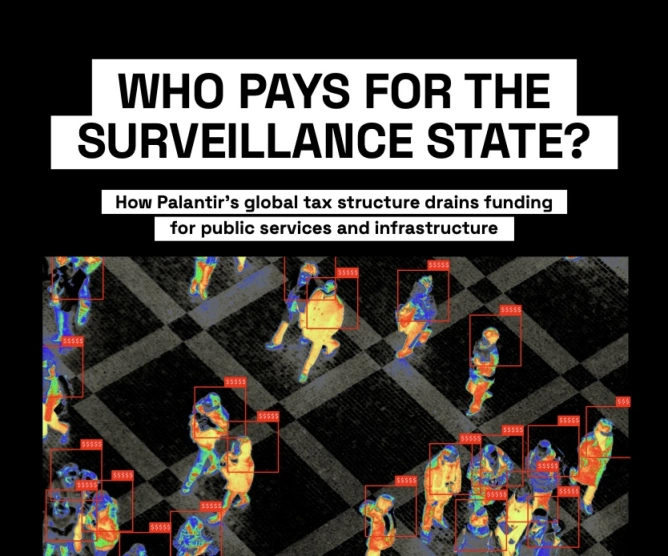
The report "Who Pays for the Surveillance State?" was published in July 2026 by CICTAR in partnership with EPSU and several European unions. The analysis uses Palantir's annual report for 2025, the financial statements of European subsidiaries for 2024, and information about the company's public contracts.
The document concludes that Palantir's expansion in Europe must be analyzed simultaneously from the perspective of taxation, public procurement, digital sovereignty, and data control. Palantir did not respond to the allegations made by the authors before publication, and the report specifies that it does not make accusations regarding illegal activities.
Latest News
22:58
22:44
22:41
22:21
22:08
See more news
NEWS ON THE SAME TOPICS
.webp)