Moldovans saved more than EUR 6 million through SEPA in the first six months



Always see our news on Google
The financial integration of the Republic of Moldova into the EU is already producing effects before accession, according to European Commissioner Valdis Dombrovskis. Participation in SEPA generated savings of more than EUR 6 million for citizens and companies in the first six months, while the EUR 1.9 billion Growth Plan finances economic, administrative and financial market reforms.
Citizens and companies in the Republic of Moldova saved more than EUR 6 million in the first six months of using transfers through the Single Euro Payments Area, SEPA, according to European Commissioner for Economy and Productivity Valdis Dombrovskis. The European official presented payment integration as one of the examples through which closer ties with the European Union are already producing economic effects before accession, alongside the elimination of additional roaming costs, energy integration and the development of financial markets.
In brief
The Republic of Moldova has been part of SEPA since October 2025, and citizens and companies saved more than EUR 6 million through transfers in the first six months.
The EU’s Growth Plan for Moldova is worth EUR 1.9 billion for the 2025–2027 period and links funding to the implementation of reforms.
More than EUR 500 million have so far been made available through the mechanism, but this wording should not be confused with the full expenditure of the amount.
The reforms cover the digitalisation of the administration, reducing the administrative burden, combating corruption and fraud, fiscal governance and the development of capital market infrastructure.
Dombrovskis warns that faster economic integration must be accompanied by macroeconomic stability, sustainable public finances and the independence of the central bank.
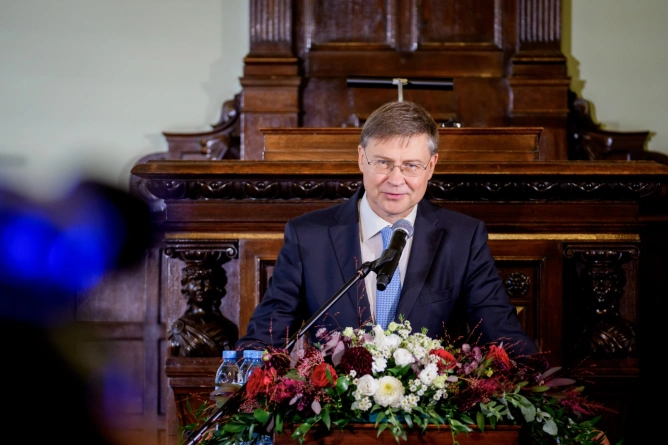
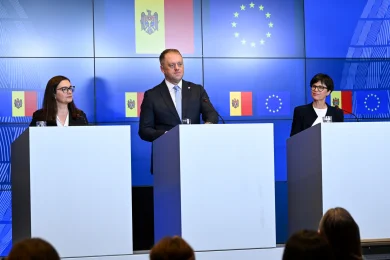
Dombrovskis made the statements at the annual conference organised in Chișinău by the National Bank of Moldova, in partnership with Banque de France and the National Bank of Romania.
The identity of the speaker, who appeared anonymously in the technical transcript of the recording, is confirmed by the official programme and the National Bank of Moldova. The Commissioner presented European integration as an economic process already under way, rather than as a benefit that begins only on the day of accession.
One of the most concrete examples is the Republic of Moldova’s participation in SEPA since October 2025. The system enables euro payments to be made under conditions closer to those existing within the Union, simplifying cross-border transfers for individuals and companies. According to Dombrovskis, the savings generated by these transfers exceeded EUR 6 million in the first six months of operation, providing a direct measure of the advantages of financial integration before accession.
The process is also continuing through the development of domestic financial infrastructure. Dombrovskis mentioned the fund of funds of the Organization for the Development of Entrepreneurship, intended to attract and channel local and international investment into startups, as well as the creation of the International Stock Exchange of Moldova. These initiatives are presented as stages in the development of the capital market and the closer connection of Moldova’s financial system with the European market.
Integration is advancing in parallel in telecommunications. Since 2026, the Republic of Moldova has benefited from the European “Roam Like at Home” regime, which allows users from Moldova who are in the EU and European citizens who are in Moldova to use mobile services without the roaming surcharges that previously existed. The measure extends the benefits of the European market to consumers before the formal accession process is completed.
Energy is another component, in a country that has been exposed in recent years to severe supply and price shocks. Dombrovskis identified the development of a new electricity interconnection with the EU market as a tool for reducing energy vulnerability. However, he pointed out that better infrastructure does not eliminate exposure to global price shocks, meaning that energy integration should be viewed as a measure of resilience and diversification, not as a guarantee against price increases.
The main financial support for this transformation is the Growth Plan for the Republic of Moldova, worth EUR 1.9 billion for the 2025–2027 period. It is the largest financial package so far offered by the European Union to the Republic of Moldova and operates through the Reform and Growth Facility, where access to funds is conditional on meeting the stages set out in the reform agenda.
Dombrovskis said that more than EUR 500 million in European funding had already been made available as reforms progressed. Commission data indicate approximately EUR 504 million released through the Facility. However, this amount should not be interpreted as EUR 504 million already spent in the economy, since payments, the release of resources, the contracting of investments and actual expenditure represent different stages.
The conditionality of funding covers a wide range of reforms. Among the priorities mentioned by the Commissioner are reducing the administrative burden on companies, digitalising public services, intensifying anti-corruption measures and strengthening fraud-prevention systems. In the financial sector, the agenda includes developing the stock exchange and post-trade infrastructure, as well as strengthening investor protection.
European integration alone does not guarantee income and productivity convergence, Dombrovskis warned. The experience of previous enlargements shows that access to the single market and investment can accelerate the closing of economic gaps, but the outcome depends on domestic policies and maintaining a stable macroeconomic framework. In the case of the Republic of Moldova, the Commissioner identified the persistent budget deficit and the increase in the public debt-to-GDP ratio as areas that still require attention.
For fiscal policy, the recommendations made in the speech include increasing budget revenues, prioritising strategic expenditure, better management of public investment and debt, and strengthening medium-term planning. Dombrovskis linked these elements to the EU’s economic governance rules and to the state’s ability to preserve sufficient fiscal space for investment and for responding to future crises.
The independence of the National Bank of Moldova is presented as another important condition for convergence. A credible monetary policy focused on price stability supports investment and confidence, while closer ties with the EU may increase the importance of this anchor as financial markets open up. Faster capital flows can bring additional investment, but they can also generate exchange-rate pressures, excessive credit growth or new inflationary risks if the domestic market is not sufficiently developed.
The Republic of Moldova is already at a more advanced stage of the formal accession negotiations. In 2026, the process moved from screening towards the actual opening of negotiation clusters, while economic integration is progressing separately through access to European instruments and policies. The two processes are linked, but they are not identical: the savings from SEPA or the funds from the Growth Plan are benefits obtained before accession and do not mean that the political and legal stages of the negotiations have already been completed.
The economic message conveyed in Chișinău is therefore that closer ties with the EU produce measurable effects before membership status is acquired, but also increase the need for strong economic institutions. The integration of payments, telecommunications, energy and financial markets can reduce costs and attract investment, but turning these advantages into sustainable convergence depends on the continuation of reforms, the stability of public finances and the credibility of monetary policy.
Latest News
21:38
21:24
21:11
20:59
20:42
See more news
NEWS ON THE SAME TOPICS

.webp)