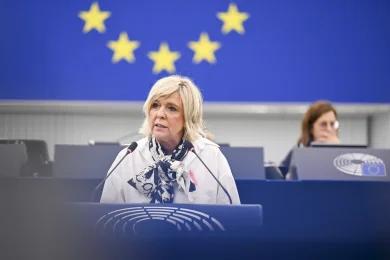
MEPs call for results in tax dialogue with the United States and warn about corporate anonymity in Delaware




Always see our news on Google
The delegation of the European Parliament’s Subcommittee on Tax Matters considers the Side-by-Side system a basis for simplifying global minimum taxation and resuming discussions on the digital economy, but criticizes the elimination of beneficial ownership reporting obligations for U.S. companies and the asymmetry it identifies in the exchange of information under FATCA.
A delegation of four Members of the European Parliament from the Subcommittee on Tax Matters (FISC) of the European Parliament concluded a visit to Washington and Delaware with a call for concrete results in tax dialogue with the United States. The delegation, led by Luděk Niedermayer, an EPP Member of the European Parliament from the Czech Republic, identified the Side-by-Side system and taxation of the digital economy among the areas where cooperation can advance, but criticized U.S. developments regarding corporate ownership transparency.
In brief
1.The FISC delegation says that dialogue with the United States must turn political agreements on international taxation into functioning rules, with simplifications for companies and a level playing field between U.S. and European groups.
2.The Side-by-Side system, agreed within the OECD/G20 Inclusive Framework in January 2026, introduces safe-harbour mechanisms for certain multinational groups and simplifications for applying the global minimum tax, without eliminating eligible domestic top-up taxes.OECD)
3.MEPs criticize the elimination of beneficial ownership reporting obligations for companies incorporated in the United States and warn about the use of anonymity by certain shell companies in Delaware. In August 2026, FinCEN turned this exemption into a permanent rule for U.S. companies and persons.FinCEN.gov)
4.The delegation also discussed the tax implications of artificial intelligence, the exchange of information under FATCA, and the effects of U.S. tax policy on interest rates and the global economy, considering the rising cost of debt service a risk that must be monitored.
One of the central points of the visit was the Side-by-Side system, resulting from negotiations on Pillar Two of international tax reform. The European delegation indicated that simplifying the rules must be combined with maintaining comparable conditions for U.S. and European companies and preserving the robustness of the international tax system.
In January 2026, the OECD/G20 Inclusive Framework on Base Erosion and Profit Shifting agreed on a Side-by-Side package for the coordinated operation of the global minimum tax. The package introduces simplifications to calculation and reporting, a protection regime for certain tax incentives based on economic activity, and two safe-harbour mechanisms for multinational groups with a parent company in a jurisdiction that meets the established criteria. Eligible domestic top-up taxes, known as QDMTT, remain applicable.OECD)
The OECD continued implementing the package in September, when it published new administrative guidance and an updated version of the standard GloBE Information Return. The revised form includes the Side-by-Side simplifications and applies to financial years beginning on or after 31 December 2025.OECD)
For the European Parliament delegation, the agreement on Side-by-Side may also create room for resuming negotiations on Pillar One, the part of the international reform addressing the allocation of taxing rights in the digitalized economy. MEPs say that the discussion on taxing the digital economy will show whether the EU and the United States can turn dialogue into a more broadly acceptable system and consider that the future tax implications of artificial intelligence development will raise additional questions.
The delegation’s message is more critical, however, regarding transparency. MEPs consider that the exchange of information under the Foreign Account Tax Compliance Act (FATCA) remains unbalanced and describe the elimination of the beneficial ownership reporting requirement for U.S. companies as a setback. FATCA requires, among other things, foreign financial institutions to report to U.S. authorities information on certain accounts held by U.S. taxpayers, while exchanges between administrations are organized through the applicable agreements.IRS)
The criticism regarding beneficial owners concerns the Corporate Transparency Act. The Financial Crimes Enforcement Network issued an interim rule in March 2025 that removed companies incorporated in the United States and U.S. persons from the scope of beneficial ownership information reporting obligations. In August 2026, FinCEN adopted the final rule, permanently eliminating these obligations for U.S. companies and persons, while certain foreign entities registered to conduct business in the United States continue to have reporting obligations.FinCEN.gov)
Delaware became a distinct focus of the delegation’s message. MEPs described the state’s corporate law system as predictable and efficient for companies, but stated that the opacity and anonymity associated with certain shell companies can create risks of tax evasion, tax avoidance, money laundering, and other illicit uses. At the same time, the delegation noted that the Delaware state administration supports the Corporate Transparency Act and expressed hope that the current framework will be amended.
The visit also included discussions on the relationship between tax policy, the budget, and global financial conditions. According to the delegation’s statement, participants addressed the fiscal sustainability of the United States and the effects of U.S. tax policy on interest rates and the global economy. MEPs considered that rising debt-service costs could become a relevant risk for the U.S. economy and, given its size and the dollar’s global role, for the international economy.
The visit does not itself produce legislative changes or a new tax agreement between the European Union and the United States. It does, however, indicate the political priorities that the FISC delegation intends to pursue in transatlantic relations, from implementing the Side-by-Side system and taxing the digital economy to beneficial ownership transparency and the international exchange of tax information.
Latest News
22:25
21:55
21:40
21:26
21:08
See more news
NEWS ON THE SAME TOPICS
.webp)