The Commission supports national taxes on windfall profits in the energy sector, while ECOFIN will discuss a possible European response



Always see our news on Google
The European Commission supports the right of Member States to tax the windfall profits of energy companies and is prepared to offer them examples of good practice, while the Irish presidency of the Council announces a new discussion at the level of finance ministers. The positions expressed on Wednesday, 7 October, in the European Parliament represent an important change of stage in the debate that resurfaced with the rise in energy prices: there is now an institutional discussion on the instrument, but no new European tax has been adopted.
In brief
Energy Commissioner Dan Jørgensen says that Member States are best placed to decide whether to tax the windfall profits of energy companies.
The Commission says it will respect national decisions, provide examples of good practice and assess the effects on the single market.
The Irish presidency of the Council announced that the taxation of windfall profits will be discussed this week at ECOFIN and examined by the Council’s technical bodies.
Six Member States previously called for a European framework, drawing on the experience of the temporary mechanism used in 2022 and 2023.
Neither the Commission nor the Council has so far announced a new mandatory contribution at EU level.
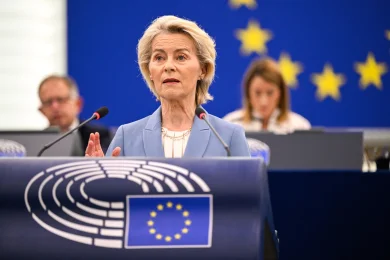
The plenary debate was requested by the Greens/EFA group and focused on the possibility that part of the additional profits earned by energy companies amid rising prices could be used to reduce pressure on households and the economy. Marie Toussaint, a French MEP from the Greens/EFA group, called for European action, arguing that the extraordinary benefits generated by the crisis should help finance measures for consumers and the energy transition.
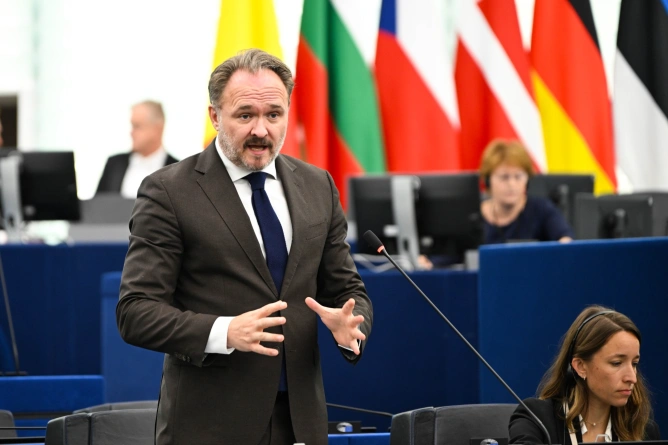
The Commission’s response, however, separated two levels of action. Dan Jørgensen, the European Commissioner for Energy and Housing, said that company taxation remains primarily a national competence and that states are best placed to adapt any potential tax to the structure of their own energy sector and to the operators active in their market.
“Member States are best placed to tax windfall profits based on domestic specificity of their own energy sector and local operators”, Jørgensen said in concluding the debate. The Commission will respect the decisions of states that resort to such taxes and is prepared to provide good practices concerning national measures.
This position does not mean that the European Executive rules out any subsequent joint intervention. Jørgensen said that price developments must be monitored and that the EU must remain prepared to use additional instruments to protect consumers if the situation requires it. The Commission is simultaneously analysing the effects of national measures on the single market and insists that taxation must not discourage the investments necessary in low-emission energy.
A concrete step will follow at Council level. Thomas Byrne, Irish Minister of State for European Affairs and Defence and representative of the Council presidency in the Strasbourg debate, announced that the taxation of windfall profits will be discussed this week within ECOFIN. The Council’s preparatory bodies will also carry out a technical analysis of the options.
Byrne recalled that six Member States sent a letter to the Irish presidency in August calling for an EU-level framework for taxing the windfall profits of energy companies. He presented the taxation of such profits as one of the fiscal measures that can be assessed in the context of the rising cost of living, without announcing that the 27 states had reached agreement on a new common instrument.
The Irish presidency asked the Commission to monitor both energy prices and data on windfall profits in the sector and to assess whether the situation warrants an intervention similar to that adopted in 2022. The Council discussion will include an exchange of experience between states that have already introduced taxes or extended existing measures.
The 2022 precedent is important, but it does not automatically represent the model for any possible new tax. During the energy crisis caused by reduced energy supplies following Russia’s invasion of Ukraine, the EU introduced, through Regulation 2022/1854, a temporary solidarity contribution for companies and permanent establishments active in oil, natural gas, coal and refining.
The mechanism applied to taxable profits in 2022 and/or 2023 that exceeded by more than 20% the average taxable profits in the four tax years beginning in 2018. The contribution had to have a rate of at least 33% applied to this base, and states could apply equivalent national measures.
The revenues were intended for objectives such as supporting households and companies affected by high prices, reducing energy consumption, investing in energy efficiency and renewable energy, or protecting jobs. The instrument was expressly designed as an exceptional and temporary measure for 2022 and 2023.
The current discussion begins from a different context and does not, for the time being, establish either the calculation base or the rate of any possible common contribution, nor the sectors that would fall within its scope. A new European intervention would require its own proposal and legal basis. For this reason, the parameters of the 2022 mechanism cannot automatically be transferred to companies in 2026.
The Commission had already given states room for action in April through AccelerateEU, the response package to the new increases in energy prices. The document states that states may use measures concerning the taxation of windfall profits to support social fairness, while the Commission can provide assistance and examples of good practice, while also assessing the effects on the single market.
Political positions in Parliament remain divided. Supporters of the tax argued that part of the benefits generated by rising prices should be redistributed to consumers and energy investments. Other speakers warned that additional taxation could reduce the liquidity and investment of European companies and weaken competitiveness.
This difference is also relevant to the next institutional step. The debate of 7 October was a thematic debate requested under Article 169 of the Parliament’s Rules of Procedure and was not followed by a vote on a new tax. ECOFIN can now discuss the options and the technical analysis, but the emergence of a common mandatory contribution at EU level would require a separate decision.
For now, the immediate consequence for states is clearer than the prospect of a European tax: the Commission confirms that governments can introduce or extend their own measures on windfall profits and do not have to wait for a new common mechanism to be established in order to act, provided that EU law and the functioning of the single market are respected.
Latest News
22:57
22:53
22:42
22:30
22:28
See more news
NEWS ON THE SAME TOPICS
.webp)
.webp)