



McGrath supports tying EU funding for 2028–2034 to respect for the rule of law and the implementation of reforms



Always see our news on Google
The Commissioner wants the budget negotiations to preserve the guarantees concerning the rule of law and the Charter of Fundamental Rights, alongside the reforms undertaken in the national and regional plans. The proposal provides for distinct procedures for blocking payments, while the final rules have not yet been adopted.
Michael McGrath supports retaining in the future EU budget conditions that would make access to funds dependent on respect for the rule of law and on the implementation of reforms undertaken by states. The Commissioner for Democracy, Justice, the Rule of Law and Consumer Protection defended the two components of the Commission’s proposal for the 2028–2034 period, which are under negotiation, citing the experience of recovery plans as an argument for using European funding to support reforms.
In brief
1.McGrath defends two components of the proposal for the future budget: respect for the rule of law and the Charter of Fundamental Rights, and linking reforms to investments. He calls for their retention in the negotiations.
2.The plans would include milestones and targets for reforms and investments, with amounts corresponding to completed stages. Obtaining funding would thus depend on concrete commitments.
3.The current conditionality regulation would continue to protect the EU budget, on the basis of a sufficiently direct link with financial risks. The plans’ safeguards would be additional.
4.The Commissioner invokes the recovery experience as an argument for reforms. However, the regulation for future plans is still in the legislative process, and his statement does not change the conditions for current payments.
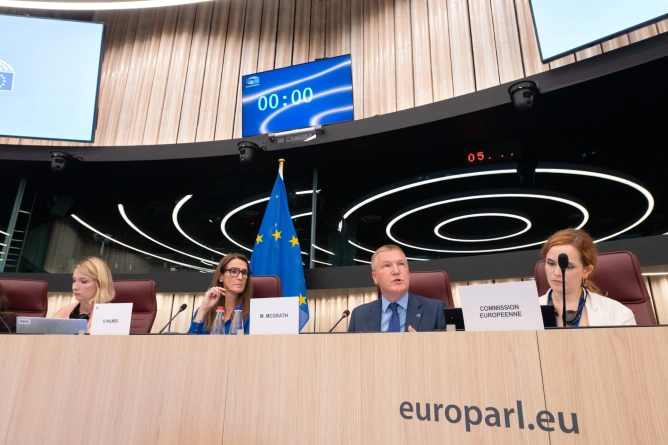
The position was presented on 15 September, during an exchange of views with the Democracy, Rule of Law and Fundamental Rights Monitoring Group within the LIBE Committee of the European Parliament. Asked how firmly he would defend these conditions in the budget negotiations, McGrath said that he would support maintaining the proposal. He distinguished between horizontal compliance with the rule of law and the Charter of Fundamental Rights and linking reforms to investments under the national and regional partnership plans.
The plans would bring together funds managed by states and regions within a common strategy, with cohesion policy and agriculture at the center. The Commission proposes that national, regional and local authorities, together with other partners, participate in their preparation and implementation. Respect for fundamental rights and the rule of law would constitute both a condition for investments and an objective of the funded reforms.
The reform component would operate through milestones and targets established in the plans. Reform and investment measures would have stages to be completed in order to obtain payments, and the financing decision would specify the amount corresponding to each stage. The Council would approve the plan on a proposal from the Commission. A study by the European Parliament Research Service describes a model inspired by the payment conditions of recovery plans.
Horizontal conditions would have to be respected throughout the implementation period. If it found that they had not been fulfilled, the Commission would notify the state, which would have two months to submit observations and take remedial measures. The decision would identify the measures affected, taking into account the financial impact and the characteristics of the violation. The related payments would remain blocked until the condition was fulfilled.
The authority that would decide differs between the two procedures. For the Charter of Fundamental Rights, the Commission would decide; for the rule-of-law condition, the Council would decide, on a proposal from the Commission. The difference is highlighted by the European Court of Auditors.
Article 67 would separately allow payments to be suspended for unfulfilled milestones or targets, or for reversed progress. The state could submit observations before the suspension.
The current budgetary conditionality regulation would continue to apply to the entire EU budget. It requires a sufficiently direct link between a breach of the rule of law and the adverse impact on, or serious risk to, the budget. The Commission proposes the measures, and the Council decides; the instrument can be used when other procedures would not protect the funds more effectively. The new safeguards in the plans would complement this regulation.
McGrath considers that the recovery model worked well overall and encouraged long-awaited reforms. However, his assessment does not eliminate questions about the verification of future payments. The Court of Auditors notes that the proposal relies on states’ declarations concerning the fulfillment of milestones, without the submission of supporting evidence and without its assessment by the Commission before payment, unlike the recovery mechanism. Auditors call for verification on the basis of sufficient evidence before the funds are released.
The rules remain open to negotiation. The legislative file for the fund that would support the plans is awaiting a decision by the parliamentary committees, according to the Parliament’s Legislative Observatory. McGrath’s statement expresses what the Commission wants to retain in the final agreement; it does not introduce new conditions for current payments and does not establish the form in which Parliament and the Council will adopt the regulation.
Latest News
21:49
21:49
21:44
21:39
21:30
See more news
NEWS ON THE SAME TOPICS


.webp)









.webp)


