MEPs call for the suspension of some EU funds for Slovakia over rule-of-law concerns




Always see our news on Google
Michael McGrath invokes the fulfillment of legal criteria and the results of an intervention concerning whistleblower protection, without announcing the activation of budget conditionality. The dispute concerns the shift from repeated recommendations to financial measures to protect the European budget.
Members of the European Parliament called on the European Commission to use the budget conditionality mechanism against Slovakia, arguing that dialogue and repeated recommendations are not stopping the deterioration of anti-corruption safeguards. The Commissioner for Democracy, Justice, the Rule of Law and Consumer Protection, Michael McGrath, replied that the European executive is prepared to intervene if the legal criteria are met, without announcing the launch of the procedure.
In briefMembers of the European Parliament called for a shift from dialogue and recommendations to financial measures, citing persistent problems concerning anti-corruption safeguards and the protection of European money in Slovakia.
McGrath said that all instruments remain available if the legal conditions are met. He did not announce the launch of the conditionality mechanism and did not provide a timetable.
The European Public Prosecutor’s Office flagged the limitation on suspending agricultural subsidies for beneficiaries sent to trial. The notification to the Commission does not constitute a decision to block funds.
The Commission closed the procedure concerning integrity whistleblowers after the contested amendment was repealed. McGrath cited this specific result without announcing that all problems concerning EU funds had been resolved.
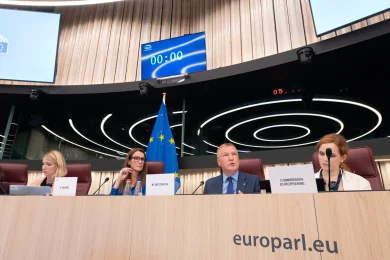
The dispute dominated part of the exchange of views with the Democracy, Rule of Law and Fundamental Rights Monitoring Group within the European Parliament’s Committee on Civil Liberties. Participants who called for financial measures challenged the results of an approach based on reports and correspondence with the Slovak authorities. The question addressed to the commissioner was when the repeatedly reported problems would have budgetary consequences. The debate took place on 15 September, as part of the examination of the Commission’s report on the rule of law in 2026.
The pressure is backed by positions adopted by the plenary. On 20 May, Parliament reiterated its request to activate the conditionality mechanism in a resolution approved by 347 votes in favor, 165 against and 25 abstentions. Members of the European Parliament cited the weakening of anti-corruption safeguards and risks to the EU’s financial interests. A similar request had been made in April, during the examination of the implementation of the European budget for 2024.
At the meeting, the criticism also concerned the dismantling of specialized structures and the alleged misuse of European money. Some participants also cited the intervention of the European Public Prosecutor’s Office to call for a shift to financial measures. McGrath replied that the annual report is only one of the Commission’s instruments and that infringement procedures can produce results. He mentioned the dialogue concerning amendments to Slovakia’s Constitution and their compatibility with EU law.
The European Public Prosecutor’s Office notified the Commission on 1 June under the budget conditionality mechanism. According to its statement, amendments to Slovak agricultural legislation severely limit the suspension of payments between the referral of beneficiaries for trial and their final conviction. In the assessment of the European Chief Prosecutor, certain provisions “substantially reduce the effective protection of the EU’s financial interests.”
The European mechanism requires a sufficiently direct relationship between rule-of-law violations and the impairment, or serious risk of impairment, of the EU budget. The Commission must also examine whether other instruments would protect the funds more effectively. It proposes proportionate measures, including payment suspensions, while the Council decides on them. Parliament’s resolution and the prosecutors’ notification may inform the assessment without automatically resulting in the blocking of funds.
McGrath insisted that Slovakia’s situation is being analyzed by several Commission services, including the Directorate-General for Budget regarding the possible use of the conditionality regulation. He reaffirmed his readiness to use all instruments to protect the rule of law and the Union’s financial interests, in compliance with the conditions laid down by EU law. In his intervention, he did not specify which criteria had not yet been met, nor did he give a deadline for a decision.
As an example of the effectiveness of the Commission’s intervention, the commissioner cited the case concerning the protection of integrity whistleblowers. The procedure had been opened in January, after amendments adopted in December 2025 provided for the abolition of the Slovak whistleblower protection office and could expose protected persons to reprisals, according to the Commission. The Slovak authorities repealed the contested amendment before it took effect, and the Commission closed the procedure on 8 July, considering the issues in that case resolved.
The result cited therefore concerns a precise legislative intervention. The MEPs’ request addresses more broadly Slovakia’s capacity to prevent and sanction abuses affecting the European budget. In his response, McGrath presented the withdrawal of the amendment as evidence that Commission action can bring about change, but he did not announce that the warnings concerning the protection of funds had been resolved as a whole.
https://2eu.brussels/ro/news/eurodeputatii-cer-suspendarea-unor-fonduri-ue-pentru-slovacia-din-cauza-problemelor-privind-statul-de-drept
Latest News
07:18
07:15
07:14
07:10
22:55
See more news
NEWS ON THE SAME TOPICS


.webp)