The Council of the European Union adopts new sanctions against Russia, targeting energy revenues, the military industry, and propaganda.



Always see our news on Google
The Council of the European Union has adopted a new set of restrictive measures against Russia, targeting 34 individuals and 47 entities. The sanctions aim to limit the Russian military-industrial complex, revenues obtained from oil exports through the shadow fleet, hybrid activities, state propaganda, and human rights violations, including in the case of the persecution, poisoning, and death of Alexei Navalny.
The Council of the European Union has adopted a new set of sanctions against Russia, targeting 34 individuals and 47 entities involved in supporting the war against Ukraine, in hybrid activities, propaganda, and human rights violations. The measures aim to reduce Moscow's energy revenues, limit the Russian military-industrial complex, and expose the networks used to justify aggression and suppress internal opposition.
In short
1. The Council of the European Union has adopted new sanctions against Russia, targeting 34 individuals and 47 entities.
2. The measures include 7 individuals and 21 entities that support the Russian military-industrial complex and facilitators from third countries.
3. The European Union sanctions 2 individuals and 24 entities related to the transport and export of oil or petroleum products from Russia, including through the shadow fleet.
4. The new listings include Russian propagandists, a foundation created by decree of Vladimir Putin, and individuals involved in the Alexei Navalny case.
5. The Council has extended until June 23, 2027, the sanctions related to the illegal annexation of Crimea and the city of Sevastopol.
Kaja Kallas, the High Representative of the Union for Foreign Affairs and Security Policy, stated that the adopted package puts additional pressure on Russia to end the war. According to her, the measures strike "at the heart of Russia's military-industrial complex," at the shadow fleet, and at the networks that fuel Moscow's hybrid attacks against Europe.
Kallas stated that work continues in parallel for a broader package, the 21st set of sanctions. She said that each measure reduces Russia's maneuvering space and asserted that Western sanctions have already cost Russia between 1,000 and 1,300 billion euros.
In the military-industrial field, the Council sanctions manufacturers and suppliers of drones and military equipment used by Russian forces in the war against Ukraine. Among the targeted entities are JSC Lavochkin Research and Production Association, associated with the state corporation Roscosmos, LLC Rustakt, LLC ASFPV, LLC IONOS, as well as Chinese companies such as Shenzhen Minghuaxin and Xinxiang Richful Lubricant Additive Company.
The list also includes ERA Military Innovation Technopolis and Foundation for Advanced Studies, institutions created by the government of the Russian Federation for the development of advanced unmanned systems for military use. The Council presents these measures as part of the effort to reduce Russia's ability to sustain its military production and access technologies or components through external networks.
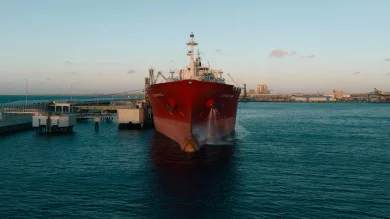
An important part of the package targets energy revenues. The Council included on the list 2 individuals, Tahir Garayev and Konstantin Rogach, and 24 entities related to the transport and export of oil or petroleum products from Russia, including through the shadow fleet. The European Union describes this fleet as a tool for evading sanctions, which creates risks for maritime safety and the environment.
The targeted entities in this category include Lukoil-Western Siberia and several companies based in Russia, Liberia, Turkey, the United Arab Emirates, Azerbaijan, and Hong Kong. The Council states that energy revenues continue to provide a lifeline for the Russian economy affected by war and sanctions.
The new package also includes measures against hybrid activities and Russian propaganda. The Council has listed 10 individuals and one entity, including propagandists involved in manipulation and foreign information interference, such as Anatoly Kuzichev, Kirill Fedorov, Roman Antonovskii, and Maria Volkonskaya, editor-in-chief of the state-controlled publication Krymskaya Gazeta.
According to the Council, these individuals have contributed to the spread of disinformation that justifies, promotes, or legitimizes Russia's war against Ukraine. They are also accused of promoting hostile and manipulative narratives targeting Ukraine, dehumanizing Ukrainians, or distorting historical facts.
Among the sanctioned individuals is also Alexandra Jost, a social media influencer living in Russia, and Georgiy Shevkunov, a bishop of the Russian Orthodox Church. The Council states that Shevkunov plays an active role in spreading Russian propaganda and disinformation aimed at justifying the armed aggression against Ukraine. The list also includes the Presidential Foundation for Cultural Initiatives, a foundation created by decree of President Vladimir Putin.
The Council has also imposed sanctions in connection with the Alexei Navalny case, following the joint statement on February 16, 2026, by the United Kingdom, Sweden, France, Germany, and the Netherlands regarding his poisoning in February 2024 with the lethal toxin epibatidine. The measures target one entity and 15 individuals, including Russian judges and prosecutors, personnel from law enforcement structures, from the FSB security service, and from the medical system.
The package also includes IPJSC NTK, a company that cooperated with the Department for Information Technologies of the city of Moscow in developing a facial recognition system. According to the Council, the system was intended for monitoring and detaining independent journalists, opposition activists, and participants in peaceful protests in support of Navalny and against Russia's war in Ukraine.
Following the annual review, the Council also decided to extend until June 23, 2027, the sanctions adopted in response to the illegal annexation of Crimea and the city of Sevastopol by the Russian Federation. The European Union reiterated that it does not recognize and continues to condemn the illegal annexation of Crimea and Sevastopol, which it considers a violation of international law.
The Council reiterated the position of the European Council from March 19, 2026, according to which the European Union reaffirms and maintains its strong support for the independence, sovereignty, and territorial integrity of Ukraine within its internationally recognized borders. The EU states that it will continue to provide Ukraine with political, financial, economic, humanitarian, military, and diplomatic support, in coordination with its partners and allies.
Latest News
22:52
22:34
22:28
21:56
21:29
See more news
NEWS ON THE SAME TOPICS

.webp)