Kallas says Usmanov and Fridman will not return to the EU list anytime soon, while sanctions on more than 3,000 individuals and entities are extended until 2029


.webp)

Always see our news on Google
Kaja Kallas says she does not expect Alisher Usmanov and Mikhail Fridman to be re-included on the EU sanctions list in the near future, after the Council removed their names during the September review. Separately, the member states extended for three years, until 22 September 2029, the measures applicable to a group of more than 3,000 persons and entities, while Kallas says work is also underway on new listings.
Alisher Usmanov and Mikhail Fridman are not expected to return to the European Union sanctions list in the near future, according to Kaja Kallas, after the Council decided in September not to maintain their inclusion in the restrictive-measures regime linked to the threat to Ukraine’s territorial integrity. At the same time, the EU changed the time horizon for the rest of the regime, extending by 36 months, until 22 September 2029, the sanctions applicable to a group of more than 3,000 persons and entities.
In brief
1. The EU Council extended for three years, until 22 September 2029, the individual sanctions against more than 3,000 persons and entities covered by the regime concerning Ukraine’s territorial integrity.
2. In the same review, the Council did not renew the inclusion of three persons and one entity and separately removed three deceased persons.
3. The act published in the Official Journal shows that those removed from the list include Alisher Usmanov, Mikhail Fridman and Andrey Falaleev, while the entity removed is Redbird Corporate Services Ltd.
4. Kaja Kallas said that the member states may propose new names, but that she does not see Usmanov and Fridman being re-included in the near future.
5. Kallas also said that work is underway on approximately 1,600 new listings. These are works in progress and not sanctions already adopted.
The Council of the European Union decided on 22 September to extend for a further 36 months the restrictive measures against persons and entities considered responsible for actions that undermine or threaten the territorial integrity, sovereignty and independence of Ukraine. The new deadline is 22 September 2029, which means that the regime will no longer undergo a simple renewal at the previous interval for the entire group remaining on the list. The Council specified that the measures currently apply to more than 3,000 persons and entities.
For individuals, the measures include travel restrictions in the European Union and asset freezes. The regime also prohibits making funds or other economic resources available to listed persons and entities. The three-year extension thus provides a longer legal horizon for most listings, without meaning that the list becomes permanent or that every inclusion is shielded from review or judicial oversight.
The September review also resulted in removals. The Council announced that it had not renewed the inclusion of three persons and one entity and had separately removed three deceased persons. The implementing regulation published in the Official Journal identifies the persons whose inclusion was removed as Alisher Burkhanovich Usmanov, Mikhail Maratovich Fridman and Andrey Pavlovich Falaleev, while the entity removed is Redbird Corporate Services Ltd. The legal act also separately removes the listings of three deceased persons.
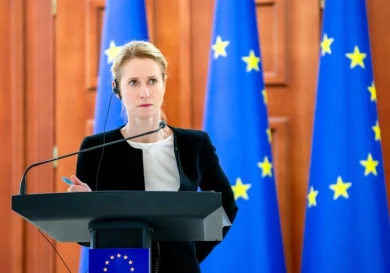
Usmanov and Fridman became the subject of a question addressed to Kaja Kallas after the EU–Republic of Moldova Association Council meeting in Brussels. The question concerned the possibility of the two names being re-included on the European list after their removal in September. Kallas stressed that the member states are the ones that can propose names for listing and that the final decision belongs to the member states meeting in the Council.
Regarding the two, her message was that a quick return to the list does not appear likely. According to the conference transcript, Kallas said that she did not see these two persons being re-included “too soon”. The statement should be read as a political assessment of the situation at that time, not as a guarantee that Usmanov and Fridman could not be sanctioned again in the future.
The European regime allows lists to be amended when the member states reach agreement and the legal conditions are met. A removed name may, in principle, be proposed again if reasons and evidence supporting a new inclusion emerge. At the same time, sanctioned persons and companies may challenge the measures before the Union courts, and the Council must be able to legally substantiate the reasons for each listing.
Kallas also linked her response to the broader scale of the sanctions regime. She recalled the September decision extending the maintained listings for three years, instead of a more frequent renewal, and said that the EU is simultaneously working on new listings. In the conference transcript, the figure mentioned is approximately 1,600 additional listings under preparation.
However, this figure should not be interpreted as 1,600 sanctions already adopted. Kallas describes a work process, and an inclusion becomes effective only after the Council adopts the necessary acts and they are published. The figure mentioned may include persons, entities or other categories of listings from different regimes, and the documentation consulted does not provide an officially published annex allowing the approximately 1,600 cases to be broken down.
Nor should the figure cited by Kallas for the extended listings be treated separately from the Council’s official data. In her remarks, Kallas mentioned 2,998 listings maintained for three years, while the Council’s official statement describes the regime as applying to more than 3,000 persons and entities. For legal reporting, the Council’s official figure is the safer reference, while Kallas’s wording may be retained as a statement made at the conference.
The change in duration until 2029 reduces the frequency with which the entire package must be politically renewed, but does not eliminate the possibility of specific amendments. The Council may add or remove names through implementing acts, and the list continues to evolve. In the days immediately following the decision of 22 September, the EU also adopted other restrictive measures under different regimes related to Russia, showing that the three-year extension does not freeze the sanctions policy as a whole.
The distinction between regimes is also important. The list concerning Ukraine’s territorial integrity is only one component of the European sanctions system against Russia. The EU also has sectoral measures, economic restrictions, sanctions for destabilizing activities, for human rights violations and other distinct regimes. A person or entity may be affected by several acts, and removal from a particular annex should not automatically be interpreted as the disappearance of any European restriction that might have another legal basis.
In the case of Usmanov and Fridman, however, the act of 22 September provides clear legal information for this regime: their names were removed from the annex relating to measures concerning Ukraine’s territorial integrity. On 5 October, Kallas did not announce a concrete procedure for their re-inclusion and instead indicated that she did not expect a return in the near term.
For the other more than 3,000 persons and entities remaining on the list, the situation is different. Their measures have been extended until September 2029, meaning the continuation, as applicable, of travel restrictions, asset freezes and the prohibition on making funds or economic resources available to them. These effects continue on the basis of the acts adopted by the Council and do not depend on the potential new listings referred to by Kallas.
The High Representative’s statement thus describes two processes advancing in parallel. On the one hand, the EU has stabilized most existing listings for three years. On the other hand, it continues preparing new sanctions and assessing additional names, each of which nevertheless requires a decision by the member states and the necessary legal basis before producing effects.
Latest News
11:13
11:01
10:58
10:41
10:36
See more news
NEWS ON THE SAME TOPICS