Europe's defense between rhetoric and reality. Why the Commission must be pushed towards a true single defense market.



Always see our news on Google
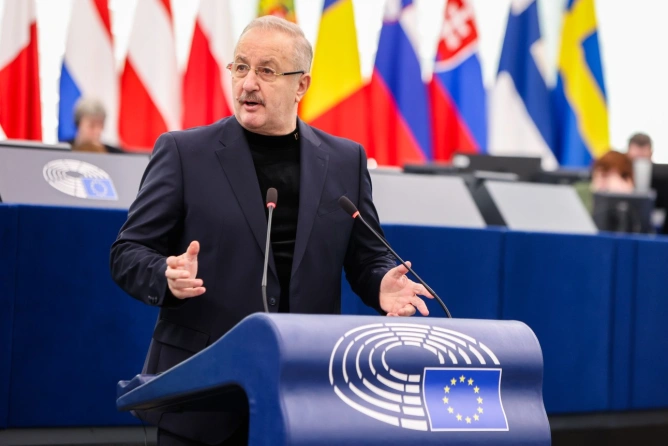
Vasile Dîncu analyzes the gap between the political environment of Europe in the field of defense and the industrial reality of the continent, arguing that the EU needs a single defense market and a much more integrated industrial policy.
The adoption of the two reports on the single defense market and major European military training projects, in the plenary session in March in Strasbourg, marks an important moment in the evolution of the Union's security policy. The European Parliament sends a clear message: Europe can no longer function with a fragmented defense industry, incoherent national acquisitions, and dangerous strategic dependencies.
But the Parliament's vote also says something else, implicitly, even if the official text is more cautious than it should be. European defense is advancing much more slowly than geopolitical reality would allow. While threats are increasing, the industrial and strategic architecture of European defense remains stuck in a bureaucratic compromise between national sovereignties, internal market rules, and incomplete Commission initiatives.
The problem is no longer the lack of analysis. The reports by Letta, Draghi, or Niinistö have already said the same thing: the fragmentation of the European defense industry produces higher costs, incompatible systems, and a reduced capacity to react. In his report on European competitiveness, Mario Draghi warns that the industrial fragmentation of defense represents one of the most costly strategic inefficiencies of the Union, at a time when global technological competition is accelerating. For the first time in decades, industrial capacity is becoming a central variable of security.
In some cases, Europe pays for military equipment about 30% more than it would pay if it were to cooperate effectively at the Union level.
The real problem is the lack of political radicalism in the institutional response. The Commission continues to treat defense as a special industrial sector of the internal market, not as a strategic infrastructure of European security. The proposed instruments are useful but insufficient. We have regulations, financial incentives, research programs, cooperation mechanisms, but all these represent necessary steps without changing the structural logic of the system.
Europe still does not have a single defense market. It only has the beginning of industrial coordination.
Strategic Fragmentation
Fragmentation remains the central problem. Europe produces too many types of similar equipment, developed separately, purchased separately, and maintained separately. The systems are not interoperable, supply chains are incomplete, and development cycles are too slow for a technological environment dominated by drones, artificial intelligence, and electronic warfare.
While the United States operates an integrated military industrial ecosystem, in reality, the difference between Europe and the great powers is not just military but systemic. The United States operates an integrated military-industrial complex capable of rapidly transforming technological innovation into military capability. China is rapidly building a similar model. Europe remains caught in a dispersed industrial model, where the logic of national markets continues to dominate the logic of continental security.
Europe continues to function as a collection of protected national markets. This fragmentation is not only the result of national interests but also the result of a deficit of European leadership.
The Commission has preferred until now to stimulate voluntary cooperation among states, but voluntary cooperation is not sufficient in a field that defines the strategic security of the continent. The European Union needs a much more direct, much more ambitious, and much more political defense industrial policy.
The Principle of Strategic Solidarity
Another conceptual obstacle is the way Europe continues to perceive threats. For a long time, European security has been thought of through the principle of geographical proximity. States closer to risk borders were considered more exposed and therefore more responsible for investments in defense.
This logic no longer corresponds to reality. Contemporary threats do not respect geography. Cyberattacks do not take borders into account, sabotage of energy infrastructures is not local, and information manipulation circulates instantly throughout the entire European space. Terrorism, regional instability, or pressure on supply chains simultaneously affect all member states.
Geography no longer protects anyone.
That is why Europe must replace the principle of proximity to threats with the principle of strategic solidarity. European security must be indivisible, the vulnerability of one member state becoming the vulnerability of the entire Union.
This conceptual change must also be reflected in the way investments, industrial programs, and military planning are organized.
What is Missing from the Commission's Strategy
The reports adopted by the Parliament call for clarifications regarding governance, the timeline, and the funding of major projects such as the European Drone Defence Initiative, Eastern Flank Watch, or Air Defence Shield. This request says a lot about the current situation. Europe announces ambitious projects, but it often remains unclear how they will be implemented.
The Commission must respond to some fundamental questions.
The first question concerns governance. Who decides the industrial priorities of European defense: member states, the Commission, the European Defence Agency, or industrial consortia? In the absence of a clear decision-making center, projects risk becoming technocratic compromises without critical mass.
The issue of funding must also be clarified. The European Defence Fund is an important instrument, but its size remains modest compared to the real needs of the European defense industry. Europe cannot build serious strategic autonomy with limited budgetary programs.
Finally, the third question concerns real industrial integration. In the absence of firm rules regarding common procurement and European production, the concept of "Buy European" risks remaining more of a political formula than an economic practice.
Europe must move from incentives to obligations and from slogans to pragmatic solutions.
A Defense Industrial Policy
The European Union must explicitly assume that the defense industry is not an ordinary economic sector, but a strategic infrastructure comparable to energy, space, or digital infrastructure.
This means some concrete changes.
Common procurement must become the rule, not the exception.
Major European programs must be designed from the outset as multinational programs.
Defense production must be organized in European industrial ecosystems, not in fragmented chains dominated by national logics.
Innovation must be accelerated through radical instruments, similar to DARPA-type agencies. The war in Ukraine has shown one essential thing: the speed of technological adaptation has become a decisive factor of military power. Drones, autonomous systems, and military artificial intelligence have radically reduced traditional development cycles of weaponry. In this context, Europe can no longer afford slow and fragmented industrial processes.
Europe needs mechanisms capable of financing disruptive technologies, not just incremental projects.
Finally, the integration of Ukraine into the European defense industrial ecosystem must be treated as a strategic priority.
Europe Needs a Strategic Decision
Europe is entering a decisive stage in its security history. The war in Ukraine, global instability, and the rapid transformation of military technologies force the Union to rethink how it produces security.
The single defense market is not a technical project. It is a fundamental political choice.
If Europe wants to remain a strategic actor in a world dominated by great powers, it must quickly build an integrated, innovative defense industry capable of producing at scale.
The war in Iran adds a new dimension to European strategic urgency. It brutally shows how vulnerable Europe remains in a world of interconnected conflicts. A military crisis in the Persian Gulf immediately produces effects on energy security, financial markets, and European political stability.
Maritime straits, energy infrastructures, supply chains, and digital networks transform any regional conflict into a global event. The conflict demonstrates that Europe lives in a new era of global strategic interdependence, where energy security, digital infrastructure, and geopolitical stability are inseparable. A military crisis in the Middle East can produce effects on European energy markets, industrial chains, and internal political stability within days.
At the same time, the war confirms an uncomfortable reality: Europe bears the geopolitical consequences of crises without always having the capacity to decisively influence their evolution.
This is the definition of strategic dependency. The lesson is clear. In the contemporary world, security is no longer determined by distance but by the ability to act collectively.
Geography no longer protects anyone; only strategic solidarity and common industrial power can protect Europe.
The history of European integration has often advanced under the pressure of crises. Today, Europe finds itself again in such a moment. The difference is that this time, the stakes are not just economic prosperity but the continent's ability to defend its own political order.
The European Parliament has taken a step in this direction. Now it is the Commission's turn to demonstrate that it can transform this political ambition into a real power strategy.
Latest News
15:14
14:58
14:41
14:19
14:05
See more news
NEWS ON THE SAME TOPICS